

When a Valuation Calculator Is Useful for Founders
Updated for founders using a quick business-worth estimate to frame valuation expectations, screen buyer outreach, evaluate timing, or decide when to move from calculator output to a more formal valuation or sell-side advisory process.
Key answer: a valuation calculator is useful for founders when the goal is a fast, directional range rather than a sale-ready answer. It is most helpful for early expectation-setting, screening inbound buyer interest, deciding whether an offer is worth pursuing, and preparing for a more substantive valuation conversation. The best use of a how much is my business worth calculator is not to determine an exact price, but to decide whether the situation is worth taking seriously and what questions should come next.
Why it matters: calculator output is an estimate, not buyer underwriting. Founders should pair any quick range with a clear understanding of Auxo’s business valuation calculator, what goes into a business valuation calculator, business valuation calculator accuracy, and how a valuation calculator differs from a professional valuation.
Founders usually do not start with a full valuation model. They start with a practical question: a buyer called, an investor asked for numbers, a board member wants a rough value range, or the owner is deciding whether a sale in the next 12 to 24 months is realistic. A small business valuation calculator, estimate business value calculator, or business worth calculator can help orient that early-stage decision before the founder commits to a fuller process.
Transaction context: a calculator is useful after curiosity but before diligence. It helps a founder frame a rough range, screen inbound interest, and decide whether timing or buyer outreach deserves more attention, but it cannot fully assess earnings quality, customer concentration, founder dependence, working capital, debt, deal structure, or buyer-specific underwriting. Once a buyer conversation becomes real, the work shifts from estimation to preparation, diligence readiness, and negotiation strategy.
This page connects directly to how much a business is worth, how buyers build valuation models, how buyers actually use valuation calculators, valuation services, and sell-side M&A advisory.
Many founders want a number before they want a process. That impulse is understandable. A quick estimate is easier to digest than a full valuation discussion, and a calculator feels like a low-friction way to answer the question of how to estimate business value.
But the founder’s real need usually goes beyond a single number. It is clarity about what the number can support. A directional estimate can be useful for expectation-setting, internal planning, inbound-offer triage, and deciding whether the company may be ready for a deeper review. It becomes much less reliable when the founder is negotiating with a sophisticated buyer, defending adjustments, comparing deal structures, or trying to separate headline enterprise value from likely cash at close.
This article explains when a valuation calculator is useful, what founders can reasonably learn from one, where simplified estimates break down, and when to move from calculator output into formal valuation services or a structured sell-side M&A advisory process.
Executive summary
A valuation calculator is most useful when the decision is still provisional. It can help founders frame a valuation range, assess whether outreach from a buyer deserves attention, and prepare for a deeper discussion with advisors. It can also help owners avoid anchoring to an obviously unrealistic expectation before engaging the market.
Its limits show up quickly in live situations. Small changes in normalized earnings, multiple assumptions, debt, or risk adjustments can move value materially. More importantly, buyers do not buy calculator outputs. They buy companies after diligence, and they reprice issues they believe threaten future cash flow, transferability, or execution certainty. Founders who understand that boundary use the estimate constructively. Founders who treat it as a deal quote often lose time, leverage, or both.
Key takeaways
- A valuation calculator is best used for directional range-setting, not final pricing.
- It is especially useful for founders evaluating inbound interest, internal timing decisions, or whether a formal process is worth pursuing.
- The quality of the estimate depends heavily on the quality of the inputs, especially normalized earnings and realistic multiple assumptions.
- Complex businesses outgrow calculators quickly, particularly where concentration, add-backs, debt, working capital, or structure are meaningful issues.
- Calculator outputs should be interpreted alongside the limits described in calculator versus valuation and calculator accuracy discussions.
- Once buyer conversations become real, the process shifts from estimation to underwriting, preparation, and negotiation.
When Is a Valuation Calculator Useful?
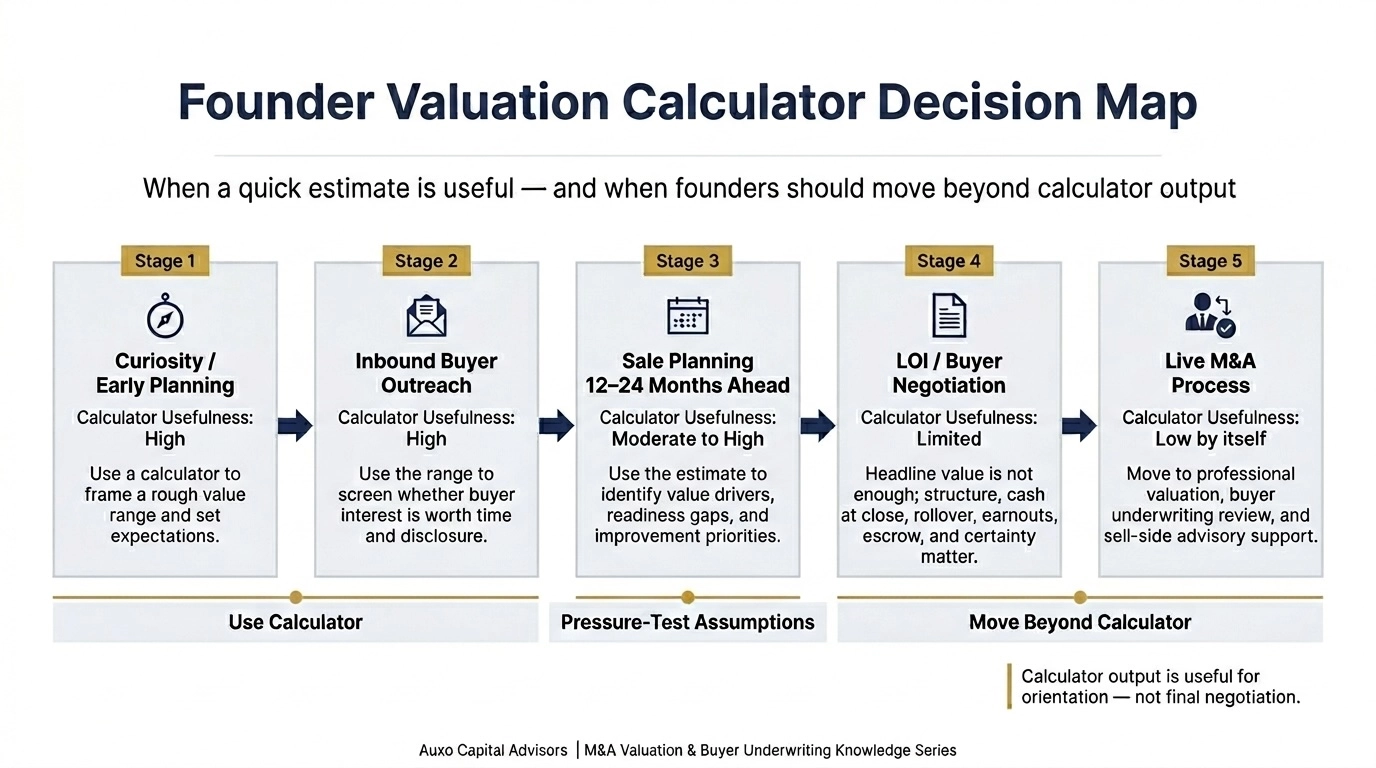
A valuation calculator is most useful when the founder is still framing the decision. It becomes less useful as soon as the question shifts from rough value range to buyer negotiation, deal structure, diligence risk, or actual seller proceeds.
| Founder question | Calculator usefulness | Best next step |
|---|---|---|
| “What range might my business fall into?” | High — useful for directional expectation-setting | Use a business valuation calculator and review the assumptions behind the estimate. |
| “Is this inbound buyer outreach worth my time?” | High — useful as an initial sanity check | Compare the indication against a rough range, then assess buyer seriousness and information risk. |
| “Should I plan for a sale in 12 to 24 months?” | Moderate to high — useful for baseline planning | Use the estimate to identify value drivers, readiness gaps, and potential improvement priorities. |
| “Is this LOI better than another offer?” | Limited — headline value alone is not enough | Compare structure, rollover, earnout, escrow, working capital, certainty, and cash at close. |
| “What will I actually receive at closing?” | Low — most calculators do not fully model proceeds | Move to a valuation/proceeds bridge or advisor-led transaction review. |
| “Can I defend this value to a buyer?” | Low — buyer underwriting requires more support | Escalate to valuation services or a structured sell-side M&A advisory process. |
The simplest rule is this: use a calculator for orientation, not final negotiation. Once the value range will influence buyer discussions, shareholder decisions, or transaction timing, the founder should pressure-test the calculator output against buyer underwriting logic, financial normalization, and deal structure.
A practical framework for deciding whether a calculator is the right tool
| Founder situation | Is a calculator useful? | What it can answer | What it cannot answer well |
|---|---|---|---|
| Curious about a rough business value range | Yes | Directional range and expectation framing | Defensible market value in a negotiated process |
| Received an early inbound expression of interest | Yes | Whether the outreach seems plausibly serious or obviously low | Whether the buyer will hold price after diligence |
| Planning a sale in 12 to 24 months | Yes | How earnings improvement might affect range expectations | How a future process will perform with real buyers |
| Comparing competing buyers or LOIs | Only partially | Very rough baseline for headline value | Structure, rollover, earnout, working capital, and certainty |
| Negotiating a live transaction | No, not by itself | Limited sanity-checking | Buyer underwriting, diligence repricing, and proceeds analysis |
The point of this framework is not that calculators are weak tools. It is that they solve a narrower problem than many founders expect. If you are still deciding whether to lean in, a calculator can be efficient and useful. If you are already debating price, structure, or timing with a real buyer, the estimate is no longer the center of the analysis.
Definitions founders should keep straight
Valuation calculator: an input-driven estimate that produces a rough value range based on simplified assumptions. It is useful as an early screening tool, especially for founders asking how to estimate business worth without yet launching a process.
Professional valuation: a more disciplined assessment that applies market evidence, normalized financial analysis, business-specific judgment, and often scenario-based interpretation. Auxo’s valuation services sit in this deeper category.
Buyer underwriting: the live transaction process through which a buyer tests earnings quality, durability, risk, and integration or return potential. If you want to understand the model behind that work, see how buyers build a valuation model.
Enterprise value versus equity value: a calculator may suggest the value of the business as an operating asset, but seller proceeds depend on debt, cash, working capital mechanics, transaction fees, and structure. That is one reason a quick estimate and a final check at close often diverge.
What Information Should Founders Gather Before Using a Valuation Calculator?
A valuation calculator becomes more useful when the founder enters thoughtful inputs instead of rough guesses. Before using a calculator, founders should gather a few basic pieces of information that help make the estimate more credible.
| Information to gather | Why it matters | Founder caution |
|---|---|---|
| Trailing twelve-month revenue and EBITDA | Creates the baseline for a quick business value estimate | Reported EBITDA may not reflect normalized earnings |
| Owner compensation and add-back items | Helps identify whether earnings need to be adjusted | Buyers may reject unsupported or promotional add-backs |
| Debt, cash, and working capital levels | Helps bridge enterprise value toward equity value and likely proceeds | A headline value range is not the same as cash at close |
| Customer concentration and revenue durability | Helps assess whether the selected valuation range is realistic | Concentration can reduce buyer appetite or shift value into structure |
| Recent growth and margin trends | Helps determine whether performance is improving, stable, or weakening | Forward-looking assumptions need support before buyers credit them |
The goal is not to turn a simple calculator into a full valuation model. The goal is to avoid entering numbers that create false precision. For a deeper explanation of the assumptions behind calculator outputs, see what goes into a business valuation calculator.
The situations where a valuation calculator is genuinely useful
Early expectation-setting before a founder commits to a process
For many owners, the first use case is internal. They want a rough answer to “Is this a $5 million conversation, a $25 million conversation, or a $75 million conversation?” That kind of range-setting is precisely where a calculator can help. It imposes some discipline, even if the estimate is imperfect, and it can prevent founders from anchoring on anecdotal stories that have little relevance to their own company.
This use case is especially valuable when paired with a healthy skepticism about precision. A founder who uses a calculator to frame a range is typically better prepared than one who has no benchmark at all. The issue is not whether the estimate is exact. The issue is whether it helps orient strategy, timing, and seriousness.
Inbound buyer outreach triage
Founders often receive vague buyer outreach long before they intended to explore a sale. In that setting, a quick estimate can help determine whether the outreach deserves a management meeting, a signed NDA, or a polite decline. If the implied value range is well below what the business might reasonably support, the founder may choose not to engage deeply.
That said, even here the estimate is only a first filter. A buyer offering a lower headline number may still produce better net economics through cleaner structure or higher certainty. Conversely, a buyer hinting at an aggressive range may later reduce value once diligence begins. The calculator helps decide whether to continue the conversation; it does not tell the founder whether the buyer will ultimately perform.
Planning for a sale 12 to 24 months ahead
Another strong use case is pre-sale planning. If a founder believes the company may be sold in the next one to two years, a calculator can provide a starting baseline against which operational improvement can be evaluated. If margins improve, concentration declines, or earnings become cleaner, the founder can begin to see how value may move directionally.
This is where the estimate becomes a management tool rather than a transaction answer. It can focus attention on the handful of issues that will matter most later: recurring earnings quality, leadership depth, customer diversification, and the credibility of the growth story.
Preparing for an advisor conversation
Founders often hesitate to engage advisors because they feel unprepared. A calculator can be useful here because it gives them a preliminary frame for a more informed conversation. Instead of asking only “what is my business worth,” they can ask better questions: Which assumptions are most exposed? What would buyers likely discount? Are there diligence issues that could move value materially?
That shift in questioning usually marks the point where the founder is ready to move from a broad calculator-based estimate to a more serious valuation or process discussion.
The Inputs That Make a Quick Estimate More or Less Credible
A valuation calculator is only as useful as the assumptions behind it. For founders, the most important inputs are usually normalized earnings, the selected valuation multiple, and the bridge from enterprise value to actual seller economics. If those inputs are weak, the calculator may still produce a number, but the number may not survive buyer scrutiny.
Clean earnings matter more than founder optimism
The biggest difference between a useful estimate and a misleading one is usually not the multiple. It is the earnings input. Founder compensation, one-time legal spend, unusual bonuses, personal expenses, startup losses from a new division, temporary project costs, or run-rate adjustments can all affect the baseline. If those items are not thought through, the estimate may be directionally wrong before the multiple is even applied.
This is why any business valuation calculator for founders should be treated as only as good as the earnings number behind it. In a live process, buyers will test those adjustments aggressively, and unsupported add-backs can disappear quickly.
Multiple selection is really a shorthand for risk and quality
Founders sometimes speak about multiples as though they are universal market prices. They are not. A multiple is shorthand for a buyer’s view of earnings durability, transferability, growth, concentration, margin profile, cyclicality, and execution risk. A company with strong recurring revenue and low customer concentration will not be read the same way as a business with project-based revenue and a founder-dependent sales engine.
For that reason, even a seemingly simple estimate should be read as a range. If you want a deeper view into how assumptions move calculator outputs, see which valuation assumptions actually change calculator outputs.
Debt, cash, working capital, and structure still matter
Founders who search for an estimate business value calculator are usually trying to solve for total value, but actual seller economics depend on more than enterprise value. Net debt, excess cash, normalized working capital targets, transaction expenses, escrows, seller notes, earnouts, rollover equity, and other deal terms can all affect equity value and cash at close.
That gap does not make the estimate useless. It simply means the founder should not confuse a rough indication of business value with expected take-home proceeds. Once debt, cash, working capital, and structure become part of the conversation, the founder has moved beyond calculator output and into buyer underwriting, offer comparison, and transaction strategy.
The complexity triggers that usually break a simple calculator
Customer concentration and revenue concentration
A business may look strong on aggregate earnings while still carrying significant underwriting risk. The classic example is concentration. If one customer represents 30% of revenue, or one product line drives the majority of margin, a calculator may not fully reflect how buyers will discount that exposure. In live underwriting, concentration almost always affects the multiple or structure, and sometimes both.
Founder dependence and weak transferability
If the company relies heavily on the founder for sales, customer relationships, hiring, pricing, or delivery, value becomes less portable. Buyers will ask whether earnings survive the transition. A calculator can rarely score that nuance correctly. This is one reason many founder-led businesses look better in a quick estimate than they do under diligence.
Messy adjustments or inconsistent financial reporting
Where add-backs are numerous, financials are inconsistent, or margins move unpredictably, a simple estimate loses reliability quickly. The issue is not only accounting hygiene. It is whether the buyer can trust the earnings base. If the answer is uncertain, the buyer may underwrite to a lower number, delay conviction, or use structure to protect against perceived risk.
Meaningful deal-structure variables
Once earnouts, seller notes, rollover equity, escrow, working capital disputes, or contingent compensation become part of the conversation, a calculator becomes a thin instrument. At that point, comparing offers requires more than a rough value estimate. It requires a proceeds mindset and a process strategy.
Strategic buyer dynamics or unusual market positioning
Simple calculators also struggle when strategic value is plausible. A company with scarce capabilities, valuable channel access, differentiated IP, or a highly attractive geography may draw a broader set of outcomes than a simplified range implies. The reverse is also true: a company in a challenged niche may trade below what simple market heuristics suggest. Auxo addresses these breakdown points more directly in where valuation calculators break down in M&A.
What a Valuation Calculator Should Not Be Used For
A calculator can be very useful when the founder is trying to orient around value. It becomes dangerous when the founder uses the output as if it were a buyer offer, a defensible valuation opinion, or a substitute for diligence preparation.
| Do not use a calculator for… | Why it falls short | Better approach |
|---|---|---|
| Defending a purchase price in negotiation | Buyers will re-underwrite earnings, risk, growth, and deal structure rather than accept a calculator output. | Prepare a buyer-supported valuation narrative and normalized earnings analysis. |
| Comparing competing LOIs | Headline value may hide differences in rollover, earnouts, escrows, working capital, and certainty of close. | Compare total proceeds, cash at close, conditional value, and execution risk. |
| Estimating actual seller proceeds | Most tools do not fully account for debt, cash, fees, taxes, escrows, working capital, or contingent consideration. | Build a proceeds bridge from enterprise value to equity value to expected cash at close. |
| Replacing quality-of-earnings or normalized EBITDA work | Calculator accuracy depends on the earnings input. If EBITDA is wrong, the output will be wrong. | Pressure-test add-backs, run-rate assumptions, and earnings quality before relying on the range. |
| Setting a sale price without market feedback | A calculator cannot know buyer appetite, strategic fit, market timing, or process competition. | Use valuation analysis together with buyer universe strategy and process planning. |
For a deeper discussion of where simplified outputs fail, see where valuation calculators break down in M&A. For the difference between a quick estimate and deeper analysis, see valuation calculator vs. valuation.
Worked scenario: using a calculator to triage an inbound indication of interest
Consider a founder-led services business with $3.0 million of reported EBITDA. The owner receives a call from a buyer implying a valuation in the “low twenties.” The founder uses a calculator to get a quick directional check before deciding whether to engage.
| Scenario item | Case A: reported view | Case B: normalized founder view | Case C: buyer-adjusted view |
|---|---|---|---|
| EBITDA base | $3.0 million | $3.5 million | $3.2 million |
| Selected multiple | 6.0x | 6.5x | 5.75x |
| Indicative enterprise value | $18.0 million | $22.75 million | $18.4 million |
| Less net debt | $2.0 million | $2.0 million | $2.0 million |
| Indicative equity value | $16.0 million | $20.75 million | $16.4 million |
| Potential cash-at-close impact | Further affected by working capital and fees | Further affected by working capital and fees | Further affected by working capital and fees |
This is exactly why a calculator is useful as a triage tool but weak as a final answer. It immediately tells the founder that “low twenties” may not be unreasonable if the adjustments hold and the business supports the higher end of the range. It also shows how quickly that conclusion changes if the buyer rejects part of the founder’s add-backs or applies a lower multiple due to concentration, growth concerns, or transition risk.
The most important shift in this example is not the arithmetic. It is the perspective. The founder starts with a calculator range and decides whether the buyer call merits further attention. The buyer, by contrast, moves into underwriting. That means validating the quality of earnings, testing the durability of customers and margins, and deciding whether the business deserves a market multiple or a discounted one. For more on this gap, see how buyers actually use valuation calculators and the mechanics behind buyer valuation models.
What Founders Should Do After Getting a Calculator Range
The useful question is not only “what number did the calculator produce?” The better question is what the founder should do with that range. The next step depends on whether the estimate is below expectations, consistent with the founder’s goals, or connected to a live buyer conversation.
| Calculator result or situation | What it may mean | Recommended founder response |
|---|---|---|
| Range is below expectations | The business may need more earnings growth, cleaner reporting, lower concentration, or stronger transferability before a sale process. | Identify value drivers and build a 12–24 month readiness plan before engaging buyers broadly. |
| Range is near the founder’s target | The business may be worth a deeper review, especially if timing, market conditions, and buyer appetite are favorable. | Pressure-test assumptions through valuation services and begin assessing sale readiness. |
| Inbound buyer indication is below the range | The buyer may be opportunistic, may be using conservative assumptions, or may not have enough information. | Do not over-disclose. Screen seriousness, ask for more context, and avoid anchoring too quickly. |
| Inbound buyer indication is above the range | The buyer may see strategic value, but the number may depend on diligence, structure, or aggressive assumptions. | Evaluate certainty, structure, timing, and whether value is cash at close or contingent consideration. |
| Sale is likely within 12 months | The founder has moved beyond curiosity and into preparation. | Begin a more formal valuation, readiness, and buyer-positioning process before engaging the market. |
| Multiple buyers are involved | The issue is no longer calculator output; it is process leverage and offer comparison. | Move toward sell-side M&A advisory and compare offers on proceeds, structure, certainty, and strategic fit. |
This is also where advisor credibility begins to matter. Buyers often evaluate not only the business, but the quality of the seller’s materials, process discipline, and support behind the valuation story. Founders preparing to engage the market should understand how buyers evaluate M&A advisors before treating a quick estimate as enough.
Seller takeaway
A founder should use a valuation calculator to establish a credible range, not to defend a single number. The output is most useful when it helps answer a practical question: Is this buyer conversation worth pursuing, does my timing make sense, and what would need to improve before a formal process?
If the estimate creates conviction that the company may be in play, the next step is not to cling to the midpoint. It is to identify what could change that range in diligence: unsupported add-backs, customer concentration, working capital needs, founder dependence, or weak transferability. Founders who use the tool that way tend to be better prepared and less exposed to surprise repricing.
What buyers actually focus on after the calculator stage
Once a buyer moves beyond an initial screen, the center of gravity shifts from estimation to confidence. Buyers want to know whether the earnings base is real, whether growth is repeatable, whether margins are defendable, and whether the business can transition without the founder carrying too much of the commercial burden. A calculator compresses these questions into a rough assumption set. A buyer expands them again.
That is why valuation often changes during diligence even when no one has acted in bad faith. The buyer is not simply re-running the same math. The buyer is converting uncertainty into price, structure, or both. A customer contract that lacks durability may pressure the multiple. A stretched working capital profile may affect cash at close. Weak systems or reporting may increase escrow demands or reduce confidence in management forecasts.
For founders, the practical implication is straightforward: the estimate should be read as a starting hypothesis about value rather than proof. If the business has strong recurring revenue, diversified customers, visible margins, and low transition risk, the calculator may prove directionally close. If those qualities are uneven, the estimate becomes much more fragile.
Why advisory process changes the outcome beyond the estimate
A good advisor does not merely produce a tighter valuation range. The more important role is translating the business into a form buyers can underwrite with confidence, while controlling how and when risk points are introduced into the process. That affects more than price. It affects buyer mix, negotiating leverage, structure, timing, and certainty of close.
For example, if a founder is using a calculator because an inbound buyer has made contact, the immediate temptation is to negotiate directly off the rough estimate. That can be costly. Without process discipline, the buyer often controls the narrative, frames risk on its own terms, and pushes the seller into reacting to diligence findings one at a time. An advisor-led process can reposition those same facts, broaden competitive tension, and distinguish between issues that deserve adjustment and issues that do not.
This is where a quick estimate gives way to transaction strategy. Founders who believe they may be entering that phase should move from a rough business value estimate into a more structured conversation around valuation services or, if a process is likely, sell-side M&A advisory. The difference is not only better math. It is better positioning.
In live deals, that positioning can preserve value in ways a calculator never captures. It can defend supportable adjustments, frame concentration intelligently, prepare management for diligence, and convert a broad range into a negotiation strategy. That is often where the real economic gain resides.
Frequently asked questions
When is a business valuation calculator useful for founders?
It is most useful when the founder needs a directional estimate for expectation-setting, sale planning, or screening inbound interest. It is least useful when the founder needs a fully defensible value in a live transaction.
What can a valuation calculator actually tell me?
It can usually tell you whether your business appears to fall within a broad valuation range based on the inputs provided. That can help answer whether a conversation is worth pursuing or whether your expectations are generally realistic.
How accurate is a business valuation calculator?
Accuracy depends on both the quality of the inputs and the complexity of the business. For a closer discussion of that boundary, see business valuation calculator accuracy.
What inputs matter most in a quick business value estimate?
Normalized earnings, realistic multiple assumptions, debt, and any material working capital considerations matter most. If those inputs are weak, the output will usually be weak as well.
When should I stop using a calculator and get a professional valuation?
You should move beyond a calculator once a real buyer is engaged, when value appears meaningful enough to justify preparation, or when the business has complexity that a simplified estimate cannot handle well.
Can a calculator help me prepare for selling my business?
Yes. It can provide a baseline for planning and help you identify whether improving margins, reducing concentration, or cleaning up financial reporting may materially change your likely range.
Why do buyers value businesses differently than calculators do?
Because buyers do not stop at simplified assumptions. They re-underwrite earnings quality, risk, growth durability, transition issues, and structure. Auxo’s overview of how buyers build a valuation model explains that shift.
What does a valuation calculator miss most often?
It most often underweights concentration, founder dependence, unsupported add-backs, working capital dynamics, debt, and the difference between enterprise value and actual seller proceeds.
How do earnings adjustments affect the estimate?
They can move value materially. A one-time adjustment to EBITDA does not just change the earnings base; it is then multiplied through the valuation multiple, which is why even modest adjustments can have an outsized effect.
How do growth and margin assumptions change the result?
They influence the multiple buyers may be willing to apply. Higher quality growth and stronger margins can support better valuation outcomes, but only if buyers believe the performance is durable and transferable.
Is a calculator useful for screening inbound offers?
Yes, especially as an initial sanity check. It can help founders decide whether an indication of interest appears serious enough to warrant time and disclosure, while recognizing that the final economics may still shift.
What should I do after I get a valuation range?
Use the range to ask sharper questions. Which assumptions are fragile? What would buyers likely challenge? Is the company ready for diligence? If the opportunity is becoming real, move from quick estimation to a deeper discussion around valuation services or execution planning.
Media & Press Inquiries
Auxo Capital Advisors publishes educational commentary on middle-market M&A, business valuation, calculator-driven valuation estimates, buyer underwriting, transaction preparation, and founder-led sell-side decision-making. Journalists, editors, podcast hosts, conference organizers, and researchers seeking perspective on business valuation or founder-led M&A topics are welcome to cite this article with attribution.
Suggested citation: Auxo Capital Advisors. “When a Valuation Calculator Is Useful for Founders.” April 2026.
For media requests, speaking inquiries, or permission questions related to this article, contact: info@auxocapitaladvisors.com
Disclosure
This article is provided for informational purposes only and is not legal, tax, audit, or investment advice. Any references to valuation ranges, multiples, earnings adjustments, or transaction outcomes are illustrative and intended to explain decision frameworks rather than predict a specific result for any company.
Actual valuation outcomes depend on business-specific facts, quality of financial information, buyer universe, timing, industry conditions, diligence findings, financing markets, legal and tax structure, working capital treatment, negotiation leverage, and many other factors. A calculator output or illustrative scenario should not be treated as a binding indication of value, a fairness opinion, or a guarantee of proceeds in a future transaction.


