

How Working Capital Risk Affects Engineering Firm Valuation in M&A
Updated for founder-led and middle-market engineering firms evaluating how AR aging, WIP quality, billing cadence, collections discipline, working-capital pegs, working-capital collars, QoE diligence, purchase-price adjustments, and cash-at-close mechanics affect valuation and deal certainty in M&A.
Key answer: Working capital risk in an engineering firm becomes a valuation issue when buyers believe reported revenue, AR, WIP, billing cadence, or collections discipline do not convert into cash predictably. The issue is not just whether the balance sheet is accurate. The issue is whether the buyer will inherit a cash funding need, a disputed working-capital peg, a collection problem, or a post-closing purchase-price adjustment that reduces seller proceeds.
Why it matters in M&A: Buyers use working capital to test revenue quality, project controls, billing discipline, cash conversion, and closing-balance-sheet reliability. A firm with clean AR aging, well-supported WIP, consistent billing cadence, and a defensible peg generally earns more confidence than a peer with similar EBITDA but stale receivables, unexplained unbilled balances, delayed invoicing, or weak project-level support. Weak working capital may not always reduce headline enterprise value immediately, but it can reduce cash at close through higher pegs, reserves, collection holdbacks, escrows, collars, or true-up exposure.
For broader valuation context, owners should read this article alongside Auxo’s AEC valuation guide, engineering firm valuation multiples, and who buys AEC firms. For transaction-mechanics context, the closest companion resources are Auxo’s AEC working capital peg, AEC quality of earnings, and AEC due diligence checklist because working capital issues often surface through QoE review, peg negotiations, and seller-preparation gaps before closing.
This guide focuses on how buyers underwrite working capital risk in engineering-firm M&A and how AR aging, WIP quality, billing discipline, collections, working-capital pegs, working-capital collars, QoE diligence, and purchase-price adjustment mechanics affect valuation confidence and seller proceeds.
Owners, buyers, and advisors often use overlapping language when discussing this issue, including working capital risk, cash conversion, AR aging, accounts receivable quality, WIP realization, unbilled work, billing cadence, collections discipline, working-capital peg, working-capital collar, purchase-price adjustment, QoE diligence, cash at close, and seller proceeds. This guide uses those terms as transaction-underwriting concepts tied to buyer diligence, closing mechanics, and realized seller proceeds.
The core issue is whether project-based revenue converts into cash on a predictable timeline and whether the buyer can trust the closing balance sheet. That distinction affects buyer appetite, lender confidence, QoE findings, working-capital definitions, escrow design, holdback requests, true-up risk, and the probability that nominal enterprise value translates into actual seller proceeds. Weak working capital does not always destroy a deal, but it gives buyers another way to move economics from price into structure.
Transaction context: this article is the working-capital risk guide in the AEC Risk series, so its role is to connect project-based cash conversion to the deal economics buyers negotiate in engineering-firm M&A. AR aging, WIP support, retainage, billing lag, deferred revenue, accrued liabilities, project closeout balances, and monthly net working capital history matter because they influence whether buyers believe reported revenue and EBITDA are backed by collectible cash.
Working capital should be read as a bridge between operations and seller proceeds. If a buyer thinks cash conversion is weak, the seller may preserve headline enterprise value but lose economics through peg shortfalls, collection reserves, escrows, holdbacks, collars, or post-closing adjustment disputes. The key transaction question is whether the closing balance sheet delivers the normal operating liquidity the buyer believes it is purchasing.
Working capital also overlaps with other engineering-firm transaction risks. A firm with poor billing discipline may also face project concentration risk if AR or WIP is tied to one large assignment, or founder dependency risk if collections depend on one owner’s personal client leverage. Buyers ask whether those issues are isolated and explainable or whether they compound into broader doubts about revenue quality, project controls, QoE findings, and closing certainty.
For owners preparing for market, this guide should also be read with Auxo’s AEC working capital peg, AEC quality of earnings, and AEC due diligence checklist. Those pages provide the mechanics and preparation context that support the working-capital underwriting framework covered here.
In engineering deals, cash conversion is part of the underwriting case
Founders often assume working capital is a largely mechanical closing adjustment. Buyers usually do not. They treat it as evidence. A clean AR aging schedule supports confidence in revenue quality. A credible WIP rollforward supports confidence in project controls. A stable billing cadence suggests management can turn earned revenue into cash without unusual intervention. By contrast, a business that consistently bills late, carries unexplained unbilled balances, or tolerates stale receivables may still be attractive, but the buyer is more likely to price the risk through structure rather than simply accepting management’s narrative.
This is particularly important in founder-led engineering firms where client relationships, billing escalation, or project issue resolution still depend heavily on a small group of principals. Even if the firm remains commercially strong, the buyer may conclude that collections discipline and WIP realization depend on founder attention that will not exist in the same form after closing. Those underwriting concerns often show up before a buyer changes its nominal multiple. More commonly, they appear in diligence requests, peg negotiations, collection holdbacks, escrow asks, or late-stage purchase price adjustment debates.
Executive summary
Working capital risk in engineering-firm M&A is not just a closing balance sheet issue. Buyers use AR aging, WIP quality, billing cadence, collections history, and monthly net working capital trends to determine whether reported revenue converts into cash predictably after closing. A firm with clean receivables, disciplined billing, and well-supported unbilled work usually gives buyers more confidence than a peer with similar EBITDA but stale AR, thin WIP support, delayed invoicing, or inconsistent project-level documentation.
The practical issue is that weak working capital can reduce seller economics even when headline enterprise value appears unchanged. A buyer may preserve the nominal valuation but protect itself through a higher working-capital peg, tighter definitions, excluded balances, reserves, escrows, collection holdbacks, collars, or post-closing purchase-price adjustments. In those situations, the seller may win the multiple discussion but still receive less cash at close because the buyer is not comfortable with cash conversion, revenue cutoff, or delivered working capital.
For engineering firms, the most sensitive areas are accounts receivable collectability, unbilled WIP realization, retainage, milestone billing, deferred revenue, accrued liabilities, and the timing gap between work performed, invoices issued, and cash collected. These issues often become more important during quality-of-earnings review because they affect buyer confidence in revenue quality, normalized EBITDA, and the closing balance sheet. The cleaner the support, the easier it is to defend the peg and limit structure creep.
Sellers should address working capital well before buyer outreach. That means cleaning up aged receivables, documenting WIP at the project level, normalizing billing cadence, preparing monthly net working capital rollforwards, and understanding how the peg will likely be negotiated before an LOI is signed. The objective is not to eliminate every project-based timing issue. The objective is to make working capital measurable, explainable, and defensible before buyers use it to create leverage.
Key takeaways
First, a strong engineering firm can still create transaction friction if revenue recognition outruns billing discipline.
Second, buyers typically separate earnings quality from working-capital delivery, but the two judgments influence each other in practice.
Third, sellers often focus on multiple while buyers focus on the cash burden they inherit on day one.
Fourth, the cleaner the support for AR and WIP, the easier it is to defend the peg and reduce late-stage structure creep.
The underwriting framework buyers use
Most buyers assess working capital in engineering transactions through a practical four-step lens. First, they test whether reported current assets are real and collectible. Second, they determine what level of working capital is required to operate the business normally without post-close cash strain. Third, they compare that normalized need with the expected closing balance sheet. Fourth, they decide whether the resulting risk should be addressed through the peg, through specific exclusions and reserves, or through additional structure.
That framework is less theoretical than it sounds. The buyer is trying to answer a simple question: if it pays full value for the business, will it also have to inject extra cash immediately because AR is slow, WIP is overstated, or billing timing has been managed to flatter earnings and minimize current liabilities at close? In live processes, this is where broader discussions of valuation and buyer appetite intersect with transaction mechanics. The answer depends partly on who the acquirer is, which Auxo addresses in its overview of AEC buyers, but the discipline around AR and WIP almost always affects the conclusion.
| Buyer question | What they review | Likely deal consequence |
|---|---|---|
| Are receivables collectible? | AR aging, write-offs, dispute history, client concentration | Reserves, exclusions, collection holdback, lower confidence in earnings |
| Is WIP real and billable? | Unbilled schedules, project status, burn-to-bill patterns, PM support | WIP haircut, revised peg, delayed close, more diligence |
| What working capital is needed to run the business? | Monthly NWC history, seasonality, payroll cycle, billing cadence | Higher peg, collar, or adjustment framework |
| Could the closing balance sheet be managed? | Cutoff testing, invoice timing, accrued expenses, collections timing | Tighter definitions, more scrutiny, purchase-price adjustment dispute risk |
Read this table as an underwriting map rather than a checklist. Buyers rarely isolate one issue and ignore the rest. Older receivables can trigger deeper review of billing cadence; weak WIP support can trigger skepticism about normalized EBITDA; unusual month-end billing pushes can cause buyers to redefine the peg methodology. For readers looking for broader pricing context, the engineering firm multiples page helps explain why two firms with similar EBITDA can still trade differently once diligence quality and risk allocation are factored in.
Working capital risk severity scale: how buyers sort AR, WIP, and billing issues
Buyers rarely treat working capital risk as a single accounting item. They sort the issue by severity based on whether AR is collectible, WIP is supportable, billing cadence is disciplined, and the historical working-capital profile is reliable enough to set a defensible peg. The higher the severity, the more likely the buyer is to shift value into purchase-price adjustments, reserves, escrows, holdbacks, collars, or other cash-at-close protections.
| Severity level | What buyers see | Likely underwriting concern | Likely deal consequence |
|---|---|---|---|
| Low risk | Current AR is clean, WIP is documented by project, billing is timely, and monthly net working capital history is stable. | Working capital appears normal and predictable. | Standard peg process, ordinary true-up mechanics, and limited need for special reserves or holdbacks. |
| Moderate risk | Some aging, retainage, billing lag, or unbilled work exists, but management can explain it with project-level support. | Buyers need to separate timing noise from asset-quality risk. | More diligence, possible collar discussion, tighter definitions, and limited reserves for specific balances. |
| High risk | AR includes meaningful stale balances, WIP support is inconsistent, billing cadence is uneven, or cash conversion has deteriorated. | Buyers question revenue quality, EBITDA support, and the seller’s proposed working-capital peg. | Higher peg, excluded balances, collection holdback, larger escrow, QoE escalation, or purchase-price adjustment pressure. |
| Critical risk | The buyer cannot verify collectability, WIP realization, billing cutoff, or the cash needed to operate the business after close. | Working capital becomes a broader diligence and closing-certainty issue. | Potential retrade, delayed closing, special indemnity, material holdback, lower cash at close, or buyer withdrawal if the risk cannot be bounded. |
This severity scale is why owners should not wait for QoE diligence to organize AR, WIP, billing, and monthly working-capital support. Once buyers view the risk as high or critical, the debate often shifts away from accounting cleanup and toward economic protection. Auxo’s AEC quality of earnings discussion provides helpful context for how buyers use diligence findings to reassess revenue quality, normalized EBITDA, and post-closing adjustment risk.
Working capital risk bridge for engineering firm M&A
Working capital risk becomes expensive when buyers trace operating issues in AR, WIP, billing cadence, or collections into transaction economics. The bridge below shows how buyer diligence typically moves from AR and WIP exposure to quality testing, peg negotiation, purchase-price adjustment risk, and cash-at-close impact.
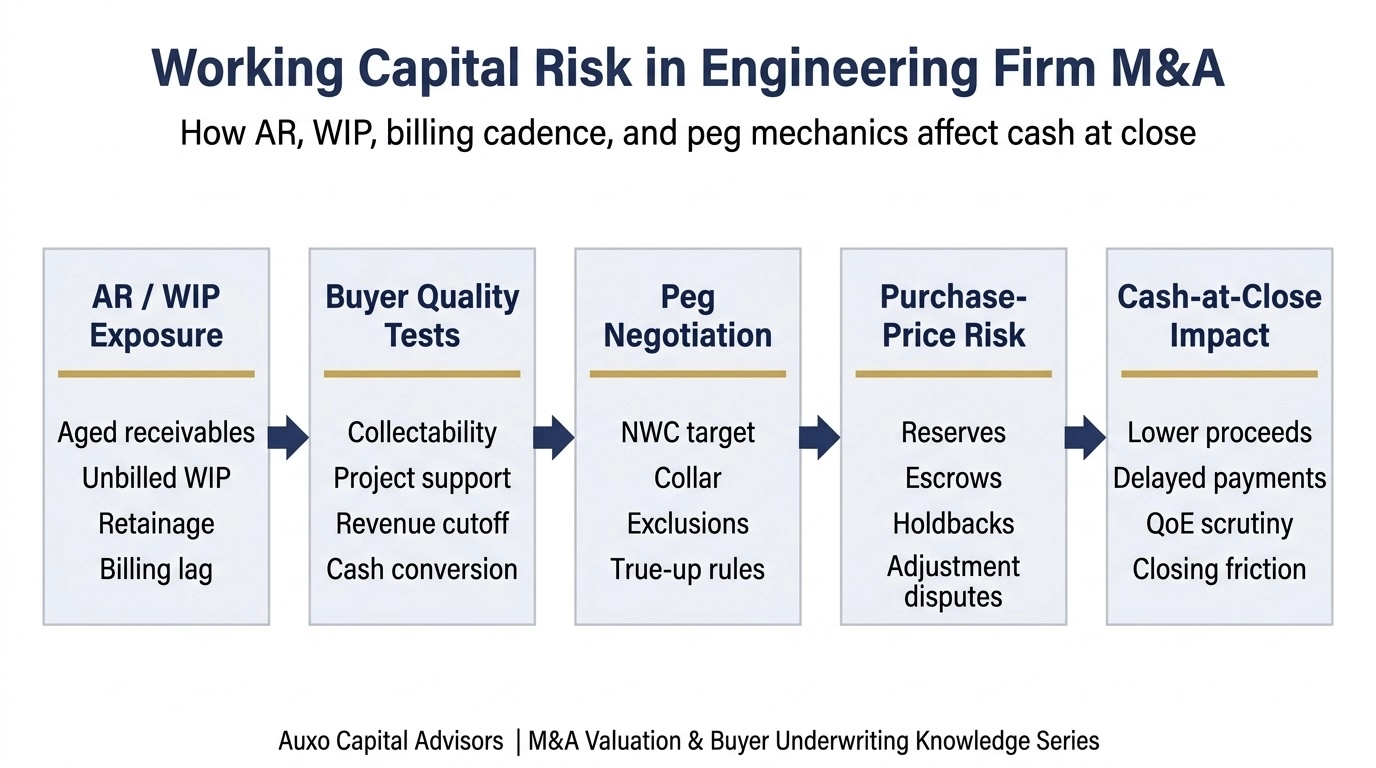
The key diligence question is not whether the firm has receivables or unbilled work. Project-based engineering firms usually do. The question is whether those balances are collectible, contractually supported, consistently billed, and properly reflected in the working-capital peg so that enterprise value translates into expected seller proceeds.
Definitions that matter in live deal documents
Working capital: usually current operating assets minus current operating liabilities, subject to negotiated inclusions and exclusions. In engineering deals, the treatment of cash, debt-like items, taxes, deferred revenue, accrued bonuses, and retainage can meaningfully change the result.
Working-capital peg: the normalized target level of net working capital the seller is expected to deliver at closing. If actual closing working capital is below the peg, purchase price is generally reduced; if above, the seller may receive an increase.
Working-capital collar: a negotiated range around the peg within which no adjustment occurs or within which minor variances are treated differently. Collars are not universal, but they appear when both sides want to reduce disputes over small fluctuations.
Purchase price adjustment: the post-closing true-up process that compares estimated closing balances with final determined balances under the purchase agreement definitions.
WIP: in this context, work performed but not yet billed or not yet fully billed. It can represent legitimate earned value, but it can also mask delayed invoicing, change-order uncertainty, realization risk, or weak project discipline.
Accounts receivable quality is a collectability test, not a balance-sheet footnote
Buyers do not evaluate AR by looking only at total days sales outstanding. They want to understand who owes the money, why it has not been collected, whether the amounts are disputed, and how long collections depend on partner intervention. In engineering firms, an aging schedule with a large share of balances over 90 or 120 days can be explained by public-sector payment cycles, retainage, client process, or milestone acceptance mechanics. But those explanations must be specific, documented, and consistent over time. Broad reassurances that “these clients always pay” usually do not survive diligence.
The underwriting consequence is straightforward: the older and less supported the receivable, the less likely the buyer is to treat it as fully equivalent to cash. Some buyers will request a reserve adjustment. Others will seek a separate collection holdback for clearly questionable balances. More sophisticated buyers may leave the receivable in the delivered working capital but then lower confidence elsewhere by tightening the peg or pressing for more favorable structure. In each case, AR quality affects economics even if the issue never appears as a clean line-item haircut.
Engineering-specific AR review often includes retainage, milestone billings awaiting client signoff, and project-closeout balances. These can be legitimate, but they need to reconcile to contract terms and project status. Where sellers get into trouble is not with complexity itself, but with inconsistency. If similar projects show widely different invoice timing, write-off patterns, or collection cycles, buyers start to question management control. That can influence the diligence burden described in Auxo’s AEC due diligence checklist far more than founders expect.
WIP quality can support value—or become a retrade catalyst
Unbilled WIP often sits at the center of engineering-firm working-capital debates because it blends accounting, project management, and collectability. Buyers are not inherently skeptical of unbilled work. In many engineering firms, monthly closes and revenue recognition create a normal lag between work performed and invoice issuance. The problem arises when that lag is persistent, poorly explained, or detached from contractual billing rights.
When WIP schedules are clean, the buyer can usually see project-by-project status, fee burn, amounts billed to date, amounts earned, and the reason for any unbilled balance. That support gives the buyer confidence that unbilled revenue will convert to invoices and then to cash. When schedules are thin or inconsistent, WIP starts to look less like a current asset and more like a soft estimate. At that point, the issue is no longer just accounting. It becomes a question of whether reported EBITDA has been flattered by work that is difficult to realize.
This is where sellers sometimes misread buyer behavior. They assume the debate is about technical revenue recognition. In live deals, the buyer is usually asking a more commercial question: if we own this project tomorrow, what portion of this unbilled balance can we invoice confidently, when will it be billed, and how much management time will it take to collect? Weak answers lead to risk repricing. Strong answers help preserve both peg credibility and valuation confidence.
Billing cadence changes both the peg and post-close cash needs
Billing cadence is one of the simplest operating variables and one of the most consequential in a transaction. A firm that invoices monthly, closes quickly, and pursues collections systematically tends to carry more predictable AR and lower unbilled balances. A comparable firm that invoices at milestones, delays month-end billing, or allows project managers to bill opportunistically can report similar revenue while requiring far more working capital to sustain operations. The buyer inherits that timing mismatch immediately.
For engineering businesses, payroll and subcontractor obligations usually continue on a fixed schedule. Customer receipts do not. If billing discipline is weak, the buyer may need to fund a larger operating cushion even when the historical P&L looks healthy. That is why buyers often analyze monthly trends in billed versus unbilled amounts, DSO by client type, and the elapsed days between work performance and invoice issuance. The issue is not merely whether the seller eventually gets paid; it is whether the business systematically converts earned revenue into cash on a timeline that supports normal operations.
Sellers should also recognize that billing cadence can distort the peg discussion if the business has historically underbilled at certain points in the month or quarter. If the peg is based on month-end averages but closing occurs during a period with unusual billing delay, the seller may feel unfairly penalized. That is exactly why process preparation and careful historical normalization matter. Done well, they let the seller explain the true operating cycle rather than allowing the buyer to define “normal” based on a conservative read of messy data.
How the working-capital peg is set—and where it breaks down
In principle, the peg is just a normalized average of working capital needed to run the business. In practice, engineering-firm pegs are often negotiated around three points of tension: seasonality, billing timing, and asset quality. Buyers usually start with a monthly trailing analysis, often 12 months and sometimes longer, then adjust for known anomalies, growth effects, timing distortions, and non-operating items. Sellers understandably prefer a definition that reflects how the business actually runs; buyers prefer a definition that prevents them from funding a hidden shortfall after closing.
For engineering firms, the peg is often where operations become economics. A delayed billing cycle, unusual retainage pattern, seasonal project ramp, or unsupported WIP balance can change the target level of working capital the buyer expects at close. Auxo’s separate discussion of the AEC working capital peg explains how buyers and sellers negotiate the benchmark, definitions, exclusions, collars, and true-up process that determine whether working capital becomes a neutral closing item or a source of value leakage.
Peg disputes usually emerge when historical balances do not represent a clean baseline. If collections surged unusually before closing, the buyer may argue the estimate is inflated by temporary cash conversion. If invoices were delayed, the seller may argue the estimated closing deficit is artificial and will reverse quickly. If older AR or unsupported WIP remain in the balance, the buyer may contend that those balances should not count toward normalized working capital at all. Once those arguments begin, the issue stops being arithmetic and becomes a contest over credibility and evidence.
| Peg issue | Why it appears in engineering deals | Typical negotiation response |
|---|---|---|
| Seasonality distortion | Municipal budgets, project starts, year-end collections, staffing ramps | Use longer averaging period or monthly stratification |
| Billing lag | Invoicing delayed relative to work performed | Normalize billed/unbilled patterns and define cutoff rules carefully |
| Aged AR inclusion | Large public-sector balances, retainage, disputed invoices | Reserve, exclude, or subject to special true-up treatment |
| Unbilled WIP support | Project records do not clearly support earned but unbilled amounts | Haircut, enhanced diligence, or separate escrow/holdback discussion |
The lesson for sellers is that peg negotiations reward preparation, not indignation. If a firm can produce a defensible monthly history, explain exceptions clearly, and tie AR and WIP to contract mechanics, the debate becomes narrower and more manageable. If not, the buyer often gains leverage to push conservatism into the definitions. For broader transaction context, Auxo’s valuation guide is the right companion; for execution planning, readiness work usually begins with the kinds of records highlighted in the sell-side readiness checklist.
The schedules buyers request before they get comfortable
Engineering-firm buyers usually want more than a trial balance and a summary AR aging. They need transaction-grade schedules that show the connection between project activity, billing, collection, and working-capital delivery. The more project-based the firm, the more important those schedules become. Buyers are trying to identify whether balance-sheet items represent routine operating capital or unresolved project issues that have simply not yet been forced into view.
- Detailed AR aging by customer, project, and aging bucket, with notes on disputed, retained, or slow-pay balances.
- WIP and deferred revenue schedules showing earned, billed, collected, and remaining balances by project.
- Monthly net working capital rollforwards for at least the trailing twelve months.
- Write-off, credit memo, and bad-debt history by client and project manager.
- Backlog summaries tied to contract type, billing terms, and remaining performance obligations.
- Evidence of invoice timing: days from work performed to invoice issuance, and days from invoice to collection.
Those requests are not bureaucratic overreach. They are how a buyer distinguishes timing noise from structural weakness. A well-prepared seller can organize these materials before launching a process, reducing the chance that the buyer defines the narrative first. That discipline is one reason many owners engage advisors before market outreach, particularly when the objective is to avoid late surprises during the sale process described in Auxo’s sell-side M&A advisory framework.
How weak working-capital discipline gets repriced in a sale process
Buyers do not always respond to working-capital risk by lowering the headline multiple immediately. Often, they first reprice through certainty. That may mean a more conservative peg, a collection reserve, a specific indemnity around revenue cutoff, or an escrow tied to older receivables. In competitive processes, some bidders may preserve their nominal enterprise value while shifting risk into structure so their bid remains visually attractive. Sellers who focus only on headline value can miss how much economics are being moved elsewhere.
There is also an indirect valuation effect. If AR and WIP issues undermine confidence in revenue quality, buyers may become less comfortable with full credit for recent EBITDA growth. A firm that appears to be scaling nicely on paper can look far less attractive if that growth is accompanied by rising unbilled balances, longer collection cycles, or higher write-offs. In that case, the buyer may apply more conservative forward assumptions, lower quality-of-earnings confidence, or demand stronger post-close protections. The result is often not a single dramatic haircut but a cumulative erosion of leverage across negotiations.
Quality-of-earnings review often becomes the channel through which these issues gain negotiating force. A QoE provider may identify old AR, unsupported WIP, aggressive revenue cutoff, inconsistent billing practices, or rising unbilled balances as evidence that reported earnings require more scrutiny. That does not mean every issue becomes a dollar-for-dollar valuation reduction, but it can reduce buyer confidence and make protective structure easier to justify. Auxo’s AEC quality of earnings article explains how diligence findings can affect normalized EBITDA, working-capital expectations, and buyer willingness to close on clean terms.
For founder-led sellers, this is where operating hygiene becomes exit preparation. Clean billing and collection discipline improve more than liquidity. They reduce the number of ways a buyer can reinterpret success as risk. That distinction is especially important when comparing likely acquirer behavior across buyer types, a topic Auxo addresses in its buyer landscape overview.
Worked example: two similar engineering firms, very different deal economics
Consider two engineering firms, each generating $20 million of revenue and $3 million of normalized EBITDA. Assume both receive an 8.0x headline enterprise value indication, or $24 million. On the surface, they look equally attractive. Their working-capital profiles tell a different story.
| Metric | Firm A: disciplined billing | Firm B: delayed billing / weak support |
|---|---|---|
| Monthly billing cadence | Invoices issued within 5 days of month-end | Invoices often delayed 20 to 35 days |
| AR over 90 days | 8% of gross AR | 27% of gross AR |
| Unbilled WIP as % of annual revenue | 4% | 11% |
| WIP support quality | Project-level rollforward and contract tie-out | Inconsistent notes, limited support for older balances |
| Normalized working-capital peg | $2.4 million | $3.1 million |
| Estimated closing working capital | $2.35 million | $2.55 million |
| Preliminary closing adjustment | $(0.05) million | $(0.55) million |
| Additional buyer ask | None | $0.40 million collection holdback on older AR |
If both firms start at the same $24 million enterprise value, Firm A may close with only a modest peg-related reduction. Firm B, however, may experience a larger downward purchase-price adjustment at closing plus a separate holdback tied to doubtful collections. If both businesses also carry identical debt, the seller of Firm B may still see materially lower cash at close despite the same nominal multiple. In practical terms, the bridge may look like this:
Firm A illustrative bridge
Enterprise value: $24.0M
Less net debt and debt-like items: $(3.0)M
Less working-capital shortfall to peg: $(0.05)M
Estimated equity value / seller proceeds before fees and taxes: $20.95M
Firm B illustrative bridge
Enterprise value: $24.0M
Less net debt and debt-like items: $(3.0)M
Less working-capital shortfall to peg: $(0.55)M
Less AR collection holdback: $(0.40)M
Estimated equity value / cash at close before fees and taxes: $20.05M
The point is not that every buyer will use these exact mechanics. The point is that working-capital quality often changes seller proceeds even when enterprise value appears unchanged. Sellers frequently focus on the 8.0x multiple and overlook how the buyer is shifting economics into the peg, holdback, or post-close adjustment process. Buyers, by contrast, are focused on the cash burden they inherit and on whether reported current assets will convert without friction. That is where diligence discipline and process design matter.
Seller takeaway
Working capital is a value issue, not just a controller issue. Owners who tighten billing cadence, reduce aged receivables, reconcile retainage cleanly, and document WIP at the project level usually make it easier for buyers to trust both reported earnings and the closing balance sheet.
If a sale may be 6 to 12 months away, the best preparation is rarely cosmetic. It is operational: bill on time, clear stale AR, track realization by project, explain exceptions before diligence begins, and understand how your historical monthly working capital will translate into a peg. The less a buyer has to guess, the less room there is for structure to replace price.
What sellers should prepare before buyers underwrite working capital risk
Working capital is much easier to defend when sellers organize the evidence before buyer outreach. Buyers do not simply ask whether receivables exist or whether WIP appears on the balance sheet. They ask whether balances are collectible, billable, supportable, correctly aged, consistently reported, and properly reflected in the working-capital peg. That proof should be built before management meetings, not reconstructed under time pressure during QoE diligence.
| Preparation area | What to organize | Why buyers care |
|---|---|---|
| AR aging by client and project | Detailed AR aging by customer, project, invoice, aging bucket, retainage status, dispute status, and collection owner. | Allows buyers to test collectability, dispute risk, customer concentration, and whether older balances should count toward delivered working capital. |
| WIP rollforward | Project-level WIP schedules showing opening balance, work performed, billed amounts, write-offs, remaining unbilled balances, and contract support. | Shows whether unbilled work is real, billable, and likely to convert into invoices and cash. |
| Billing cadence history | Monthly billing timing, days from work performed to invoice, days from invoice to collection, and any deviations by client or project manager. | Helps buyers determine whether cash conversion is disciplined or whether billing lag creates hidden funding needs. |
| Write-off and credit memo history | Trailing write-offs, credit memos, billing corrections, disputed amounts, and project-level explanations. | Helps buyers distinguish normal timing issues from revenue realization problems. |
| Retainage and milestone billing support | Retainage schedule, milestone status, client acceptance requirements, contract terms, and expected release timing. | Determines whether retained or milestone-based balances should be treated as collectible current assets or reserved. |
| Deferred revenue and accrued liabilities | Support for deferred revenue, accrued bonuses, payroll accruals, project costs, subcontractor liabilities, taxes, and other operating obligations. | Prevents buyers from arguing that the seller underdelivered operating liabilities or understated the cash needed after closing. |
| Monthly net working capital rollforward | Trailing 12 to 24 months of monthly net working capital by agreed operating categories, with explanations for anomalies and seasonality. | Supports the peg and reduces the buyer’s ability to define “normal” using an overly conservative snapshot. |
| Peg methodology support | Proposed peg calculation, included and excluded accounts, seasonality adjustments, collar logic, cutoff procedures, and known normalization items. | Helps sellers negotiate from evidence rather than reacting to buyer-defined working-capital mechanics late in exclusivity. |
This preparation should be coordinated with broader diligence readiness. Auxo’s AEC due diligence checklist outlines the types of financial, operational, backlog, project, and transaction-support materials buyers expect. For working-capital-specific mechanics, sellers should also understand the AEC working capital peg and how QoE providers evaluate cash conversion, AR, WIP, billing cutoff, and normalized working-capital history.
Common seller mistakes when working capital quality is weak
Working capital issues become more expensive when sellers treat them as back-office details rather than transaction risks. Buyers accept that project-based engineering firms often carry AR, WIP, retainage, and timing complexity. What they penalize is the absence of proof that those balances are collectible, billable, properly supported, and normal for the business.
- Treating working capital as a closing-date accounting issue only. Buyers often use working capital history to judge revenue quality, cash conversion, and management discipline long before the final true-up.
- Assuming old AR is equivalent to cash. Older receivables may be collectible, but buyers usually require evidence, explanations, and sometimes reserves or collection holdbacks.
- Presenting WIP without project-level support. Unbilled balances need to tie to contracts, project status, fee burn, billing rights, and expected invoice timing.
- Ignoring billing lag until diligence. A firm that invoices late may still be profitable, but buyers may treat the lag as a larger cash-funding need after close.
- Waiting for QoE to explain exceptions. Once a QoE provider identifies AR or WIP issues first, the buyer usually has more leverage to push conservatism into the peg or structure.
- Focusing on enterprise value while ignoring cash at close. A seller can win the multiple debate and still lose economics through peg shortfalls, reserves, escrows, holdbacks, or true-up exposure.
- Failing to model the peg before LOI. Sellers who do not understand their historical working-capital profile often enter exclusivity without knowing how much purchase price may be exposed to adjustment.
The better approach is to make working capital measurable, documented, and explainable before buyers define the issue themselves. Sellers should know which balances are normal, which require cleanup, which need narrative support, and which may need to be handled through targeted definitions rather than broad economic concessions.
What buyers actually focus on
In live engineering transactions, buyers tend to concentrate on a smaller set of decision variables than sellers expect. They want to know whether collections depend on a founder’s personal intervention, whether unbilled balances are increasing faster than revenue, whether certain project managers bill materially slower than others, and whether month-end invoicing patterns have become more aggressive as the sale approaches. Those observations tell the buyer how much hidden operating strain may sit behind reported growth.
They also focus on where disputes are likely to appear after signing. If AR is technically valid but historically slow, the buyer may still ask whether those balances should count fully in the peg. If WIP is recognizable under accounting rules but commercially fragile, the buyer may still challenge whether it should be treated as delivered working capital without a reserve. If revenue growth has outpaced collections for several periods, the buyer may ask whether working capital requirements are structurally increasing. These are underwriting judgments, not merely accounting debates.
Buyers with strong sector familiarity are particularly attentive to patterns rather than isolated anomalies. They understand that engineering firms can have legitimate timing noise. What they are looking for is evidence that management understands the business well enough to explain and control that noise. When that evidence exists, risk stays bounded. When it does not, buyers gain latitude to protect themselves through terms.
Why process discipline and M&A advisory positioning matter
Working-capital disputes are often framed as accounting clean-up exercises. In a transaction, they are really narrative control issues. A prepared sell-side process translates project-level complexity into a buyer-ready explanation before management meetings, confirmatory diligence, and document negotiations begin. That means normalizing monthly working-capital history, identifying unusual collection delays, separating true retainage from ordinary aging, preparing WIP support that can withstand detailed scrutiny, and anticipating where a buyer may try to redefine the peg conservatively.
This is one of the places where experienced representation matters. A disciplined advisor helps management decide what is genuinely normal, what should be remediated before launch, and what should be surfaced early so it does not become a retrade point later. That is also where the sale process itself can preserve leverage: when multiple buyers understand the seller’s working-capital profile in a consistent way, it is harder for one bidder to create artificial uncertainty late in exclusivity. Auxo outlines that broader representation role in its sell-side M&A advisory page.
Advisor discipline also matters because working-capital issues can be framed in very different ways. One buyer may view AR aging or WIP complexity as ordinary project-business timing. Another may characterize the same facts as evidence of weak revenue quality, poor controls, or hidden cash funding needs. A strong sell-side process anticipates those interpretations, organizes the support, and prevents a narrow working-capital issue from becoming a generalized valuation discount.
For many engineering firms, the right answer is not to eliminate every working-capital complexity before going to market. Some project-based timing issues are normal. The real objective is to package them credibly, defend what belongs in normalized working capital, and identify where structure should be resisted or traded for value elsewhere. That kind of preparation complements the broader perspectives in the AEC valuation guide and the operational readiness work summarized in Auxo’s sell-side readiness checklist.
Working-capital positioning should also be coordinated with QoE preparation and purchase-agreement strategy. If AR, WIP, billing cutoff, or peg methodology issues are likely to arise, sellers should address them before a buyer’s diligence provider turns them into leverage. The objective is not to argue that every balance is perfect. The objective is to define what is normal, isolate what is unusual, and negotiate mechanics that protect value without exposing the seller to open-ended post-closing adjustment risk.
Frequently asked questions
What is working capital risk in an engineering firm sale?
It is the risk that the seller’s current assets and liabilities do not reflect the true cash needed to operate the business after closing. In engineering deals, that usually centers on AR collectability, WIP realization, billing lag, and the possibility that the buyer will need to inject cash immediately after closing.
Why do buyers care so much about AR and WIP?
Because those balances indicate whether recorded revenue is turning into cash on a predictable basis. AR tests collectability and dispute risk; WIP tests whether earned but unbilled work is well supported and likely to convert into invoices and collections without erosion.
How is working capital pegged in an engineering-firm transaction?
Typically through a historical monthly analysis of normalized net working capital, adjusted for seasonality, unusual timing items, and negotiated inclusions or exclusions. The goal is to estimate what level of working capital the business needs to operate normally at closing.
What causes working-capital true-up disputes?
Common causes include disputed AR inclusion, unsupported WIP, inconsistent cutoff treatment, late pre-close billing pushes, and disagreements over whether certain liabilities or reserves are ordinary operating items. Poor definitions in the purchase agreement also make disputes more likely.
How does billing lag affect valuation?
It may not always reduce the headline multiple directly, but it often increases the peg, weakens confidence in revenue quality, and leads to more conservative purchase-price mechanics. In some cases it also reduces buyer confidence in the durability of recent EBITDA growth.
Is high WIP good or bad in an acquisition?
Neither by itself. High WIP can be entirely reasonable in project-based engineering businesses. The real question is whether it is documented, contractually supportable, and converting to billed receivables on a reliable timeline. Unsupported WIP is a problem; well-supported WIP may be normal.
How do overdue receivables affect purchase price?
They can affect price through a reserve, an exclusion from normalized working capital, a collection holdback, or increased buyer conservatism elsewhere in the structure. Even when not explicitly written down, stale AR often lowers confidence in the closing balance sheet.
What documents do buyers request to assess working capital?
Usually AR agings, project-level WIP schedules, monthly working-capital rollforwards, backlog reports, write-off history, billing and collection trend data, and notes explaining older balances, retainage, milestone billing status, and unusual project items.
How can a seller improve working capital before going to market?
By tightening billing cadence, collecting stale balances, documenting project status at the WIP level, cleaning up reserves and accruals, and building a monthly normalized working-capital history that can support peg negotiations. Preparation matters most when started several months before launch.
What is a working-capital collar?
A collar is a negotiated range around the peg within which variances do not trigger an adjustment, or trigger a modified one. It is intended to reduce disputes over small fluctuations, though it does not eliminate deeper disagreements about definitions and asset quality.
How does working capital affect deal certainty?
Weak working-capital quality increases diligence burden, creates more room for late-stage buyer caution, and raises the likelihood of adjustment disputes after signing or closing. Clean working-capital support usually improves speed, confidence, and negotiating leverage.
When should an engineering firm get sell-side advisory help?
Usually before buyer outreach begins, especially if AR aging, WIP support, project billing timing, or month-to-month working-capital volatility could become debate points. Early preparation gives the seller more control over how those issues are framed and defended.
Media & press inquiries
Auxo Capital Advisors provides commentary on lower middle-market and middle-market M&A, valuation, buyer underwriting, and transaction preparation issues affecting founder-led businesses, including engineering and broader AEC firms.
For media requests, interview inquiries, or requests to cite this analysis, please contact info@auxocapitaladvisors.com.
Disclosure
This article is provided for general informational purposes only and does not constitute investment banking, legal, tax, accounting, or other professional advice. The observations here are based on transaction practice, buyer underwriting behavior, and common diligence issues seen in engineering-firm and AEC-related M&A, but each business and transaction is different.
All numerical illustrations are simplified examples intended to show how working-capital mechanics can affect enterprise value translation, purchase-price adjustments, and seller proceeds. Actual outcomes depend on business specifics, contract terms, accounting policies, diligence findings, working-capital definitions, negotiations, financing conditions, tax considerations, and the priorities of individual buyers and sellers.


