

What M&A Buyers Look for in Water Engineering Firms
Updated for founders, operators, acquirers, and referral partners evaluating what M&A buyers look for in water and wastewater engineering firms. This guide focuses on buyer underwriting, diligence evidence, valuation support, and deal-structure implications across service mix, backlog quality, client concentration, margins, contract risk, working capital, and leadership transferability.
Key answer: Buyers look for water engineering firms with durable demand, defensible client relationships, credible backlog, strong project economics, manageable concentration, clean contract and compliance history, and a management team that can retain both clients and technical talent after closing. Specialized water, wastewater, treatment, and process expertise helps, but it supports value only when the associated revenue is repeatable, transferable, and underwritable.
Why it matters: Two water engineering firms with similar revenue and EBITDA can receive very different buyer responses. One may present as a durable infrastructure platform with repeat municipal programs, funded backlog, and distributed leadership. Another may look attractive on the surface but underwrite as riskier if revenue depends on a few industrial projects, founder-owned relationships, weak backlog documentation, or contract terms that shift too much risk to the seller. The difference often shows up not only in price, but also in escrow, earnouts, rollover equity, working-capital treatment, and seller transition obligations.
Water engineering sits in a favorable strategic lane for many buyers, but favorable demand does not eliminate underwriting discipline. Acquirers still separate firms with repeatable infrastructure exposure, institutionalized delivery, and well-documented economics from firms whose revenue looks attractive only at a high level. That distinction matters because the same market tailwinds that attract buyer interest also increase scrutiny around backlog quality, staffing continuity, process capability, and project-level risk transfer.
This article should be read alongside Auxo’s broader views on engineering firm valuation multiples, the market-demand thesis in why water engineering firms are in high demand, and the valuation lens in water and wastewater engineering firm valuation. The goal here is narrower: to explain how buyers translate operating characteristics into pricing confidence, diligence scope, and deal terms.
Transaction context: once buyers are interested in a water or wastewater engineering firm, the conversation quickly moves from sector demand to diligence proof. Acquirers test whether the firm’s service mix, municipal versus industrial exposure, funded backlog, contract terms, margin history, working-capital behavior, client relationships, and leadership depth support the valuation and deal structure being discussed.
This guide should be read alongside Auxo’s article on why water engineering firms are in high demand and its companion valuation guide on how water and wastewater engineering firms are valued. The practical issue for founders is what buyers actually inspect after interest is established: whether revenue is repeatable, backlog is funded and convertible, client trust is transferable, contract risk is contained, and cash flow can survive a transaction without excessive structure.
Owners should also use this guide alongside Auxo’s AEC valuation guide, backlog quality in AEC M&A, who buys AEC firms, and private equity underwriting for AEC firms. Together, those resources connect buyer demand, buyer type, valuation, diligence, and transaction execution.
Technical capability matters, but underwriting starts with durability
Founders in the sector often assume that specialized technical capability should automatically command premium treatment. Sometimes it does. But buyers generally treat technical quality as an entry requirement, not the final reason to pay up. Premium pricing shows up when technical capability is attached to durable demand, repeat clients, attractive end-market exposure, strong margins, and low transition risk.
That is especially true in water and wastewater. A firm may have excellent engineers and a respected brand, yet still underwrite as a riskier asset if the client base is narrow, industrial work is tied to a few plant projects, or the founder personally controls every key relationship. On the other hand, a business with a strong mix of municipal master-service relationships, process specialization, and disciplined project execution may draw broad interest from strategic buyers and financial sponsors alike.
Executive summary
Acquirers of water and wastewater engineering firms usually evaluate value through three connected lenses: revenue durability, execution risk, and post-close continuity. Revenue durability is shaped by service-line mix, municipal versus industrial exposure, backlog quality, recurring inspection or programmatic work, and concentration. Execution risk is shaped by contract terms, margin consistency, regulatory exposure, claims history, staffing depth, and the extent to which the target is responsible for process performance or latent defects. Post-close continuity comes down to leadership depth, seller transition realism, incentive alignment, and whether clients are institutional relationships or founder relationships.
As a result, firms that look similar on topline revenue can receive very different indications of interest. One may merit a cleaner valuation range and a lighter diligence path; another may attract more holdbacks, earnout requests, indemnity carve-outs, or working-capital protection even if the headline multiple sounds comparable at first glance. Sellers who understand this dynamic can prepare the business to present better rather than simply defend the historical story after diligence starts.
Key takeaways
- Buyers reward water firms with durable demand, not just technical credentials.
- Municipal and industrial work can both be attractive, but they underwrite differently and often lead to different deal structures.
- Backlog quality matters more than backlog size; cancellable or low-margin backlog does not support the same valuation confidence.
- Recurring O&M, inspection, compliance, or program-management style revenue usually improves buyer confidence when it is documented and margin-accretive.
- Project concentration, client concentration, and key-person dependency are among the fastest ways to compress value or increase escrow and earnout pressure.
- Regulatory, environmental, warranty, and performance-risk items are not side issues in this subsector; they can materially change diligence scope and indemnity terms.
- In live deals, buyers often negotiate structure to solve uncertainty rather than simply walk away from a target they otherwise like.
The underwriting map buyers use in live water engineering transactions
| Underwriting lens | What buyers test | Why it changes value or structure |
|---|---|---|
| Service-line quality | Design, permitting, treatment-process engineering, controls, O&M support, CM, program management | Specialized, repeatable, and regulation-linked services tend to support stronger buyer conviction than episodic commodity design work. |
| Client mix | Municipal utilities, industrial plants, private developers, EPC partners | Different client categories change demand stability, procurement behavior, margin profile, and collection risk. |
| Backlog quality | Funded versus unfunded work, cancellation rights, option years, task-order visibility, burn rate | Only credible, financeable backlog deserves valuation support. |
| Economics | Gross margin consistency, labor utilization, write-offs, change-order recovery, EBITDA conversion | Margin quality indicates whether earnings are repeatable or flattered by timing and underinvestment. |
| Risk transfer | Standard of care, warranties, liquidated damages, performance guarantees, environmental liabilities | Contractual risk can force escrows, holdbacks, and indemnity carve-outs even when headline pricing holds. |
| Continuity | Management depth, client ownership, recruiting bench, seller transition plan | Founder dependence directly affects retention risk and post-close confidence. |
Read this table as a buyer decision tree, not a checklist of generic virtues. Water engineering firms rarely get penalized because one item is imperfect in isolation. They get repriced when several issues combine: concentrated clients, weak documentation around backlog, founder-led relationships, and contract exposure that could produce future claims. The reverse is also true. A firm with a coherent service mix, repeat municipal programs, and strong middle management can often absorb one weaker area without losing buyer conviction.
In practice, this is the buyer’s first-pass underwriting map before quality of earnings, legal diligence, contract review, insurance review, and management meetings begin. It helps buyers decide where to focus diligence, which risks are likely to affect price, and which issues may need to be addressed through structure rather than valuation alone.
Buyer underwriting map for water engineering firms
Once buyers decide the water engineering subsector is attractive, they shift quickly from market interest to company-specific underwriting. The core question becomes whether the firm’s service mix, client base, backlog, financial profile, risk allocation, and management depth support the valuation and deal terms being discussed.
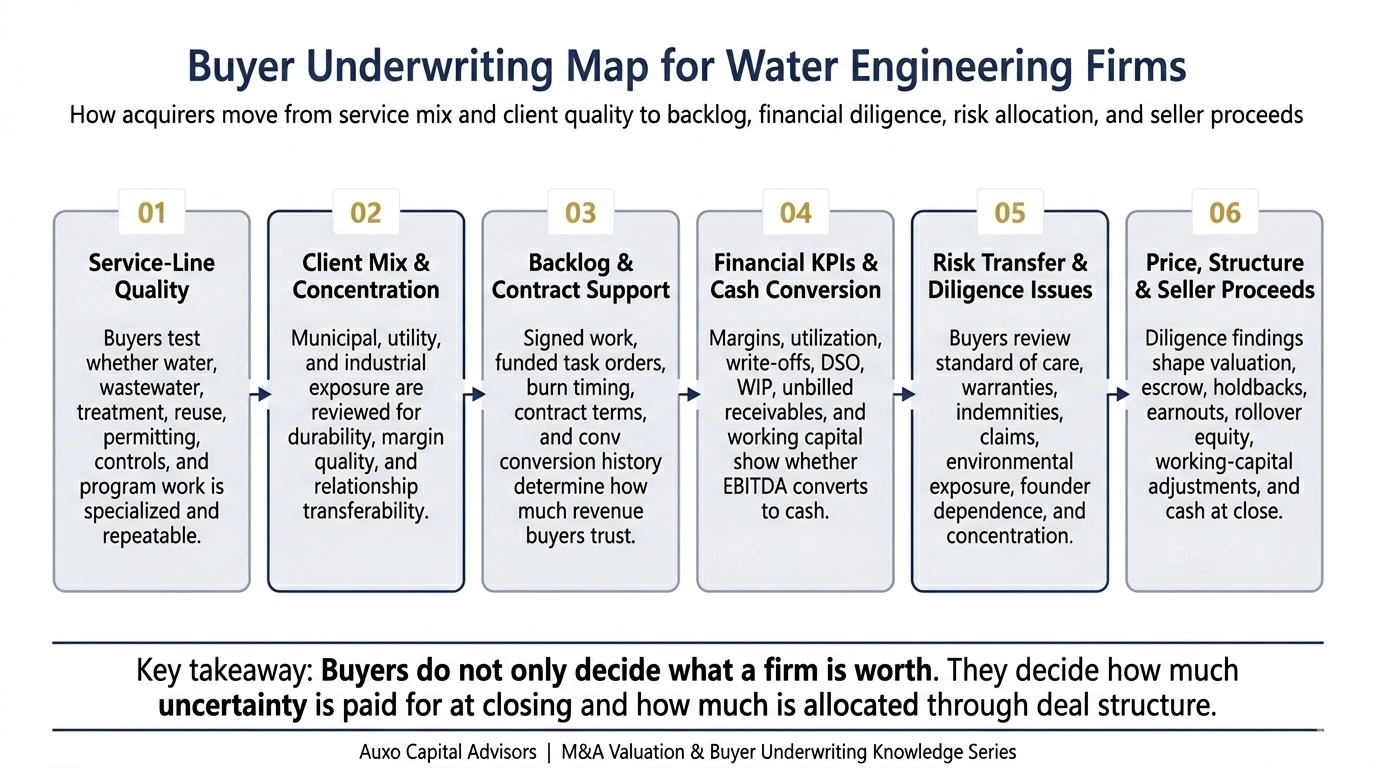
The visual is not a valuation formula. It is the way buyers organize risk. A firm can be technically strong and still face pressure if backlog is weak, client relationships are concentrated, working capital is volatile, or key relationships depend too heavily on the founder.
How buyers separate attractive firms from risky firms
Before buyers get deep into confirmatory diligence, they usually apply a first-pass screening filter. The question is not simply whether the firm operates in an attractive market. The question is whether the firm has the specific attributes that make that market exposure transferable, financeable, and scalable after closing.
| Buyer screening filter | What stronger firms show | What creates caution |
|---|---|---|
| Specialized water capability | Documented expertise in water, wastewater, treatment, reuse, process, permitting, compliance, or utility programs. | Broad civil engineering exposure with only intermittent water-related projects. |
| Repeat client relationships | Institutional municipal, utility, or industrial relationships owned across multiple leaders. | Relationships controlled by the founder or one rainmaker. |
| Funded backlog | Signed, funded, margin-tested work with visible burn timing and realistic staffing support. | Pipeline, unfunded opportunities, or future phases presented as if they were committed backlog. |
| Margin durability | Stable gross margins, disciplined project management, low write-offs, and clear change-order recovery. | Earnings flattered by delayed hiring, under-scoped projects, weak realization, or unusual one-time work. |
| Contract-risk discipline | Standard professional-services terms, clear scope boundaries, and insurable standard-of-care obligations. | Expanded warranties, performance guarantees, liquidated damages, or broad indemnity language. |
| Cash conversion | Reasonable DSO, controlled WIP, limited unbilled balances, and predictable billing cadence. | Receivable slippage, contract-asset build, collection friction, or recurring working-capital surprises. |
This screening filter explains why buyers can like the water engineering market but still approach individual targets differently. Stronger firms turn sector demand into underwritable evidence. Riskier firms ask buyers to accept more uncertainty, which usually moves value into structure, diligence protection, or a more conservative valuation range.
Terms buyers use when underwriting water and wastewater firms
Backlog quality means the degree to which signed work is likely to convert into revenue at expected margins, within a reasonable period, without unusual cancellation or repricing risk. In this subsector, buyers often distinguish sharply between framework agreements, funded task orders, and pipeline-style opportunity lists.
Recurring revenue in a water engineering context usually does not mean software-like subscriptions. It more often refers to repeat inspection, compliance, asset management, program management, O&M support, long-standing utility relationships, or multi-year task-order work that has demonstrated renewal behavior.
Risk transfer refers to how much technical, construction, environmental, or performance responsibility the engineering firm has contractually accepted. Buyers care because downside exposure can survive closing and surface well after a project is completed.
Continuity risk is the probability that clients, staff, or project knowledge leave with the founder or a small number of leaders. In lower-middle-market engineering transactions, continuity risk is often one of the most important drivers of structure.
Service-line quality refers to how buyers evaluate the durability, differentiation, margin profile, and strategic relevance of each revenue stream. Specialized treatment, permitting, compliance, controls, and programmatic utility work usually underwrite differently than more commodity project work.
Client concentration measures whether too much revenue, backlog, margin, or relationship value depends on a small number of customers. Buyers may still pursue concentrated firms, but they typically underwrite retention and renewal risk more carefully.
Project concentration occurs when a small number of large projects or active scopes drive a disproportionate share of revenue, margin, or backlog. Auxo discusses this risk in more detail in its article on project concentration risk in engineering firms.
Working-capital risk refers to the possibility that receivables, WIP, unbilled balances, retainage, billing cadence, or collection patterns reduce cash at close or require a larger normalized working-capital target. This can materially affect seller proceeds even when headline enterprise value appears attractive.
Deal structure is the way buyers allocate uncertainty through cash at close, escrow, holdbacks, earnouts, rollover equity, indemnity terms, working-capital adjustments, and retention packages. In water engineering M&A, structure often becomes the buyer’s response to backlog, concentration, contract, or transition risk.
Founder dependence describes reliance on the owner or a small number of senior professionals for client relationships, business development, technical delivery, or institutional knowledge. The more concentrated those functions are, the more likely buyers are to underwrite transition risk.
Service-line mix changes both the quality of revenue and the buyer universe
Not all water-related services underwrite the same way. Buyers usually sort service lines by how differentiated they are, how tied they are to mandatory spending, whether they generate repeat engagements, and how much execution risk they carry. Treatment-process engineering, specialized instrumentation and controls integration, permitting expertise, or embedded utility-program work can expand the buyer pool because they are harder to replace and often sit closer to critical plant or compliance needs. General civil support tied loosely to water projects may still be valuable, but it tends to compete in a wider and less differentiated market.
This is the practical buyer-underwriting counterpart to the broader demand thesis in why water engineering firms are in high demand. Strong sector demand may bring buyers into the conversation, but service-line quality helps determine whether they see the firm as a scarce acquisition target or a less differentiated project-services provider.
There is also a meaningful difference between engineering services that influence the client’s operating continuity and services that are easier to defer. Firms with strong positions in wastewater treatment upgrades, nutrient-removal projects, process optimization, resiliency planning, instrumentation, and related technical scopes often attract stronger interest because the end demand is more resistant to budget cycles than discretionary planning work alone. In some cases, the line between water engineering and adjacent process capability matters enough that buyers compare the asset against other specialized niches, including industrial process engineering valuation themes and instrumentation and controls engineering capabilities.
How buyers typically view common water service lines
| Service line | Typical buyer view | Frequent diligence questions |
|---|---|---|
| Treatment process engineering | Often attractive because it is technical, regulation-linked, and difficult to commoditize | Depth of senior talent, project outcomes, reliance on named experts, exposure to performance representations |
| Municipal planning and design | Can be durable when embedded in repeat utility programs, weaker when project-by-project and bid sensitive | Win rates, client concentration, budget dependence, funded backlog versus informal pipeline |
| Permitting and compliance support | Often favorable if recurring and tied to regulatory complexity | Renewal behavior, key personnel dependence, documentation of recurring scopes |
| Instrumentation, automation, and controls | Can command strong interest when integrated into treatment and plant modernization programs | Software or integration liability, commissioning risk, staffing bench, subcontractor dependence |
| Construction management and field support | Useful if it deepens client relationships, but margins and claims exposure are closely reviewed | Dispute history, staffing needs, receivables, change-order support, insurance coverage |
| O&M-adjacent or recurring technical support | Usually valuable if contractually sticky and margin-accretive | Contract terms, renewal rates, labor intensity, true gross-margin quality |
The seller implication is straightforward: present service lines the way buyers segment risk, not the way the firm organizes departments internally. A well-prepared process shows which services are recurring, which are mission-critical, which require scarce expertise, and which are lower-quality filler. That framing often matters as much as the raw revenue split.
Municipal versus industrial exposure drives different risk discounts and structuring choices
Municipal exposure often supports a more durable demand narrative because utility systems and public infrastructure require ongoing investment, regulatory compliance, and asset replacement. Buyers generally like municipal relationships when they are broad-based, institutional, and embedded across multi-year capital programs. But municipal work is not automatically premium. Procurement pressure, slower sales cycles, appropriations timing, and lower-margin commodity scopes can offset some of the stability benefit. Buyers want to know whether the firm is a trusted advisor to utilities or simply one of many firms competing for routine assignments.
Industrial water work can look more volatile on paper, yet it may command stronger enthusiasm when it is tied to complex treatment, process integration, high-value facilities, or recurring compliance needs. Industrial clients often move faster, allow better pricing, and value specialized expertise. The tradeoff is concentration and capital-spending sensitivity. If a large portion of revenue depends on a handful of plants, one operating decision by one customer can change the year. The key is not whether municipal or industrial is better in the abstract. It is whether the client mix creates resilience, margin quality, and repeatability. Auxo’s sector comparison on municipal versus industrial water engineering is useful background here.
Client mix also intersects with project concentration risk. A large municipal program or industrial facility relationship can improve buyer interest, but it can also create a forecast issue if too much revenue, backlog, or margin depends on one award, one facility, one agency, or one relationship owner.
How client mix changes underwriting
| Client mix characteristic | Likely underwriting effect | Typical deal-term consequence |
|---|---|---|
| Diversified municipal utility base | Supports durability and backlog confidence | Cleaner cash-at-close if other diligence items are in order |
| Municipal work concentrated in one agency or region | Stability narrative weakens because budget or relationship risk becomes concentrated | More diligence around renewal history and client retention |
| Industrial revenue from a few plants or one sponsor-backed customer | Higher concentration risk despite attractive margins | Possible earnout or customer-retention tied structure |
| Balanced municipal and industrial mix with specialized technical edge | Often favorable because demand sources diversify while expertise remains differentiated | Broader buyer universe and stronger negotiation leverage |
| Private developer water-related work | May be viewed as less durable and more cyclical than utility-driven work | Potential multiple compression and more conservative forecast assumptions |
One recurring seller mistake is assuming high-margin industrial work always deserves a premium over public-sector work. Buyers do not think that way. They ask what happens if one site expansion is delayed, if the customer changes procurement behavior, or if the incumbent technical lead leaves. Strong margins help, but concentration can still pull value back toward structure.
Backlog only supports value when the contracts behind it are durable
Backlog is one of the most cited value signals in engineering M&A, but it is also one of the most misunderstood. Buyers do not simply accept a topline backlog figure in the teaser or CIM. They want to know how much is under signed contract, how much is task-order based, how much can be canceled for convenience, how much depends on funding approvals, and whether expected margins are supported by actual project performance. A large backlog number may be directionally positive, but if it contains low-quality or weakly committed work, it will not underwrite like durable revenue.
This is especially important in water engineering, where long pursuit cycles and framework-style engagements can tempt sellers to present pipeline and backlog too loosely. Sophisticated buyers separate funded programs from probable opportunities very quickly. They also compare the stated backlog to staffing capacity, burn rates, and historical conversion. For a deeper treatment of that distinction, see Auxo’s article on backlog quality in AEC M&A.
That is why backlog quality is one of the most important bridges between buyer criteria and water and wastewater engineering firm valuation. Buyers may admire a firm’s market exposure, but they usually price the business based on how much future revenue and margin they can actually underwrite.
Contract features that help or hurt buyer confidence
- Helps: multi-year master agreements with demonstrated task-order flow, funded authorizations, repeat annual programs, clear rate schedules, and limited unilateral cancellation risk.
- Helps: standard-of-care language that aligns with insurable professional practice rather than expansive performance guarantees.
- Hurts: backlog dependent on future appropriations without historical funding consistency, informal client expectations, or one-time design wins that do not repeat.
- Hurts: contracts with broad indemnities, warranty language that exceeds normal professional standards, liquidated damages, or vague responsibility for process performance.
- Hurts: projects that appear profitable only because labor estimates have not yet caught up to scope creep or change-order friction.
Negotiations often turn here. If backlog quality is strong, the seller can defend the forecast and push buyers to price the business as a continuing platform. If backlog quality is mixed, buyers may preserve headline value but move the risk into net working capital targets, customer-retention tests, escrows, or earnout mechanics.
The operating metrics and financial KPIs that move buyer conviction
Buyers evaluating water infrastructure firms usually want more than revenue growth and EBITDA margin. They look for evidence that the business converts specialized demand into repeatable, well-controlled economics. That means understanding revenue by service line, client category, geography, contract type, and project size. It also means testing whether backlog burns predictably, whether utilization is healthy without excessive burnout, whether gross margins are consistent by practice, and whether billed work turns into cash without chronic receivable slippage.
Some KPIs tend to carry disproportionate weight in this subsector. The percentage of revenue from repeat clients matters. So does the share tied to recurring or programmatic work rather than one-off awards. Client concentration thresholds matter, especially if any single client, project, or metro area dominates results. Buyers also study working-capital intensity, since project timing and invoicing patterns can make a business look more cash-generative than it really is at a point in time. These same themes sit underneath broader discussions of valuation multiples, but they become more granular in water and wastewater diligence.
Cash conversion deserves special attention because working-capital mechanics can move real economics even when EBITDA looks strong. Auxo’s article on working capital risk in engineering firms explains why receivables, WIP, unbilled balances, and billing discipline can affect both buyer confidence and seller proceeds.
Illustrative KPI ranges buyers often examine
| KPI | What stronger underwriting often looks like | What triggers more caution |
|---|---|---|
| Repeat-client revenue | Large majority of revenue from established accounts or recurring programs | Heavy dependence on new project wins each year to refill the book |
| Recurring or programmatic revenue | Meaningful portion tied to ongoing support, compliance, or repeat task orders | Mostly episodic project revenue with weak renewal evidence |
| Client concentration | No single client dominates enterprise value exposure | One client or project contributes outsized share of revenue or margin |
| Backlog composition | Signed, funded, margin-tested work with visible burn schedule | Pipeline mixed into backlog or weakly documented task-order assumptions |
| Cash conversion | Reasonably consistent DSO and limited contract-asset build | Large unbilled balances, collection friction, or frequent working-capital swings |
| Leadership concentration | Multiple leaders own delivery, sales, and client relationships | Founder or one practice lead controls most key accounts |
There is no universal hard threshold that automatically determines price. But when several weaker indicators cluster together, buyers adjust either the valuation range or the purchase agreement mechanics. If concentration is elevated and working capital is volatile, they may need stronger downside protection even if historical EBITDA looks healthy. That is where seller preparation matters: the right presentation can separate temporary timing noise from structural weakness.
Where water engineering deals get repriced during diligence
Water and wastewater deals rarely collapse because buyers stop liking the sector. They get repriced because confirmatory work reveals that risk is concentrated differently than marketed. A few recurring issues appear often. One is overstatement of backlog quality, especially where multi-year contracts are treated as if all future work is committed. Another is margin quality that depends on delayed hiring, founder under-compensation, or incomplete recognition of project overruns. A third is contractual exposure, including expanded warranties, responsibility for equipment or process performance, or unusually broad indemnity obligations.
Environmental and regulatory issues can also become central. Buyers may focus on permitting records, claims history, latent defect exposure, design responsibility boundaries, and insurance coverage relative to project scope. They also spend time on people risk. If a niche wastewater process practice is effectively embodied in one or two individuals, that is not just an HR issue; it changes underwriting. The same logic applies to founder dependency and project concentration, themes that also show up in adjacent Auxo work around project concentration risk, founder dependency, and working capital risk.
Common water-specific diligence pressure points
- Whether treatment-process or controls work carries explicit performance obligations beyond professional standard-of-care language.
- Whether any contracts create unusual latent-defect or warranty exposure after project completion.
- Whether industrial water treatment engagements rely on one sponsor, facility, or plant manager relationship.
- Whether municipal backlog depends on discretionary future phases presented too confidently in the sale materials.
- Whether unbilled receivables and contract assets reflect normal project timing or hidden collection and closeout problems.
- Whether the organization has enough licensed and client-facing depth to retain the work after closing.
When these issues surface, buyers usually respond in one of four ways: lower price, increase escrow or holdback, introduce an earnout or retention-linked payment, or narrow the representations and warranties they are willing to accept. Sellers often fixate on the first lever. In reality, structure can move as much economic value as headline price.
That is why the next question is not only whether a diligence issue exists, but how it gets allocated. In water engineering M&A, many findings move directly into price, escrow, earnouts, rollover, indemnity scope, or working-capital treatment rather than stopping the transaction entirely.
How diligence findings move into price, structure, and seller proceeds
Buyers do not always respond to diligence issues by walking away or lowering the headline valuation. In water engineering transactions, many issues are handled through structure. A buyer may like the market, the technical team, and the growth story, but still allocate uncertainty through escrow, holdbacks, earnouts, rollover equity, retention packages, indemnity terms, or working-capital adjustments.
This distinction matters because the headline enterprise value is not the same as cash at close or seller proceeds. Backlog uncertainty, customer concentration, contract-risk exposure, founder dependence, and working-capital volatility can all move value away from guaranteed consideration. Auxo’s article on earnouts and rollover equity in AEC M&A explains how contingent and retained economics often appear when buyers want protection around future performance or transition risk.
| Diligence finding | Buyer concern | Common deal-term response |
|---|---|---|
| Backlog is attractive but not fully contracted or funded | Future revenue may not convert as presented. | Earnout, milestone payment, lower upfront cash, or more conservative forecast treatment. |
| Client or project concentration is elevated | One client, facility, agency, or project could materially change post-close performance. | Customer-retention condition, earnout, specific indemnity, or buyer valuation discount. |
| Founder owns key relationships | Revenue may not be transferable after closing. | Longer seller transition, rollover equity, employment agreement, or retention plan. |
| Contract terms expand risk | Claims, warranty, performance, or indemnity exposure could survive closing. | Escrow, special indemnity, representation carve-out, or excluded liability treatment. |
| Working capital is volatile | Normalized cash needs may be higher than the seller expects. | Higher working-capital target, purchase-price adjustment, or delayed proceeds. |
The seller implication is simple: preparation affects structure. The better a seller can support backlog, client retention, contract quality, leadership depth, and cash conversion before buyer outreach, the less room buyers have to move value out of guaranteed consideration.
Common mistakes sellers make when presenting water engineering firms
Many owners understand the strength of the water engineering market but underprepare for how buyers will test the business. The most common mistakes are not usually about the technical quality of the firm. They are about how the story is segmented, documented, and defended before diligence begins.
| Common mistake | Why buyers care | Better presentation |
|---|---|---|
| Presenting pipeline as backlog | Buyers will discount work that is not signed, funded, authorized, or historically likely to convert. | Separate signed backlog, funded work, awarded work, probable work, and speculative opportunities. |
| Overstating recurring revenue | Repeat clients are valuable, but buyers need proof that work actually recurs by contract, program, or behavior. | Show renewal history, task-order patterns, repeat-client revenue, and multi-year program data. |
| Blending municipal and industrial revenue without segmentation | Municipal and industrial work often carry different margin, concentration, timing, and procurement risks. | Segment revenue, backlog, margin, and client concentration by end market and service line. |
| Ignoring founder-controlled client relationships | Buyers worry that revenue may not transfer if the founder remains central to sales, delivery, or client trust. | Document second-level relationship ownership and show how clients interact with the broader team. |
| Treating high-margin industrial projects as durable recurring revenue | Attractive margins can still be discounted if project flow is lumpy or tied to a small number of facilities. | Separate recurring owner relationships from one-off plant upgrades or capex-driven assignments. |
| Underexplaining contract risk | Buyers will review warranties, indemnities, performance obligations, and liability exposure closely. | Prepare contract summaries that explain scope, standard-of-care language, insurance support, and open claims. |
| Failing to reconcile EBITDA to cash conversion | Strong earnings matter less if cash is trapped in receivables, WIP, unbilled balances, or working-capital growth. | Show DSO trends, billing cadence, AR aging, contract assets, retainage, and normalized working-capital needs. |
The pattern is consistent: buyers reward clarity and penalize ambiguity. A seller does not need to make every metric perfect before going to market, but the firm should be prepared to explain how its revenue, backlog, client relationships, contracts, margins, and leadership structure will survive buyer diligence.
Worked scenario: two water engineering firms with similar size, different underwriting outcomes
Consider two hypothetical firms, each with $18 million of revenue and $3 million of normalized EBITDA. On the surface, they may look similar. In a live process, they are unlikely to trade the same way.
| Firm A: municipal-program heavy | Firm B: industrial-project heavy | |
|---|---|---|
| Client mix | Broad base of municipal utilities, no client above 11% of revenue | Three industrial customers represent 46% of revenue |
| Service mix | Planning, design, permitting, recurring utility programs, some CM | High-value treatment/process and plant modernization work |
| Backlog | Signed and funded task orders with proven renewal history | Strong near-term awarded work but thinner visibility beyond current projects |
| Margins | Moderate but consistent | Higher but more variable |
| Founder dependence | Client relationships spread across several leaders | Founder and one technical lead control most key accounts |
| Contract exposure | Mostly standard public-sector professional-services terms | Some expanded warranty and performance-related language |
Indicative buyer response
| Deal element | Firm A | Firm B |
|---|---|---|
| Initial valuation confidence | Higher, because revenue durability is easier to defend | Mixed, because concentration and continuity risk are harder to underwrite |
| Likely enterprise value stance | Potentially fuller market-clearing range | Possible discount despite stronger project margins |
| Escrow / holdback | More likely to stay within normal ranges | Could increase if contractual risk is material |
| Earnout pressure | Lower if renewal behavior is well documented | Higher if customer retention or project conversion is uncertain |
| Retention packages | Focused on second-tier leaders | Essential for founder-adjacent technical and client owners |
Enterprise value to seller-proceeds bridge
| Illustrative bridge item | Firm A | Firm B |
|---|---|---|
| Illustrative enterprise value | $24.0M | $22.5M |
| Less debt / debt-like items | (1.0M) | (1.0M) |
| Working-capital adjustment | 0.0M | (0.8M) |
| Escrow / holdback | (1.2M) | (2.3M) |
| Earnout contingent portion | 0.0M | (2.0M) |
| Illustrative cash at close | $21.8M | $16.4M |
This bridge is why sellers should not evaluate offers based on headline enterprise value alone. The economic result depends on how much value is paid at closing, how much is contingent, how much is held back, and whether working-capital or indemnity mechanics move proceeds after signing.
The point is not that municipal-heavy firms always win or that industrial-focused firms deserve discounts. The point is that underwriting outcomes depend on how risk shows up. Firm B may still be the more strategically valuable asset if its technical capabilities are unique and customer retention is defendable. But the path to value may require retention packages, tighter diligence, or contingent consideration. Sellers often focus on the EBITDA profile; buyers focus on the confidence with which that EBITDA can survive closing.
Seller takeaway
Owners of water and wastewater engineering firms usually create more value by reducing buyer uncertainty than by trying to argue for a higher multiple in the abstract. The best pre-sale work is rarely cosmetic. It includes cleaning up backlog schedules, separating signed work from pipeline, documenting repeat-client behavior, clarifying contract-risk allocation, reducing founder concentration in account ownership, and showing how the business converts project earnings into cash.
If your firm has attractive technical capability but mixed underwriting signals, the right goal is not to hide the issues. It is to remediate what can be fixed and frame the rest credibly before buyers weaponize them in diligence. That is also where experienced sell-side M&A advisory support can matter: not just by creating competition, but by positioning the business around buyer logic and protecting value through structure as well as price.
What buyers actually focus on in management meetings and confirmatory diligence
In live meetings, buyers seldom spend much time admiring technical credentials in the abstract. They want to know who owns the client relationships, how work is won, what percentage of revenue comes from repeat engagements, where the next two years of work actually come from, and whether the team below the founder can sell and deliver. They also pay close attention to how management talks about risk. Teams that overstate certainty around backlog or dismiss client concentration tend to lose credibility quickly.
Another recurring focus area is whether the firm’s best work is institutionalized or personality-driven. Buyers want evidence that project management, quality control, client communication, staffing, and recruiting are part of a repeatable operating model. That matters even more when the likely acquirer is a sponsor-backed platform, because the buyer is testing not only what the firm is today but how well it can scale within a larger organization. Founders evaluating likely counterparties should understand these motivations in advance, which is part of the reason pages like who buys AEC firms and how private equity underwrites AEC firms are useful preparation tools.
In practice, buyers are usually trying to answer four questions
- Can the revenue base be trusted? They test backlog, renewal behavior, concentration, and contract enforceability.
- Can the margin profile be trusted? They look for labor discipline, normalized compensation, project write-downs, and working-capital leakage.
- Can the client relationships survive? They assess the depth of account ownership beyond the founder and key technical leaders.
- Can risks be ring-fenced? They determine whether open exposure belongs in price, escrow, indemnities, or contingent consideration.
Once you see the process through those questions, the pattern becomes clearer. Buyers are not just deciding what a water engineering firm is worth. They are deciding how much uncertainty they are willing to absorb at close and how much needs to stay with the seller for a period of time.
What sellers should prepare before buyer outreach
Owners should prepare for buyer underwriting before the first outreach email is sent. In water engineering M&A, the strongest preparation package does more than summarize historical performance. It shows buyers how the business wins work, converts backlog, manages contract risk, retains clients, protects margins, and operates beyond the founder.
A practical starting point is Auxo’s AEC sell-side readiness checklist. For water engineering firms specifically, preparation should focus on the areas buyers will test most heavily: backlog schedules, contract summaries, client concentration, municipal versus industrial revenue segmentation, project-level margin history, leadership depth, working-capital support, and transition planning.
| Preparation area | What to organize | Why buyers care |
|---|---|---|
| Backlog support | Signed contracts, funded task orders, option years, burn schedule, margin assumptions, and historical conversion. | Determines whether future revenue is underwritable or speculative. |
| Client relationship map | Client owners, renewal history, repeat-client revenue, agency or facility relationships, and transition plan. | Shows whether relationships are institutional or founder-dependent. |
| Revenue segmentation | Revenue by municipal, industrial, treatment, compliance, permitting, controls, program management, and other service lines. | Helps buyers evaluate durability, margin quality, concentration, and buyer fit. |
| Contract-risk summary | Key terms, standard-of-care language, indemnities, warranties, open claims, insurance coverage, and unusual obligations. | Reduces surprises during legal and insurance diligence. |
| Working-capital schedule | AR aging, WIP, unbilled receivables, retainage, billing cadence, DSO, and contract assets. | Protects seller proceeds by reducing disputes over normalized working capital. |
| Leadership and retention plan | Second-level managers, project leads, licensed professionals, client-facing staff, and retention priorities. | Improves buyer confidence that clients, employees, and technical knowledge will remain after closing. |
Confidentiality also matters. Water engineering firms often serve public agencies, utilities, industrial facilities, and employees who may react poorly to premature market rumors. A disciplined confidential AEC firm sale process helps sellers approach the right buyer universe while limiting disruption to clients, staff, competitors, and ongoing projects.
Why process discipline and positioning matter in this niche
Water engineering deals can look straightforward from the outside because the sector has attractive demand drivers and a familiar AEC profile. In practice, the strongest outcomes come from controlling the narrative before buyers begin to build their own risk-adjusted version of the story. A skilled advisor helps package revenue by service line and client type, reconcile backlog with actual contractual support, prepare diligence responses around claims and contract exposure, and shape management presentations so that buyers see institutional strength rather than founder dependence.
That matters because price alone rarely captures the whole economic result. A disciplined process can widen the buyer set, improve confidence in recurring or programmatic revenue, defend normalized earnings, and reduce the need for aggressive escrows or earnouts. It can also surface which buyer categories are most likely to value specific technical capabilities, whether that means strategic infrastructure acquirers, regional consolidators, or sponsor-backed platforms. For owners considering a transaction, Auxo’s broader perspective on AEC valuation and its execution support through sell-side M&A advisory are designed to address exactly those points of leverage.
In other words, the negotiation is not only about whether the business deserves a premium. It is about which risks can be disproved, which can be mitigated, and which must be allocated. That is where preparation and process quality directly influence proceeds.
Frequently asked questions
What do buyers care about most in a water engineering firm?
They care most about durable demand, backlog credibility, client concentration, margin quality, contractual risk, and leadership continuity. Specialized technical capability helps, but it supports value only when the associated revenue is repeatable and transferable after closing.
How do municipal and industrial clients affect valuation?
Municipal exposure can support a stronger durability narrative when relationships are broad and recurring. Industrial exposure can support higher margins and premium strategic interest when the work is specialized. The tradeoff is usually concentration and cyclicality. Buyers price the mix based on resilience, not labels.
Why does backlog quality matter so much in engineering acquisitions?
Because backlog often anchors the forward revenue story. Buyers want to know which work is signed, funded, and likely to convert at expected margins. Inflated or weakly committed backlog undermines confidence quickly and can trigger both valuation pressure and more conservative deal terms.
Do recurring maintenance and compliance contracts increase value?
Often yes, if they are genuinely recurring, appropriately documented, and economically attractive. Buyers generally value recurring compliance, O&M-adjacent support, asset management, and repeat task-order work because those revenue streams can make the business more predictable.
How does project concentration affect buyer risk?
High concentration means a single project delay, cancellation, or dispute can materially change results. Even when margins are strong, concentration can lead buyers to lower valuation confidence, request earnouts tied to project conversion, or build more protection into escrow and working-capital terms.
What contract terms make a water engineering firm more attractive?
Buyers prefer contracts with standard professional standard-of-care language, clear scopes, predictable pricing, reasonable termination provisions, and limited obligations for performance guarantees or non-standard indemnities. Terms that expand liability beyond normal professional risk tend to trigger more diligence and structure pressure.
Why is working capital such an important diligence issue?
Engineering firms can show healthy earnings while still consuming cash through receivables growth, unbilled work, or project timing distortions. Buyers want to know what level of working capital is truly needed to operate the business normally after close and whether recent balances are representative.
How do buyers assess management depth and succession risk?
They look at who owns client relationships, who can sell, who manages delivery, and whether technical knowledge is spread across the organization. If too much depends on the founder or a small number of senior professionals, buyers usually adjust value or structure to protect against transition risk.
What happens when a firm is too dependent on the founder?
Founder dependence usually leads to more buyer caution. That may show up in retention packages for key team members, contingent consideration, a longer seller transition, or reduced confidence in the headline valuation range. The issue is not just leadership; it is whether clients and staff stay after closing.
How do buyers underwrite backlog and pipeline assumptions?
They usually separate signed and funded work from probable follow-on work and broader pipeline opportunities. Historical conversion rates, task-order patterns, staffing availability, and client funding behavior all shape how much future revenue buyers are willing to underwrite.
What causes water engineering deals to get retraded or delayed?
Common causes include overstatement of backlog, underdocumented recurring revenue, open claims or contractual liabilities, margin quality issues, customer concentration, and management dependence that appears more severe in diligence than in the marketing materials.
How can owners improve sale readiness before approaching buyers?
They can improve readiness by organizing backlog support, cleaning up project reporting, normalizing compensation, clarifying contract-risk allocation, broadening client ownership below the founder, documenting repeat revenue, and preparing a credible transition story before going to market.
Media & press inquiries
Auxo Capital Advisors welcomes media and industry inquiries related to middle-market M&A, valuation, buyer underwriting, and transaction trends across engineering and infrastructure-related sectors, including water and wastewater engineering.
For interview requests, commentary, or speaking inquiries, please contact: info@auxocapitaladvisors.com
Disclosure
This article is provided for general informational purposes only and does not constitute investment banking, legal, tax, accounting, or other professional advice. Examples, scenarios, and valuation observations are illustrative and are intended to show how buyers may think about underwriting water and wastewater engineering firms in an M&A context.
Actual transaction outcomes depend on many factors, including company-specific diligence findings, buyer competition, transaction structure, financing conditions, working-capital mechanics, contractual risk allocation, legal documentation, tax considerations, and post-close transition requirements. No valuation implication, multiple reference, or deal-structure observation in this article should be treated as a promise of market outcome for any specific business.


