

Why M&A Buyers Want Process Engineering Firms
Updated for founder-led and middle-market process engineering firms, industrial engineering consulting firms, manufacturing engineering companies, food processing engineering firms, instrumentation engineering firms, automation-focused engineering practices, and owners evaluating how market demand translates into buyer appetite, valuation support, diligence focus, and sale-process leverage.
Key answer: Process engineering firms are in high demand because manufacturers, food and beverage processors, industrial operators, and automation-heavy facilities need specialized expertise to improve throughput, reduce downtime, modernize plants, integrate controls, support compliance, and reconfigure production systems. In M&A, buyers are especially interested in firms whose work sits close to plant economics and can be tied to measurable outcomes such as yield improvement, labor efficiency, uptime, energy use, sanitation, traceability, or production flexibility.
Why it matters: Demand alone does not create a valuation premium. Buyers pay more when a process engineering firm can prove that its technical capability is specialized, repeatable, transferable, and supported by durable customer relationships. A founder-led process engineering firm with recurring plant-support work, credible backlog, strong project margins, controls or automation depth, and a real technical bench will usually attract more buyer confidence than a generalist engineering provider with similar revenue but less defensible specialization.
For valuation context, owners should read this article alongside Auxo’s industrial process engineering firm valuation guide, engineering firm valuation multiples, and AEC valuation guide. For acquisition-screening criteria, compare this demand article with what buyers look for in industrial engineering firms and instrumentation and controls engineering firms.
This guide focuses on why process engineering firms are attracting buyer attention and how market demand becomes an M&A-relevant story for founder-led and middle-market owners.
Owners, buyers, and advisors often use overlapping language when discussing this segment, including process engineering firms, process engineering consulting, industrial engineering consulting firms, manufacturing engineering companies, food processing engineering firms, instrumentation engineering firms, manufacturing process optimization, automation engineering, and industrial process engineering services. This article uses those terms to explain how buyers evaluate demand durability, customer relevance, and transaction risk.
The core issue is whether demand is durable enough to support buyer confidence. Strong process engineering demand matters most when it creates repeat customer work, measurable plant-level results, credible backlog, technical scarcity, and a transferable operating model. Those are the same factors buyers eventually test when they convert market interest into valuation, deal structure, and seller proceeds.
Transaction context: this article explains why process engineering capability is drawing buyer attention before the discussion turns to valuation, offer structure, or diligence findings. In a sale process, the demand story matters because buyers first decide whether the firm is benefiting from durable plant-level needs or merely participating in a temporarily active project market.
Plant modernization, automation, compliance pressure, food and beverage facility complexity, manufacturing process optimization, scarce technical talent, and controls integration all matter because they can make process engineering capability more difficult to replicate and more valuable to buyers. The buyer question is whether those demand drivers show up inside the company’s own customer history, backlog, margins, staffing depth, and repeat project activity.
This demand lens should be paired with Auxo’s related industrial/process resources: industrial process engineering firm valuation, what buyers look for in industrial engineering firms, and instrumentation and controls engineering firms. Those pages address valuation mechanics, buyer criteria, and controls-specific subsegment structure. This guide focuses on why buyer appetite is increasing and what sellers need to prove before the market gives credit for that demand.
For broader transaction context, owners should also use Auxo’s AEC valuation guide, engineering firm valuation multiples, who buys AEC firms, private equity underwriting for AEC firms, and backlog quality in AEC M&A.
Demand is rising because plant problems have become more complex, more regulated, and more expensive
Founders often describe current demand as a wave of automation spending. That is only part of the picture. The stronger explanation is that industrial and food/process operators are being pressured from multiple directions at once: labor scarcity, energy cost, traceability expectations, sustainability mandates, safety requirements, production flexibility, and the need to add capacity without tolerating prolonged disruption. Those pressures create projects that are operationally critical rather than discretionary.
Process engineering firms are brought in where the economic stakes are highest. They do not merely draw plans. They shape line configuration, throughput logic, heat and mass balance assumptions, instrumentation and control integration, process safety considerations, sanitary design decisions, utility loads, changeover efficiency, and plant performance under real operating conditions. The more these decisions affect uptime and margin, the more strategic the engineering provider becomes to both customers and acquirers.
Executive summary
- Buyer demand for process engineering firms is being driven by capital investment, plant modernization, compliance intensity, digitalization, and scarce technical talent.
- Not all demand translates into premium valuation. Buyers pay up for specialist capability that is measurable, repeatable, and embedded beyond the founder.
- Food and beverage, industrial processing, chemicals, packaging, and automation-heavy manufacturing environments remain especially attractive because process failure is costly and engineering decisions affect daily operating economics.
- Acquirers underwrite technical scope, backlog composition, margin sustainability, customer concentration, bench depth, and the credibility of documented client outcomes.
- Founders who prepare KPI dashboards, margin-by-project views, standardized scope templates, and outcome-oriented case studies are better positioned to defend value.
- Diligence often reprices firms where demand is real but delivery still depends on a small number of engineers, project economics are inconsistent, or working capital behavior is weak.
Key takeaways
Demand is strongest where process engineering directly changes plant economics. Buyers are most interested in firms whose work improves yield, throughput, uptime, compliance, labor efficiency, or production flexibility in ways customers can document and repeat.
Specialization outperforms generic capability. A founder-led specialist serving food plants, processing lines, or complex industrial systems often commands more strategic interest than a broader engineering provider with less sector depth.
The premium is won in proof, not positioning language. Buyers want evidence: repeat customers, strong backlog quality, stable project margins, technical bench depth, and diligence materials that demonstrate the firm can scale beyond founder heroics.
The demand-to-underwriting framework buyers actually use
| Demand driver | What customers are buying | What buyers underwrite | Where valuation upside appears |
|---|---|---|---|
| Compliance and regulation | Plant changes that reduce operational and audit risk | Sector credibility, certifications, repeat work, liability discipline | Stickier client relationships and less commoditized project mix |
| Automation and digitalization | Controls integration, instrumentation, data visibility, labor efficiency | Controls depth, cross-functional delivery, outcome-based case studies | Higher strategic relevance and broader buyer universe |
| Cost pressure and throughput needs | Yield improvement, reduced waste, faster changeovers, uptime gains | Measured ROI, margin profile, repeatability by end market | Better quality-of-earnings narrative and stronger pricing support |
| Supply-chain resilience and reshoring | Capacity expansion, facility redesign, process flexibility | Backlog depth, project pipeline, customer diversification | Confidence in growth durability rather than one-time volume |
| Sustainability and decarbonization | Energy efficiency, utility optimization, emissions-related redesign | Ability to tie projects to measurable savings and capex ROI | Premium for relevance to long-cycle capital spending themes |
| Food safety and sanitary processing complexity | Line design, hygienic layout, traceability-aware plant work | Specialized domain expertise and defensibility versus generalists | Higher scarcity value and stronger strategic buyer interest |
This framework is useful because it shows where the story usually breaks. Founders often stop at the left side of the table. Buyers spend their time on the middle columns. A market theme only improves value when the firm can demonstrate a repeatable right to capture that theme and convert it into durable earnings. That logic also sits behind how buyers compare subsectors elsewhere in the market, whether the discussion is why water engineering firms are in high demand or why specialist industrial capabilities outperform broad-service narratives.
Process engineering buyer-demand framework
Process engineering firms attract M&A buyer interest when market demand can be tied to durable, underwriteable business characteristics. Plant modernization, automation, food and beverage complexity, measurable operating impact, and transferable technical bench depth all matter because they help buyers assess whether the firm’s growth and earnings can continue after a transaction.
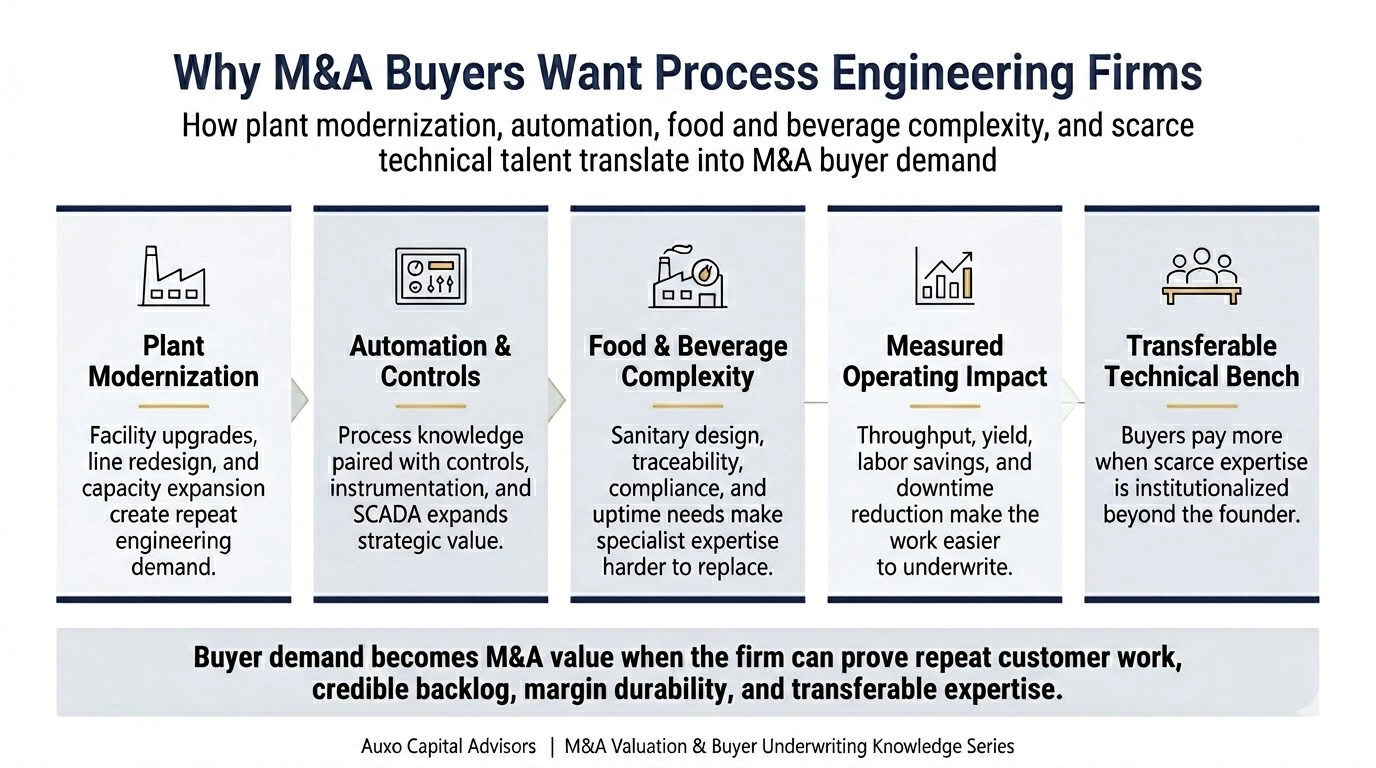
The key point for sellers is that market demand must be proven inside the company’s own data. Buyers will look for repeat customer work, credible backlog, margin durability, documented project outcomes, and technical expertise that is institutionalized beyond the founder.
Definitions that matter in live transactions
Process engineering firms are engineering businesses focused on the design, optimization, and modification of production processes in industrial and food/process environments. In buyer terms, they are often attractive because they sit close to throughput, quality, safety, and cost outcomes rather than purely architectural or administrative work.
Buyer demand is not just interest in the service category. It refers to real acquisition appetite from strategic buyers, private equity-backed platforms, or consolidators seeking scarce technical capability, cross-sell opportunities, and resilient cash flow. Auxo’s overview of who buys AEC firms provides the broader landscape.
Underwriting is the buyer’s process of converting a market narrative into a risk-adjusted view of earnings durability, growth quality, and post-close integration value. In process engineering transactions, underwriting usually tests the firm’s technical bench, backlog, repeat work, concentration, founder dependency, and measured customer outcomes.
Service demand is not the same as buyer demand
Many searches for process engineering firms, process engineering consulting, industrial engineering consulting firms, manufacturing engineering companies, food processing engineering firms, automation engineering, and instrumentation engineering firms are service-discovery searches. A plant operator may be looking for a provider. A manufacturer may be looking for production support. A facility leader may be looking for help with controls, line design, or process optimization.
In M&A, that service demand only becomes buyer demand when it points to durable economics. Acquirers want to know whether the firm has a repeatable right to win this work, whether customers come back, whether the work carries attractive margins, whether the technical capability is institutionalized, and whether demand can survive after the founder or senior technical lead steps back.
| Service-market signal | M&A buyer translation |
|---|---|
| Customers search for process engineering support | Buyers ask whether the firm has a differentiated niche or is competing as a replaceable provider. |
| Manufacturers need process optimization | Buyers ask whether the work creates measurable ROI, repeat projects, and pricing power. |
| Food processing facilities need specialized engineering | Buyers ask whether regulated-facility expertise creates stickiness and defensible margins. |
| Automation and controls needs are rising | Buyers ask whether controls capability is real, repeatable, and supported by a technical bench. |
| Technical talent is scarce | Buyers ask whether scarcity creates a moat or creates key-person dependency risk. |
The practical distinction is important. Market demand for process engineering providers can create buyer interest, but buyers still underwrite whether that demand creates transferable earnings. That is the lens owners should use before assuming market demand will automatically produce a premium sale outcome.
The market drivers increasing buyer demand for process engineering firms
1. Regulation and compliance are pushing technical work into specialist hands
Facilities operating under food safety, environmental, process safety, and traceability expectations cannot rely on generalized engineering support alone. They need firms that understand line design, sanitary risk, utility interfaces, process hazards, and operational constraints in regulated environments. That is especially true for food processing engineering firms serving facilities where design choices can affect contamination risk, washdown requirements, changeover times, and audit exposure.
From an acquirer’s perspective, regulated work is attractive when the capability is proven and difficult to replace. It can also support repeat business because once a client trusts a firm in a compliance-sensitive setting, the relationship often extends beyond the initial project.
2. Sustainability and decarbonization spending is creating measurable ROI assignments
Energy, water, waste, and emissions initiatives matter because they increasingly require process redesign rather than superficial equipment changes. Buyers respond well to firms that can show utility optimization, heat recovery, waste reduction, or process-intensity improvements tied to client savings. This is not just an ESG talking point. It is attractive because cost savings can usually be quantified, making the project outcome easier to underwrite.
When a process engineering practice can consistently point to reductions in energy intensity, product loss, or utility cost per unit, buyer confidence in pricing power and growth durability usually improves. Similar dynamics are visible in adjacent infrastructure-heavy niches such as water engineering demand, where regulation and efficiency also reinforce specialized relevance.
3. Digitalization and IIoT matter because they change operations, not because they are fashionable
Automation, controls, and data visibility are frequently cited as demand drivers, but acquirers are not paying a premium for buzzwords. They are paying for firms that can convert instrumentation, controls architecture, and process knowledge into real gains in uptime, labor productivity, throughput consistency, or remote visibility. That is why process engineering capability often becomes more valuable when paired with credible controls depth, as reflected in adjacent specialty themes like instrumentation and controls engineering firms.
For founder-led sellers, the implication is clear: the more your work can be described in operating outcomes rather than technology categories, the stronger the transaction story becomes.
4. Supply-chain resilience and reshoring are creating plant redesign work, not just new construction volume
Manufacturers and processors responding to supply uncertainty are adding regional capacity, reconfiguring lines, diversifying production flows, and adjusting facility layouts to accommodate new sourcing realities. That often creates a mix of brownfield modifications, phased expansions, and process optimization projects where specialist engineering firms are preferred over generalists.
Buyers like this work when it creates multi-project relationships and backlog visibility, not when it produces a temporary spike in one-off assignments. This is where diligence often circles back to backlog quality: is the pipeline broad, repeatable, and diversified, or is it simply the byproduct of a few unusually active clients?
5. Persistent cost pressure is forcing companies to pay for productivity gains
At many facilities, margin pressure is too severe to ignore process inefficiency. A project that raises yield, reduces scrap, shortens cleaning cycles, improves line balance, or increases uptime has a more immediate economic case than broad strategic transformation language. This is one reason process engineering consulting remains attractive even in uneven capital spending cycles: the work is often justified by margin preservation, not by discretionary experimentation.
For acquirers, that operating leverage matters. It suggests the target’s services are closer to mission-critical economics and therefore less exposed to simple fee compression.
6. Food and beverage complexity remains a distinct buyer magnet
Food and beverage facilities combine sanitary design, traceability expectations, product variability, labor sensitivity, packaging coordination, and uptime demands in ways that reward specialist firms. Buyers often view these practices favorably because domain expertise compounds over time. A firm that understands washdown zones, allergen segregation, thermal processes, CIP systems, filling lines, and production changeovers has a defensible market position that broad engineering providers rarely replicate quickly.
That does not make every food-focused practice premium-valued by default. It does mean the specialization is legible to the market, and legibility matters in competitive sale processes.
Where demand for process engineering firms is strongest
Demand for process engineering firms is not evenly distributed across every industrial market. Buyers tend to become more interested when a firm serves environments where engineering decisions affect production uptime, compliance, throughput, product quality, labor efficiency, or plant-level economics. That is why food and beverage, industrial processing, packaging, specialty manufacturing, and automation-heavy production environments often receive more attention than broad, low-differentiation engineering support.
| End market or use case | Why demand is increasing | What buyers want to see |
|---|---|---|
| Food and beverage processing | Sanitary design, traceability, capacity expansion, line modification, quality control, and uptime pressure create recurring facility needs. | Repeat work, customer stickiness, regulated-facility expertise, and documented project outcomes. |
| Industrial processing | Plants need process optimization, debottlenecking, utility efficiency, safety improvements, and modernization without prolonged downtime. | Technical depth, strong execution history, margin discipline, and a credible bench beyond the founder. |
| Manufacturing process optimization | Manufacturers are under pressure to improve throughput, reduce scrap, shorten changeovers, and increase labor productivity. | Measurable ROI, project-level margin data, repeat-customer activity, and outcome-based case studies. |
| Automation-heavy facilities | Legacy facilities need better instrumentation, controls, data visibility, and process automation to reduce labor dependence and improve reliability. | Controls integration depth, SCADA/PLC/DCS familiarity, repeat deployment history, and team continuity. |
| Packaging and specialty manufacturing | Complex production lines require flexible layouts, line balancing, quality-sensitive workflows, and faster product changeovers. | Specialized process knowledge, customer concentration discipline, and evidence that the work repeats across facilities or programs. |
The M&A implication is that buyers do not reward end-market exposure by label alone. Food processing, manufacturing process optimization, automation, and industrial processing exposure matter most when they create recurring demand, technical scarcity, and a more defensible revenue base. For owners, the goal is to show that the firm’s end-market exposure is more than a list of served industries; it is a source of durable buyer confidence.
How process engineering demand translates into M&A value
Strong demand for process engineering firms becomes most valuable in M&A when buyers can connect market need to durable earnings. A buyer is not simply asking whether manufacturers, food processors, or industrial operators need process engineering support. The buyer is asking whether a specific firm has a repeatable right to capture that demand after closing.
That distinction matters because many process engineering firms benefit from the same broad demand drivers, but not all of them convert those drivers into the same acquisition profile. A firm with recurring plant-support work, strong food and beverage expertise, documented manufacturing process optimization results, credible automation and controls integration, and a transferable technical bench can underwrite very differently from a firm that relies on one-off projects and founder-held relationships.
| Demand signal | What buyers want to prove | How it can affect M&A value |
|---|---|---|
| Plant modernization | Whether modernization work is recurring across customers, facilities, and phased capital programs. | Can support stronger backlog visibility and buyer confidence in future revenue. |
| Manufacturing process optimization | Whether the firm can document measurable gains in throughput, yield, uptime, waste reduction, labor efficiency, or changeover speed. | Can make the firm more strategic because the engineering work is tied directly to customer economics. |
| Food processing expertise | Whether sanitary design, traceability, compliance, line modification, and regulated-facility know-how create customer stickiness. | Can support scarcity value when expertise is visible in repeat relationships and defensible margins. |
| Automation and controls integration | Whether process knowledge is paired with instrumentation, controls, SCADA, PLC, DCS, or automation capability that is commercially embedded. | Can expand strategic buyer interest and improve cross-sell relevance when the capability is institutionalized. |
| Scarce technical talent | Whether talent scarcity creates a moat or creates dependency on a few key engineers. | Can improve value when the bench is deep, but can reduce value when the firm is too dependent on one or two people. |
For sellers, the practical goal is to prove that demand is not just external. It should be visible inside the company’s own revenue mix, backlog quality, project margins, repeat-customer behavior, and team depth. That is why demand-side positioning should be coordinated with the valuation framework in Auxo’s industrial process engineering firm valuation guide and the acquisition-screening criteria in what buyers look for in industrial engineering firms.
The capabilities buyers underwrite behind the demand narrative
Once a buyer accepts that the end markets are attractive, the analysis shifts from market story to firm-specific proof. The central question becomes whether the target has the right technical and commercial architecture to keep winning.
Technical scope that reaches into plant-critical decisions
Buyers assign more value to firms whose engineering scope touches bottlenecks, compliance, controls, utility integration, line performance, and process reliability. A practice limited to commoditized drafting support or narrow overflow labor will rarely receive the same response as one engaged in core process design and operational improvement.
Delivery models that are repeatable, not purely bespoke
Even specialist work should show some delivery consistency: recurring workstreams, reusable scope templates, standard design modules, benchmark KPIs, and repeatable client reporting. Repeatability lowers execution risk and makes growth look more scalable.
Measured ROI that can survive diligence
If management says projects improved throughput or reduced downtime, buyers will ask how that was measured, who validated it, and whether it can be demonstrated across multiple projects. Case studies that tie engineering scope to line speed, scrap reduction, labor savings, energy savings, or uptime improvement are much stronger than generic client testimonials.
Sector concentration that reflects expertise rather than fragility
There is a difference between healthy specialization and dangerous concentration. A food-processing specialist can be very attractive. A firm dependent on two customers and one plant manager relationship is not. Buyers make that distinction quickly, often using the same risk lens they apply in adjacent topics such as project concentration risk and founder dependency risk.
Talent depth that extends beyond the founder and one or two stars
Scarce expertise helps valuation, but only if the expertise is institutionalized. If the entire client proposition depends on the founder’s technical judgment or a single lead engineer, buyers will reprice the opportunity through rollover demands, earnouts, retention packages, or lower headline valuation. Scarcity creates upside only when the bench is real.
Why scarce technical expertise can increase value or increase risk
Scarce technical expertise is one of the clearest reasons process engineering firms attract buyer interest. In markets where qualified process engineers, controls specialists, food processing experts, and manufacturing optimization talent are difficult to recruit, acquiring a specialized firm can be faster than building the capability internally. That scarcity can expand buyer appetite, especially when the firm gives a strategic acquirer or private equity-backed platform access to customers, technical talent, and repeatable process knowledge.
But scarcity cuts both ways. If the scarce expertise is concentrated in the founder or one senior engineer, buyers may view the same capability as a retention risk. The question is whether the firm owns a transferable capability or whether a few individuals own the buyer’s real reason for interest.
| Technical scarcity profile | Buyer interpretation | Likely deal impact |
|---|---|---|
| Deep bench across process, controls, and project leadership | The capability looks institutional and scalable. | Stronger buyer confidence and cleaner valuation support. |
| Specialization concentrated in the founder | The buyer may not be acquiring the full capability without a transition dependency. | More rollover, earnout, employment agreement, or retention structure. |
| One or two key engineers own the technical edge | The business may be fragile if those people leave after closing. | Key-person diligence, retention packages, and possible valuation discount. |
| Documented playbooks and repeat delivery methods | The firm’s know-how is easier to transfer and scale. | Improved integration confidence and stronger strategic fit. |
For founders, the practical takeaway is to institutionalize the scarcity before going to market. Documenting methods, training younger engineers, distributing client relationships, and showing repeatable project execution can turn scarce expertise from a buyer concern into a buyer advantage.
The seller evidence that turns demand into a premium story
In most founder-led firms, the underlying value is stronger than the presentation. Buyers may be interested in the capability, but they still need data that converts technical relevance into underwritable earnings. The most effective sellers prepare evidence in the language buyers use to allocate capital.
KPI dashboard buyers can trust
A useful diligence package usually includes project margin by type, utilization trends, repeat-customer revenue, average project duration, proposal win rates, backlog aging, write-offs, schedule adherence, and revenue by engineer level or service line. Where possible, founders should also show a small set of client-outcome KPIs such as throughput gains, cycle time reductions, scrap reduction, downtime reduction, or utility savings achieved on representative projects.
Contract structure that supports earnings durability
Buyers look closely at fee arrangements, change-order behavior, milestone billing, retention terms, and service or maintenance components. Engagements that reduce working-capital strain and reward scoped technical value tend to underwrite better than loosely defined projects with chronic collection drag. That is one reason topics like working capital risk in engineering firms matter even when the demand story is strong.
Case studies built for diligence, not marketing
Most firms have project summaries. Far fewer have buyer-ready case studies. The difference is material. A diligence-ready case study should identify the client environment, operational issue, engineering scope, implementation complexity, measurable result, time to benefit, and whether follow-on work was awarded. Buyers are trying to determine whether success was repeatable or accidental.
Delivery playbooks and institutional knowledge capture
If the firm has recurring methods for line assessments, process bottleneck analysis, controls integration, hygienic design reviews, commissioning, startup support, or optimization audits, those should be documented. The more the target can show institutional process rather than artisan dependence, the stronger the risk-adjusted value story becomes.
Where buyer enthusiasm gets repriced during diligence
Demand can attract bidders, but diligence determines whether enthusiasm survives. Process engineering firms most often lose valuation support when buyers conclude that the business is narrower, less repeatable, or more founder-dependent than the initial narrative suggested.
Founder dependence disguised as specialization
Many attractive firms are initially marketed as scarce specialists. During diligence, that may turn into a concern that only the founder can scope work, win key accounts, or supervise technically sensitive assignments. Once that shift happens, buyers rarely ignore it. They change structure, ask for longer transition commitments, or lower risk-adjusted value.
Backlog that looks full but lacks quality
Volume is not the same as quality. Buyers want to know whether backlog consists of profitable work with credible realization, diversified counterparties, and manageable execution risk. A backlog of underpriced, labor-heavy, or unclearly scoped projects can weaken the story even when the top line looks strong. That is exactly why backlog quality analysis carries so much weight.
Outcome claims that cannot be substantiated
If management repeatedly says its work improves efficiency but cannot show measured outcomes, buyers begin to treat those claims as marketing language rather than underwriting evidence. The premium often goes to the firm with fewer claims but stronger proof.
Concentration hidden inside specialization
A firm may appear diversified by project count while remaining highly concentrated by decision-maker, facility network, or industry pocket. Buyers look through those layers quickly. If revenue is effectively controlled by one food conglomerate, one processor, or one sponsor-backed industrial customer, the demand story may still be positive, but the risk discount widens.
Weak commercial controls around engineering delivery
Strong technical firms sometimes underperform in transaction processes because they do not manage project economics tightly enough. Margin leakage, billing slippage, soft scopes, and poor forecast discipline tell buyers that earnings quality may not fully convert to cash. Underwriters then become more conservative, even when they still want the platform.
Common mistakes owners make when describing process engineering demand
Owners often know that market demand is strong, but they sometimes describe it in ways that weaken the buyer’s underwriting case. The strongest sale narratives do not simply say that process engineering, automation, food processing, or manufacturing optimization are attractive markets. They show why the seller’s specific firm is positioned to capture that demand repeatedly and profitably.
| Common mistake | Why it weakens the story | Better framing |
|---|---|---|
| Overusing automation language | Buyers may treat it as buzzword-driven unless tied to real controls depth, customer need, and project outcomes. | Show how automation work improves uptime, labor efficiency, throughput, or plant visibility. |
| Claiming food processing exposure without proof | Food processing specialization only matters if it creates repeat work, regulated-facility expertise, and customer stickiness. | Document sanitary design, line modification, traceability, compliance, and recurring facility work. |
| Equating demand with valuation premium | Buyers do not pay more for a market theme unless the company has durable earnings and transferable capability. | Connect demand to backlog quality, margins, customer retention, and team depth. |
| Presenting the firm as a general engineering provider | A broad description can bury the scarce process engineering capability that buyers may value most. | Clarify where the firm is genuinely specialized and why that specialization matters commercially. |
| Ignoring founder or key-person dependency | Specialization can look fragile if customer trust and technical authority sit with one person. | Show leadership continuity, role distribution, technical bench depth, and succession coverage. |
The strongest positioning is specific, evidence-based, and buyer-readable. A founder does not need to claim that every market theme is attractive. The better approach is to show which demand drivers the firm actually captures, how that work repeats, and why the capability will remain valuable after a transaction.
Worked comparison: specialist process engineering firm versus broad generalist
Consider two founder-led firms with similar headline scale. Each generates approximately $12 million of revenue and $2.2 million of normalized EBITDA. On paper, the businesses can look comparable. In a live process, buyers often treat them very differently.
| Attribute | Specialist process engineering firm | Broad generalist engineering firm |
|---|---|---|
| End markets | Food processing, packaging, industrial flow systems | Mixed industrial drafting and general facility support |
| Value proposition | Measured throughput, yield, and compliance improvement | Responsive engineering labor and project support |
| Repeat revenue profile | High repeat customer base with multi-phase assignments | Lower repeatability, more one-off projects |
| Technical bench | Documented team depth across process and controls | Broader but less differentiated staffing mix |
| Backlog profile | Diversified and tied to active plant improvement programs | Less visible, more opportunistic project intake |
| Buyer interpretation | Scarce, strategic, cross-sell capable platform or tuck-in | Useful revenue base but more commoditized and replaceable |
| Likely valuation implication | Stronger buyer competition and more support for premium positioning | More range compression and greater diligence sensitivity |
The lesson is not that every specialist automatically commands a superior outcome. It is that buyers pay for how earnings are produced, not just how much EBITDA exists today. If the specialist firm can show that its enterprise value is supported by recurring plant-critical demand, the bridge from enterprise value to actual purchase price is more likely to hold together through diligence. The generalist may still sell well, but more of its economics may be exposed to negotiation around risk, retention, and post-close support. Readers looking for the broader numeric context can use Auxo’s engineering valuation multiples page and the more specific coordinated discussion on industrial process engineering firm valuation.
It is also worth separating enterprise value from seller proceeds. Even when a process specialist supports a stronger headline multiple, cash at close can still move based on working capital targets, net debt, retention packages, earnouts, and founder transition terms. That is another reason owners should avoid translating market demand directly into expected personal proceeds without transaction-level analysis.
Seller takeaway
High market demand is not a substitute for sale readiness. Founders create the most leverage when they can prove that their process engineering capability is specialized, repeatable, and institutionalized. The market may already want the category, but buyers still need confidence that earnings do not depend on a handful of relationships, undocumented know-how, or weak commercial controls.
The practical objective is to make your differentiation easy to underwrite. Prepare backlog segmentation, margin-by-project analysis, repeat-customer data, outcome-oriented case studies, and a clear map of technical bench depth. If your firm’s appeal comes from food/process expertise, instrumentation integration, or plant optimization know-how, package it in buyer language before going to market.
What process engineering sellers should prepare before buyer outreach
Founders should not wait until diligence to organize the evidence behind the demand story. If process engineering firms are in high demand because of plant modernization, automation, compliance, manufacturing process optimization, food processing complexity, and scarce technical talent, then buyers will expect sellers to prove those themes in the company’s own data.
| Preparation area | What to organize | Why it matters to buyers |
|---|---|---|
| Revenue by capability | Revenue and gross margin by process engineering, manufacturing process optimization, food processing, automation, controls, instrumentation, and related service areas. | Shows whether demand is tied to real specialization or broad service language. |
| Repeat-customer evidence | Customer history, repeat assignments, multi-site work, phased plant upgrades, MSAs, and recurring facility-support relationships. | Helps buyers determine whether demand is durable and transferable after closing. |
| Outcome-based case studies | Project examples showing throughput gains, uptime improvement, yield improvement, downtime reduction, labor savings, compliance outcomes, or utility savings. | Converts technical capability into measurable customer economics. |
| Backlog and pipeline quality | Signed backlog, awarded work, pipeline categories, expected timing, project margins, staffing needs, and customer-level visibility. | Allows buyers to test whether current demand will convert into revenue, EBITDA, and cash. |
| Technical bench depth | Key engineers, controls specialists, project managers, technical reviewers, relationship owners, succession coverage, and retention plans. | Shows whether scarce expertise is institutionalized or dependent on the founder and a few key people. |
| Commercial controls | Pricing discipline, change-order history, billing cadence, project margin controls, utilization, WIP, and working-capital trends. | Helps buyers determine whether demand converts into durable margins and seller proceeds. |
This preparation is especially important because strong sector demand can create false confidence. Buyers may like the category, but they will still reprice risk if the firm cannot prove repeatability, transferability, backlog quality, and margin durability. Auxo’s sell-side M&A advisory process helps owners turn market demand into a buyer-ready equity story before outreach begins.
What buyers actually focus on
In management conversations, buyers may spend time discussing market themes. In investment committee materials, they focus on whether the target can convert those themes into defendable cash flow. That usually narrows attention to a handful of practical questions.
Is the capability scarce enough to matter?
If the target’s process engineering work can be replicated by other manufacturing engineering companies with limited effort, strategic value compresses. If the target has recognized depth in a complex niche, the strategic logic strengthens considerably.
Does the firm sit close enough to customer economics?
Buyers favor firms whose work affects throughput, quality, compliance, uptime, or labor efficiency. The closer the engineering sits to operating performance, the more resilient pricing and repeat work may be.
Can growth continue without overloading the current team?
Acquirers study hiring capacity, training systems, team composition, and delivery leadership because scarcity cuts both ways. A firm can be highly desirable and still difficult to scale if technical expertise is too thinly distributed.
How reliable is the backlog and customer base?
Backlog is attractive only if it reflects profitable, executable work. Buyers also examine client concentration, facility concentration, repeat assignment history, and whether project wins are tied to institutional relationships or founder charisma.
Will the integration create more value than the buyer is paying for?
Strategic acquirers may see cross-sell opportunities into existing industrial accounts. Private equity-backed buyers may see platform expansion, professionalization, and add-on potential. But both groups still pressure-test whether the target’s capability will hold up after integration. Auxo’s review of private equity underwriting for AEC firms is helpful context here because it shows how enthusiasm is filtered through return discipline.
Why process, positioning, and advisor discipline change the outcome
When demand for a subsector is strong, owners sometimes assume the market will recognize value automatically. In reality, attractive subsectors often make process quality more important, not less important. Buyers move quickly toward the same targets, compare them aggressively, and use diligence to separate scarce platforms from merely well-positioned stories.
Advisory discipline matters because the seller’s job is not just to attract interest. It is to frame the firm in the right buyer universe, present capability in underwriting terms, anticipate where diligence will challenge the narrative, and preserve competitive tension when bids begin to diverge on structure rather than headline price. That is where a purposeful sell-side M&A advisory process can materially affect outcome.
For process engineering firms, the positioning work is especially important. The firm may look like a general engineering practice in a superficial CIM, but like a scarce specialist when the story is organized around technical depth, plant-critical roles, client ROI, and repeatable end-market relevance. The difference between those two presentations can alter buyer mix, management meeting quality, and the amount of price erosion buyers attempt later in the process.
Frequently asked questions
Why are process engineering firms in high demand right now?
Because manufacturers and processors are facing simultaneous pressure to improve efficiency, automate operations, meet compliance requirements, reduce labor dependence, and expand or reconfigure capacity. Process engineering firms are often brought in where these pressures intersect and where plant-level economics are directly affected.
What industries most often need process engineering firms?
Demand is strongest in food and beverage, industrial processing, chemicals, packaging, specialty manufacturing, and other process-intensive environments where throughput, sanitary design, process safety, utility optimization, and controls integration matter.
What is the difference between process engineering and general industrial engineering?
Process engineering is typically more focused on how materials, fluids, thermal systems, controls, and production flow operate inside a plant environment. General industrial engineering can be broader and may not always involve the same depth of process-specific operational impact or regulated facility complexity.
Why do buyers value process engineering capability so highly?
Because the capability is often scarce, tied to critical customer operations, and difficult to replace quickly. When a firm can improve uptime, yield, compliance, or cost performance, buyers often view the revenue as more strategic and less commoditized.
How does automation affect demand for process engineering firms?
Automation increases demand when it requires integration between controls, instrumentation, process flow, facility constraints, and operating outcomes. Buyers reward firms that can bridge process engineering and automation execution in a way that produces measurable plant performance gains.
Why are food and beverage facilities an important market for process engineering firms?
Food and beverage environments combine sanitary design, traceability, cleaning requirements, production variability, and uptime sensitivity. That creates a strong need for specialist engineering firms with domain experience rather than broad engineering providers without food/process depth.
What makes a process engineering firm more attractive in a sale process?
Technical specialization, repeat customers, credible backlog, strong project margins, outcome-based case studies, and a management team that extends beyond the founder all improve buyer confidence and can strengthen valuation support.
How does technical specialization affect buyer interest?
Specialization can expand buyer appetite when it is connected to a niche that is commercially attractive and difficult to staff. It can reduce buyer interest if the specialization is too narrow, too customer-concentrated, or too dependent on one person.
Do process engineering firms command stronger valuation multiples?
They can, but only when the specialization is underwritable. Buyers may support better pricing for firms with strong demand drivers, defensible capability, and durable earnings, but premiums are not automatic and should be considered in the broader context of risk, structure, and market process.
What do buyers underwrite most carefully in a process engineering firm?
Usually technical bench depth, customer concentration, repeatability of work, backlog quality, founder dependency, project margin consistency, and evidence that client outcomes are real and reproducible.
How can a founder prepare a process engineering firm for sale?
Start by documenting normalized earnings, backlog quality, repeat-client economics, team depth, project-level margins, and measurable client outcomes. Then organize the firm’s equity story around why its technical niche is scarce, durable, and transferable.
When should an owner talk to an M&A advisor about market demand?
Usually before launching a process, not after inbound interest appears. Early advisory work helps a founder determine whether current demand is broad enough to create real competitive tension and what preparation is needed to convert market interest into valuation leverage.
Media & press inquiries
Auxo Capital Advisors regularly comments on lower-middle-market M&A, buyer underwriting, engineering sector valuation, and founder-led sell-side preparation. Journalists, editors, podcasters, and event organizers covering engineering, industrial services, private equity, or transaction trends are welcome to reach out.
For media and press inquiries, contact info@auxocapitaladvisors.com. Please include your outlet, topic, deadline, and any relevant interview context so the request can be routed efficiently.
Disclosure
This article is provided for general informational purposes only and reflects Auxo Capital Advisors’ editorial perspective on buyer behavior, valuation drivers, and transaction dynamics in the engineering and AEC market. It is not legal, tax, accounting, investment, or valuation advice, and it should not be relied upon as a substitute for transaction-specific professional guidance.
Any examples, scenarios, and comparative observations in this article are illustrative only. Actual transaction outcomes depend on many factors, including diligence findings, normalized earnings, working capital mechanics, customer concentration, management continuity, financing markets, legal terms, tax structuring, and the objectives of specific buyers and sellers. Market demand for a subsector does not guarantee a particular valuation range, deal structure, or closing outcome.


