

How Industrial & Process Engineering Firms Are Valued in M&A
Updated for founder-led and middle-market industrial engineering firms, process engineering firms, manufacturing engineering companies, food processing engineering specialists, instrumentation engineering firms, and owners evaluating how buyers translate technical specialization, recurring work, backlog quality, margin durability, and leadership continuity into enterprise value, deal structure, and seller proceeds.
Key answer: Industrial and process engineering firms are typically valued using normalized EBITDA as the starting point, but the multiple buyers apply depends on the quality and transferability of the earnings. Buyers underwrite specialization, end-market exposure, recurring or repeat customer work, backlog convertibility, utilization discipline, margin stability, automation and controls depth, customer concentration, and key-person risk before deciding whether the firm deserves a premium, a discount, or more protective deal structure.
Why it matters: Two firms with similar EBITDA can produce very different sale outcomes. A process engineering firm with repeat plant-support work, credible backlog, diversified customer relationships, strong project controls, and a transferable management bench may attract broader buyer interest and stronger multiple support. A similar-sized firm with episodic project work, weak backlog documentation, founder-dependent customer relationships, or volatile margins may still sell, but buyers often shift risk into earnouts, escrows, rollover, or purchase-price adjustments.
For broader valuation context, owners should read this article alongside Auxo’s AEC valuation guide, engineering firm valuation multiples, and who buys AEC firms. For owners preparing for an actual process, the bridge from valuation theory to buyer positioning is where sell-side M&A advisory becomes material.
This guide focuses on how acquirers value founder-led and middle-market industrial and process engineering firms in an M&A context, and why technical capability only supports stronger value when it creates underwriteable earnings. The practical issue is whether process expertise, manufacturing engineering depth, food processing specialization, automation capability, or instrumentation and controls work can be tied to durable EBITDA rather than treated as descriptive service language.
Owners, buyers, and advisors often use overlapping language when discussing this segment, including industrial process engineering firm valuation, process engineering firms, industrial engineering consulting firms, manufacturing engineering companies, food processing engineering firms, instrumentation engineering firms, automation controls, and engineering firm EBITDA multiples. This guide uses those terms as valuation and buyer-underwriting context. The core question is how those capabilities influence normalized EBITDA, multiple support, enterprise value, purchase-price structure, and seller proceeds.
Readers who want the demand-side context should also review Auxo’s article on why process engineering firms are in high demand. Readers focused on acquisition screening should compare this valuation framework with what buyers look for in industrial engineering firms and instrumentation and controls engineering firms.
Transaction context: this guide explains how buyers convert operating quality into valuation for industrial and process engineering firms: what EBITDA they trust, what multiple they apply, what risks they structure around, and how headline enterprise value becomes actual seller proceeds. In a sale process, the premium case is strongest when specialization is tied to repeat plant work, credible backlog, margin durability, and technical capability that remains transferable after the founder steps back.
Valuation should be read as a risk-adjusted view of future cash flow quality. Specialization, end-market exposure, food and beverage or industrial process expertise, automation and instrumentation capability, repeat customer work, backlog visibility, utilization, margin quality, working capital, and leadership continuity all matter because they affect how confidently a buyer can underwrite post-close earnings.
This guide should be read alongside Auxo’s related industrial and process engineering resources: why process engineering firms are in high demand, what buyers look for in industrial engineering firms, and instrumentation and controls engineering firms. Those resources connect demand, buyer criteria, instrumentation and controls capability, and subsegment structure to the valuation mechanics discussed here.
For broader market context, owners should also use Auxo’s AEC valuation guide, engineering firm valuation multiples, private equity underwriting for AEC firms, and backlog quality in AEC M&A to understand the broader valuation and diligence mechanics that support this guide.
Industrial and process engineering is valued on durability, not just technical credentials
Founders in this segment often know, correctly, that their firms are more specialized than a general engineering practice. They may serve food and beverage facilities, chemical and process environments, advanced manufacturing plants, instrumentation-heavy facilities, or automation-driven retrofit programs. They may hold valuable process knowledge, a strong compliance mindset, or unusually sticky client relationships. The issue in a sale process is not whether that expertise is real. The issue is whether a buyer can underwrite that expertise as durable economic value.
That distinction is where pricing separates. A sophisticated buyer asks whether specialization leads to better win rates, premium billing, lower project execution risk, repeat assignments, and strategic expansion potential inside an existing platform. If the answer is yes, the firm may command a stronger multiple and cleaner structure. If the answer is less clear, the same specialization may be treated as founder-centric know-how that raises diligence concerns rather than value. The rest of this article explains how that judgment is made, where valuation ranges usually move, and what seller-side preparation changes the conversation.
Executive summary
Most industrial and process engineering firms are valued from the middle outward. Buyers start with normalized EBITDA, frame an initial multiple range from comparable technical-services businesses, then move value up or down based on specialization, end-market mix, backlog convertibility, margin consistency, concentration, and management depth. They then use transaction structure to absorb the risks they do not want to pay for upfront.
In that sense, valuation is not a static market quote. It is a negotiated view of cash flow durability. A firm with recurring plant optimization work, strong instrumentation and controls capability, balanced customer exposure, and clean reporting can attract a materially different process than a similarly sized firm that relies on a handful of episodic capital projects led personally by the founder. Understanding that gap helps owners interpret both multiple ranges and actual offers more realistically.
Key takeaways
- Normalized EBITDA remains the primary valuation anchor, but reported earnings in founder-led firms often need material adjustment before a buyer accepts them.
- Specialization only supports a premium when it is transferable, repeatable, and visible in margins, client retention, or strategic relevance.
- Backlog matters, but buyers distinguish sharply between awarded, contracted, funded, billable, and realistically convertible backlog.
- Instrumentation, controls, and automation capability can raise value when it broadens wallet share and embeds the firm deeper in plant operations; it does not create a premium automatically.
- Food processing and other regulated environments can support better resilience if customer relationships are recurring and compliance-driven, but customer concentration or capex cyclicality can offset that benefit.
- Enterprise value and seller proceeds are not the same number; debt, working-capital adjustments, escrows, and contingent payments often explain the gap.
The valuation architecture buyers apply to this niche
| Step | What buyers test | Why it changes value |
|---|---|---|
| 1. Normalize earnings | Owner comp, discretionary spend, one-time costs, true delivery margins | Defines the earnings base on which all multiples are applied |
| 2. Assess revenue durability | Repeat work, master service agreements, client retention, backlog convertibility | Determines whether current EBITDA deserves a premium or a discount |
| 3. Evaluate specialization | Technical depth, subsegment positioning, instrumentation/automation integration | Supports strategic relevance and margin defense |
| 4. Reprice risk | Concentration, founder dependence, labor depth, claims or warranty exposure | Moves economics from price to earnout, escrow, or retention design |
| 5. Bridge EV to proceeds | Debt, working capital, cash, transaction adjustments | Converts valuation into actual seller economics |
This framework is useful because it separates valuation mechanics from valuation support. Many owners spend too much time debating the “right” market multiple before proving the firm deserves to sit at the top half of any range. In live processes, the burden is not just to state why the business is specialized, but to show why that specialization reduces underwriting uncertainty and expands buyer confidence.
Industrial and process engineering valuation framework
Buyers do not value industrial and process engineering firms by applying a generic multiple to reported earnings. They move through a valuation bridge: normalizing EBITDA, testing multiple support, estimating enterprise value, applying closing adjustments, and converting headline value into actual seller proceeds.
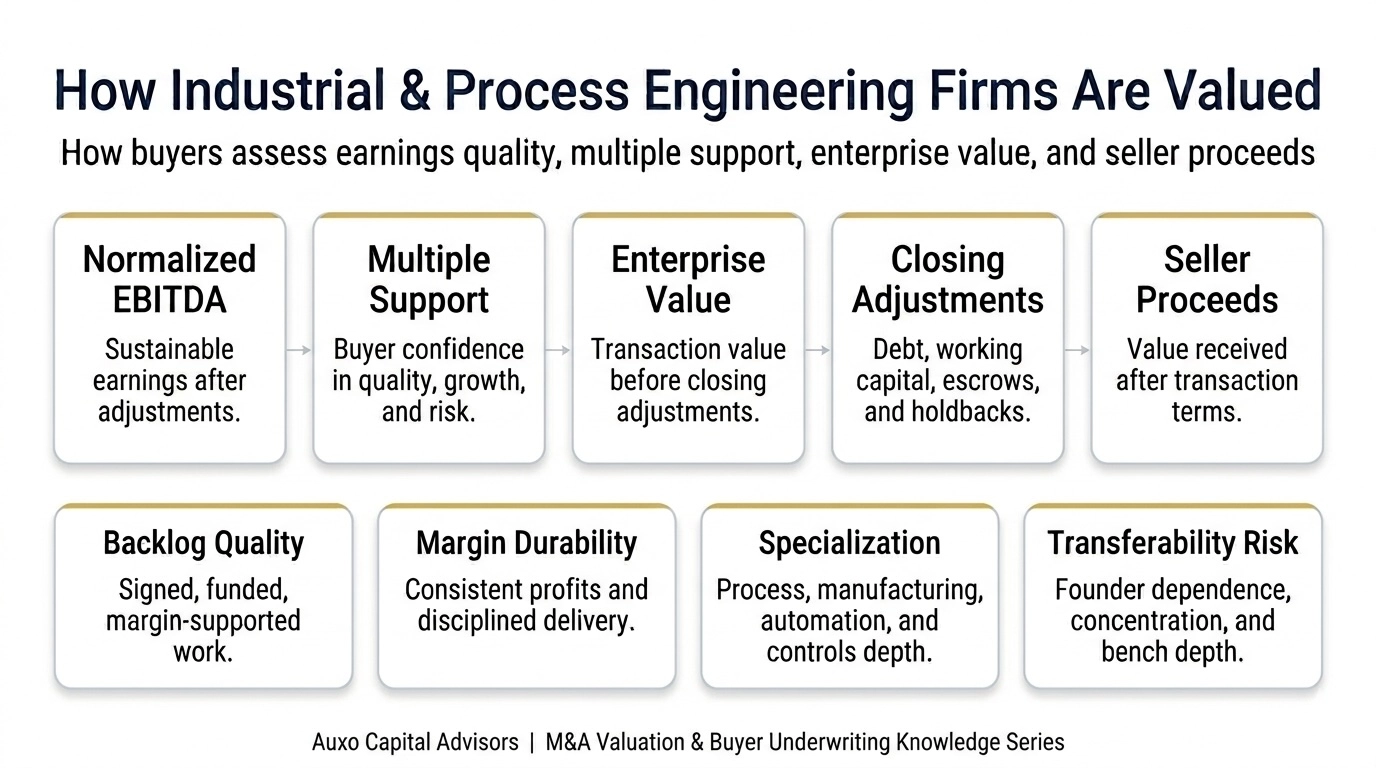
This framework is especially important for founder-led firms because the highest negotiated value is not always the highest realized proceeds. Working capital, debt-like items, escrows, holdbacks, earnouts, and transition risk can all change the difference between headline enterprise value and cash received at closing.
Definitions that matter in live valuation discussions
Enterprise value is the value of the business before subtracting debt or adding excess cash. Equity value is what remains for the seller after debt-like items and other negotiated adjustments are applied. Normalized EBITDA is the earnings base after removing unusual, owner-specific, or non-recurring items and after aligning compensation and operating expenses to how a buyer expects the business to run.
Backlog is not one uniform number. Buyers separate signed backlog from probable pipeline, and they further assess how much of that work is likely to convert on expected timing and margin. Repeat revenue in this niche rarely means SaaS-like recurring revenue; more often it means recurring client demand, recurring facility spend, repeat scopes, or maintenance and optimization work that is highly probable even if not formally contracted long-term.
Normalized EBITDA is the entry point, not the conclusion
For most industrial and process engineering firms, the first major valuation debate is not the multiple. It is the earnings base. Founder-led businesses often carry owner compensation below or above market, absorb travel or personal expenses inconsistently, mix development costs with operating costs, or include project volatility that obscures steady-state profitability. Buyers will rebuild EBITDA from the ground up if they think the reported number does not reflect transferable economics.
That work becomes especially important in firms where principal engineers or founders both sell and deliver. A buyer needs to know which portion of earnings depends on a specific individual’s technical authority or personal relationships. If the firm would need to replace part of that role with a higher-cost hire or additional incentive compensation, normalized EBITDA may be lower than management expects. Conversely, if the business has been run conservatively and carries excess overhead, reported EBITDA may understate real earning power. The underwriting discipline seen across private equity underwriting in AEC shows up here very clearly.
Common EBITDA normalization issues in this segment
- Founder compensation that is not market-based for the role actually performed
- Bonuses or distributions that function as compensation but are booked inconsistently
- One-time ERP, relocation, legal, or facility costs
- Project write-downs that may be non-recurring or, alternatively, evidence of weak execution controls
- Underinvestment in business development, quality systems, or management infrastructure
- Unclear allocation between engineering design labor and non-billable technical oversight
Owners sometimes assume every adjustment that boosts EBITDA will be accepted if it is explained well. That is rarely how buyers respond. They ask whether the cost really disappears post-close, whether the item has occurred more than once, and whether the add-back masks a structural issue such as project leakage or inconsistent pricing discipline. The cleaner the financial story, the easier it becomes to defend the upper end of a value range.
Backlog convertibility and revenue visibility shape confidence in the model
After normalizing earnings, buyers turn to durability. In industrial and process engineering, that usually means reviewing awarded backlog, expected burn rate, booked-vs-unbooked extensions, repeat customer behavior, and the cadence of project awards across the year. A firm may have an impressive stated backlog number but still receive a discount if the work is front-end loaded, margin-uncertain, weakly documented, or too dependent on a handful of capital projects.
By contrast, firms with repeat plant work, facility upgrades, process optimization programs, shutdown support, instrumentation refreshes, or ongoing compliance-driven assignments tend to underwrite better because the buyer can see how demand renews. This is why backlog is better understood as a quality question than a size question. Auxo’s discussion of backlog quality in AEC M&A applies directly here: the central issue is how much future revenue is both visible and credibly profitable.
The backlog metrics buyers usually want
| Metric | Buyer question | Seller implication |
|---|---|---|
| Signed backlog | What work is contractually committed? | Document award status clearly, not just probability |
| Billed vs. unbilled backlog | How much remains to convert into revenue? | Show timing and expected burn by project |
| Gross margin by project type | Is backlog mix consistent with historical profitability? | Separate strong scopes from lower-margin pass-through work |
| Repeat client revenue | How much of next year is likely to come from existing customers? | Track retention and expansion, not just total revenue |
| Utilization by discipline | Can the team deliver backlog without margin erosion? | Show staffing depth by process, mechanical, electrical, and controls capability |
One subtle but important issue is whether the backlog sits with the firm or with the founder. If the lead process engineer personally owns the technical relationship and project scoping, buyers will often underwrite renewal risk more conservatively even when customers are loyal. That dynamic becomes a structure issue quickly, often through employment agreements, retention packages, or deferred consideration.
The operating characteristics that expand or compress EBITDA multiples
There is no single published multiple that reliably covers all industrial and process engineering firms. The market range changes with size, growth, strategic relevance, margin profile, and transferability. Still, buyers generally think in bands. Lower-middle-market firms with weaker visibility, concentrated customers, founder-led delivery, or lumpy project economics may trade at more modest EBITDA multiples. Firms with stronger recurring relationships, clearer niche positioning, professionalized delivery, and broader buyer appeal can move toward the higher end of the range for specialized technical services.
The practical question is not the exact market median; it is what pushes a specific business up or down. The following matrix summarizes the underwriting logic.
| Driver | Supports higher valuation | Creates downward pressure |
|---|---|---|
| Specialization | Clear process expertise tied to repeat demand and defensible pricing | Generalist positioning or specialization tied only to one principal |
| End-market mix | Diverse industrial exposure with resilient spend patterns and attractive niches | Heavy exposure to cyclical capex pauses or one volatile vertical |
| Contract type | Repeat scopes, MSAs, embedded technical support, well-managed T&M or phased engagements | Fixed-fee projects with recurring margin leakage or poorly scoped change orders |
| Technical capability | Integrated process, instrumentation, and controls expertise that widens client wallet share | Capability described broadly but not visible in win rates or margin outcomes |
| Backlog quality | Signed, funded, margin-consistent backlog with repeat-customer overlap | Pipeline-heavy “backlog,” delayed starts, or margin-uncertain project mix |
| Utilization and labor model | Strong utilization with sustainable staffing depth and manageable subcontract reliance | Overloaded key staff, fragile bench, or underutilized specialized teams |
| Management depth | Business development, delivery, and client management distributed across leaders | Founder as primary rainmaker, technical reviewer, and relationship owner |
Illustratively, a small founder-led firm with inconsistent margins and concentrated industrial exposure may attract a mid-single-digit EBITDA multiple, while a larger, better-diversified specialized platform with strong recurring customer relationships and visible growth may support a meaningfully higher band. Those are not fixed market promises; they are underwriting outcomes. Readers looking for a broader frame on multiple dispersion across engineering businesses can use Auxo’s resource on engineering firm valuation multiples as a companion, but industrial and process engineering should be interpreted through the more specific drivers outlined here.
How subsegment examples affect underwriting
Food processing engineering firms can underwrite well when customer relationships are sticky, regulatory or quality requirements create repeat work, and the firm supports line modifications, capacity expansions, sanitation-sensitive design, or operational optimization that recurs over time. The premium weakens if the work is heavily episodic or concentrated in a few processors.
Instrumentation engineering firms often benefit when instrumentation capability is part of a broader plant modernization or controls integration offering. Buyers value the ability to sit deeper in the operating environment, not just the technical label itself.
Automation and controls capability can be especially valuable when it increases share of client spend and supports higher-margin, stickier work streams. But buyers usually distinguish between a true controls-led capability and a firm that occasionally touches controls on projects led elsewhere.
When controls, SCADA, PLC, DCS, or instrumentation capability is central to the thesis, owners should be prepared to show whether the capability is institutionalized or dependent on a small group of key people. Auxo’s article on instrumentation and controls engineering firms explains why this subsegment can create strategic buyer interest when the work is repeatable, technically scarce, and commercially embedded.
How to interpret EBITDA multiple ranges for industrial and process engineering firms
Owners often want a single EBITDA multiple before buyers have finished underwriting the business. That is understandable, but it can be misleading. Industrial and process engineering firms do not receive a higher valuation simply because they operate in a specialized technical niche. They receive stronger multiple support when specialization shows up in repeat customer demand, margin quality, backlog visibility, technical bench depth, and lower transferability risk.
In practice, buyers usually begin with a broad range for engineering and technical-services firms, then move the company up or down based on company-specific evidence. A firm with clean normalized EBITDA, diversified customers, recurring plant-support work, credible backlog, and institutionalized automation or controls capability may support stronger multiple confidence. A firm with similar revenue but weaker reporting, founder-dependent relationships, or episodic project concentration may be valued more conservatively even if the technical work is impressive.
| Multiple pressure point | What supports the higher end | What pulls valuation down |
|---|---|---|
| Earnings quality | Clean normalized EBITDA, limited add-back debate, consistent cash conversion. | Heavy adjustments, unclear owner compensation, project write-downs, or volatile cash flow. |
| Revenue durability | Repeat customers, recurring plant-support work, MSAs, and credible backlog conversion. | One-off capital projects, soft pipeline, or revenue tied to a few large programs. |
| Technical specialization | Process engineering, food processing, automation, instrumentation, or controls capability that is material and repeatable. | Specialization that exists mostly in marketing language or depends on one principal engineer. |
| Management depth | Team-led delivery, distributed customer ownership, and credible technical succession. | Founder as primary rainmaker, reviewer, technical authority, and relationship owner. |
| Buyer fit | Clear strategic adjacency, cross-sell relevance, and scarcity value to likely acquirers. | Narrow buyer universe, low strategic differentiation, or limited integration relevance. |
That is why a multiple range should be treated as a starting framework, not a valuation conclusion. The real question is where the business belongs inside the range after buyer diligence. Owners can use Auxo’s engineering firm valuation multiples resource for broader market context, but industrial and process engineering firms should be judged through the more specific underwriting factors in this article.
How industrial, process, manufacturing, food processing, and controls subsegments affect value
Industrial and process engineering firms often describe themselves using overlapping market language, but buyers do not value every subsegment the same way. The valuation question is not simply whether a firm serves industrial clients. The question is whether the firm’s specialization creates repeat demand, pricing power, technical scarcity, margin resilience, and transferable customer relationships.
This is why a broad industrial engineering consulting firm may trade differently from a process engineering firm embedded in recurring plant-support work, a manufacturing engineering company tied to multi-site production improvement programs, a food processing engineering specialist working in regulated facility environments, or an instrumentation and controls engineering firm with repeatable automation and SCADA-related capability.
| Subsegment | What buyers test | Valuation implication |
|---|---|---|
| Industrial engineering consulting | Whether the firm solves recurring operating, production, process, or facility problems rather than selling one-off advisory support. | Can support solid buyer interest when the work is repeatable, margin-supported, and tied to durable industrial client needs. |
| Process engineering | Whether the firm has specialized capability in process design, optimization, debottlenecking, modernization, or compliance-driven facility work. | Can support stronger multiple confidence when demand is durable and not dependent on a small number of episodic capital projects. |
| Manufacturing engineering | Whether the firm is embedded in production improvement, throughput, reliability, plant modernization, or standards-driven programs. | More valuable when the work repeats across facilities or operating programs rather than depending on isolated projects. |
| Food processing engineering | Whether customer needs are driven by sanitation, compliance, throughput, facility expansion, line modification, or quality-sensitive production environments. | Can create attractive specialization if the customer base is sticky, diversified, and supported by recurring facility needs. |
| Instrumentation and controls | Whether controls, instrumentation, SCADA, PLC, DCS, or automation capability is institutionalized and commercially meaningful. | Can improve strategic fit and scarcity value when supported by technical bench depth, repeat deployment history, and customer stickiness. |
Why food processing and regulated facility exposure can matter
Food processing engineering firms and other regulated-facility specialists can be attractive when the work is tied to recurring sanitation, quality, capacity, compliance, line modification, or facility modernization needs. Buyers often like these niches because customer needs can be operationally critical and less discretionary than generic project work. But the valuation benefit depends on the quality of the customer relationships and the repeatability of the work.
A food processing or regulated-facility angle does not automatically create a premium. Buyers still test whether revenue is diversified, whether customer relationships are transferable, whether margins are consistent, and whether the technical bench can support the work after the founder steps back. The stronger valuation case is built when regulated-facility specialization is visible in repeat work, backlog quality, pricing discipline, and durable customer demand.
For owners, the practical point is that subsegment language should be translated into valuation evidence. A claim of process expertise, automation capability, or food processing specialization only helps value if buyers can see it in revenue mix, margin quality, repeat customer behavior, backlog quality, technical bench depth, and transferability. For related context, see Auxo’s articles on process engineering demand, buyer criteria for industrial engineering firms, and instrumentation and controls engineering firms.
What sellers should not overclaim in valuation discussions
Industrial and process engineering owners sometimes weaken their valuation case by presenting every technical capability as a premium driver. Buyers usually separate real value drivers from descriptive service language. A firm does not earn a stronger multiple simply because it mentions process engineering, automation, instrumentation, controls, food processing, or manufacturing engineering. Those capabilities matter only when they improve the buyer’s view of future earnings quality.
| Seller claim | Buyer follow-up question | What evidence is needed |
|---|---|---|
| “We have process engineering specialization.” | How much revenue and margin actually comes from repeatable process engineering work? | Revenue by capability, repeat project history, margin by scope, and customer examples. |
| “We serve attractive industrial end markets.” | Are those customers recurring, diversified, and resilient through capex cycles? | Customer-level history, backlog, repeat work, and exposure by end market. |
| “We have automation and controls capability.” | Is it a real practice or a few technical people? | Team depth, project examples, standards, deployment history, and retention plans. |
| “Our backlog supports next year.” | What portion is signed, funded, staffed, and margin-supported? | Backlog by contract status, expected burn, margin, customer, and staffing plan. |
| “The founder can transition easily.” | Who owns the relationships, delivery decisions, and technical authority after close? | Org chart, relationship map, succession plan, and customer-facing transition plan. |
The stronger approach is to make fewer claims and support them better. Buyers reward evidence, not labels. A focused valuation story that ties specialization to durable earnings usually performs better than a broad narrative that tries to make every service line sound equally strategic.
How buyers triangulate value across methods
EBITDA multiples tend to anchor conversations in this segment, but sophisticated buyers still triangulate value using several methods. They do so not because each method produces the same answer, but because each method tests the business from a different angle. In a competitive process, that triangulation also shapes negotiation strategy.
Comparable company logic
Public comparables are usually imperfect for lower-middle-market engineering firms, but buyers still use them directionally to frame where specialized technical-services platforms trade relative to growth, margin, and end-market exposure. This method is most useful for setting the outer bounds of valuation logic and understanding how the market prices niche engineering capabilities versus broader professional services. It breaks down when public comps are much larger, more diversified, or structurally different from the target.
Precedent transaction logic
Private transaction evidence often carries more practical weight because it reflects actual control premiums and buyer behavior for specialized firms. Buyers ask what similar engineering or technical-services businesses sold for, what made them attractive, and whether those outcomes were driven by strategic fit, scale, or unique growth angles. Sellers often over-read precedent data by ignoring differences in management depth, concentration, or process quality.
DCF logic
A discounted cash flow model can be useful as a cross-check when recurring revenue visibility is good and management can credibly forecast margin and staffing needs. It is usually less influential in smaller founder-led firms with project-based variability, where assumptions about growth and working capital can shift value sharply. DCF is therefore more often a discipline tool than the lead pricing mechanism in this niche.
Buyer returns logic
Private equity buyers, in particular, also run a returns model. They ask what purchase price still allows an acceptable exit multiple and internal rate of return after considering leverage, future tuck-ins, management investments, and downside scenarios. This is one reason strategic narratives matter. If a buyer sees the firm as a strong platform or an attractive bolt-on, it may justify paying more because post-close synergies or cross-sell potential support the return case.
When these methods are reconciled, the valuation range that survives is usually the one consistent with both market evidence and buyer confidence in earnings durability. That is why owners should not expect DCF, precedent transactions, and comp multiples to line up mechanically. Their role is to build conviction, not to force one formulaic answer.
Where valuation ranges move during diligence
Diligence typically changes value in one of three ways. It can reduce the earnings base, lower the multiple, or leave headline enterprise value intact while shifting economics into escrow, earnout, or retention structures. In industrial and process engineering, the most common pressure points are concentration, key-person dependence, project margin volatility, weak backlog documentation, and underdeveloped middle management.
| Diligence finding | Likely valuation effect | Typical deal response |
|---|---|---|
| Top customer concentration rises above buyer comfort | Multiple compression | Price reduction or contingent structure tied to retention |
| Founder owns technical review and client trust | Risk repricing | Employment agreement, earnout, or rollover expectations |
| Backlog lacks contractual support or margin clarity | Forecast haircut | Lower base valuation or increased scrutiny on NWC target |
| Project write-downs reveal execution inconsistency | Normalized EBITDA reduction | Revised QoE and renegotiation of headline value |
| Strong recurring account behavior across diversified clients | Supports premium valuation | Cleaner LOI and stronger buyer competition |
The lesson for sellers is that many valuation debates are not abstract. They are avoidable diligence conversations. A firm that can show clean project economics, good utilization controls, documented customer recurrence, and a management team beyond the founder usually experiences fewer late-stage repricings. That preparation also improves leverage with the buyer universe described in Auxo’s overview of who buys AEC firms, since different buyer types discount risk differently.
Enterprise value is not the same as seller proceeds
One of the most common misconceptions in engineering-firm transactions is treating a headline multiple as if it represents cash to the seller. It does not. Enterprise value must still be bridged to equity value, and equity value must still be bridged to actual cash at close after debt, debt-like items, working-capital adjustments, escrows, and any contingent consideration are addressed.
Indicative bridge:
Enterprise Value
minus Debt and debt-like items
plus Excess cash, if retained in the deal economics
minus / plus Working-capital adjustment at closing
minus Escrow, holdback, and deferred consideration
equals Seller proceeds at close
For industrial and process engineering firms, working-capital mechanics can matter more than owners expect because receivables timing, WIP treatment, deferred revenue, bonuses, and subcontractor accruals can all affect the final close statement. A strong valuation discussion therefore has to include purchase-price mechanics early, not just a headline EBITDA multiple. This is one reason transaction preparation and representation under a disciplined sell-side M&A advisory process can materially influence realized outcome rather than only nominal value.
Worked underwriting example: from headline multiple to cash at close
Consider a hypothetical industrial/process engineering firm with $3.2 million of reported EBITDA. The business focuses on process optimization and plant upgrades for diversified manufacturing clients, with a meaningful instrumentation and controls capability. It has decent backlog, but the founder still reviews major technical deliverables and two customers represent 34% of revenue.
| Item | Case input | Buyer interpretation |
|---|---|---|
| Reported EBITDA | $3.2 million | Starting point only |
| Add-backs accepted | $0.5 million | Some personal and one-time costs removed |
| Management replacement adjustment | ($0.3 million) | Founder role partly needs institutionalization |
| Normalized EBITDA | $3.4 million | Credible earnings base |
| Initial market multiple | 6.5x | Reflects size and specialized niche |
| Premium for specialization and repeat work | +0.5x | Instrumentation and recurring customer activity help |
| Discount for concentration and founder dependence | (1.0x) | Risk remains material |
| Selected multiple | 6.0x | Balanced underwriting view |
| Enterprise value | $20.4 million | Headline valuation |
| Less debt and debt-like items | ($2.2 million) | Reduces equity value |
| Less closing working-capital shortfall | ($0.8 million) | Below-target NWC at close |
| Less escrow/holdback | ($1.0 million) | Not all proceeds delivered at close |
| Cash at close to seller | $16.4 million | Economic outcome before taxes |
The most important change in this example is not the market multiple itself. It is the interaction between normalized EBITDA, concentration risk, and founder transferability. A seller might focus on the 6.5x “starting” multiple and conclude the buyer is discounting unfairly. The buyer, however, is really saying something more specific: the firm has enough technical depth to earn a premium, but not enough diversification and management independence to receive that premium without adjustment.
This is also where negotiations often turn. If management depth can be demonstrated more convincingly, if concentration is shown to be less risky than it first appears, or if the working-capital profile is prepared carefully before market, the same business may preserve more of the headline enterprise value in actual proceeds. The worked example therefore illustrates a broader point: valuation is rarely lost in one dramatic move; it is often eroded across several underwriting and closing bridges.
Seller takeaway
Owners of industrial and process engineering firms usually improve value most effectively by proving four things before a sale: the earnings are clean, the client relationships are durable, the technical capability is broader than one individual, and the backlog converts predictably into profitable revenue. Those points often matter more than trying to argue for a generic premium multiple based on industry identity alone.
In practical terms, that means tightening financial reporting, documenting recurring customer behavior, clarifying utilization and project economics by discipline, reducing avoidable concentration where possible, and showing that process, instrumentation, automation, and project delivery know-how are institutional rather than purely founder-held. Sellers who prepare around those issues tend to defend price more effectively and face fewer late-stage concessions.
What sellers should prepare before testing valuation
Owners often ask what multiple their industrial or process engineering firm could command before preparing the evidence buyers need to support that multiple. That sequence creates avoidable risk. A stronger valuation discussion starts with a diligence-ready package that helps buyers understand the quality of earnings, backlog, customer relationships, project execution, working capital, technical bench depth, and founder transition plan.
| Preparation area | What to organize | Why it affects valuation |
|---|---|---|
| Normalized EBITDA support | Owner compensation, add-backs, non-recurring costs, project write-downs, bonus practices, and run-rate adjustments. | Defines the earnings base buyers are willing to multiply. |
| Backlog and pipeline quality | Signed backlog, awarded work, pipeline categories, expected burn, project margins, and customer-level visibility. | Determines whether buyers trust near-term revenue and EBITDA visibility. |
| Revenue by subsegment | Revenue and margin by process engineering, industrial consulting, manufacturing engineering, food processing, automation, controls, and instrumentation capability where applicable. | Shows whether specialization is real, profitable, and material enough to support a premium. |
| Customer concentration and repeat work | Top-customer history, repeat customer behavior, relationship ownership, MSAs, recurring plant-support work, and multi-site program evidence. | Helps buyers decide whether revenue durability supports stronger multiple confidence. |
| Project margin and utilization evidence | Gross margin by project type, utilization by discipline, WIP schedules, realization, change-order history, and delivery-risk controls. | Separates sustainable profitability from timing, pricing luck, or underreported execution risk. |
| Leadership and technical bench depth | Organization chart, role clarity, key technical leaders, succession coverage, client ownership, and retention plans. | Determines whether buyers view the earnings as transferable after the founder steps back. |
| Working capital and proceeds bridge | AR, WIP, deferred revenue, billing cadence, subcontractor accruals, retainage, and historical working-capital trends. | Connects headline enterprise value to actual cash proceeds at closing. |
This preparation is especially important when owners want buyers to credit niche specialization or automation and controls capability. A buyer will not usually pay a premium for language alone. The stronger case is built when the financial, operational, and customer evidence all point to durable, transferable earnings. Auxo’s sell-side M&A advisory process is designed to help owners build that valuation case before the market tests it.
What buyers actually focus on
Buyers may ask about technical niches, but they are usually trying to answer a narrower question: why will this business keep producing attractive cash flow after the transaction? In industrial and process engineering, that leads them repeatedly to five areas.
1. Relationship durability
They want to know whether key accounts return because the firm is deeply embedded in plant operations or because the founder is personally trusted. The former supports value; the latter often pushes economics into retention structure.
2. Scope quality
Not all revenue is equal. Buyers separate front-end conceptual work, EPC-adjacent support, optimization work, shutdown support, instrumentation, and controls-related assignments because each has different margin and repeatability characteristics.
3. Team depth
The question is not just whether the team is talented. It is whether the team can sell, manage, and deliver work with enough independence to scale under new ownership.
4. End-market resilience
Exposure to attractive industrial niches can help, but cyclicality, regulatory change, and customer capex behavior still matter. A buyer will underwrite how spending behaves in a downturn, not just what niche names appear in the pitch.
5. Integration relevance
Strategic buyers and platform-backed sponsors also ask whether the firm fills a capability gap, opens a geography, strengthens account coverage, or expands controls and automation content. Those strategic factors can elevate value when they are real and demonstrable.
These are the same themes that often distinguish attractive firms from merely competent ones. They also explain why some specialized process engineering firms draw stronger interest than broader industrial engineering consulting firms of similar size. The issue is not branding; it is underwritten transferability.
For owners who want a more detailed acquisition-screening checklist, Auxo’s companion article on what buyers look for in industrial engineering firms explains how acquirers evaluate specialization, concentration, recurring program work, automation and controls depth, margin quality, and leadership continuity before submitting or revising an offer.
Why process discipline and positioning affect outcome
In this segment, advisory value is rarely about inventing a better number. It is about framing the business in buyer language, controlling the diligence narrative, and preserving leverage as underwriting questions become more detailed. Industrial and process engineering firms are often easy to oversimplify from the outside. A disciplined advisor helps distinguish between commodity project revenue and truly embedded technical relationships, between occasional controls work and real automation capability, and between founder charisma and institutional business quality.
Process quality also matters because these deals frequently turn on nuanced diligence themes: accepted add-backs, customer retention evidence, project margin consistency, management-transition planning, and working-capital normalization. When those issues are anticipated early, the seller has a stronger chance of defending both price and structure. When they are surfaced late, buyers gain leverage quickly. For owners exploring a transaction, Auxo’s approach to sell-side M&A advisory is designed around exactly that problem: translating business quality into competitive buyer tension and better negotiation outcomes rather than leaving value exposed to avoidable repricing.
Frequently asked questions
How are industrial process engineering firms valued?
Most are valued primarily on a normalized EBITDA multiple, supported by transaction evidence, buyer returns analysis, and a cross-check against broader comparable-company logic. The multiple depends on durability of earnings, technical specialization, client concentration, backlog quality, and management depth.
What EBITDA multiple do engineering firms sell for?
There is no single market multiple that applies across all engineering firms. Smaller founder-led firms with concentration or transferability issues may trade in more modest mid-single-digit ranges, while larger, better-diversified specialized firms can support higher outcomes. Industrial and process engineering must be judged by its specific underwriting profile, not broad category averages alone.
What drives a higher valuation for process engineering firms?
Clear niche specialization, repeat customer demand, good margins, diversified accounts, credible backlog, and evidence that work can be won and delivered without the founder all support a stronger valuation. Buyers pay more when risk is lower and growth feels durable.
Do food processing engineering firms command better multiples?
They can, particularly when they serve sticky customers in regulated or compliance-sensitive environments and generate repeat facility work. But food processing exposure alone is not enough; buyers still test customer concentration, margin quality, and how cyclical the project base really is.
How do buyers underwrite automation and instrumentation capability?
Buyers look for evidence that automation, controls, or instrumentation capability is commercially meaningful. They want to see whether it increases project scope, supports better margins, embeds the firm in customer operations, and creates cross-sell opportunities. They do not usually award a premium for technical labels alone.
Does client concentration hurt valuation in engineering firms?
Usually yes, especially when a small number of customers drive a large share of revenue or backlog. Concentration increases earnings risk, which can reduce the multiple, trigger contingent consideration, or increase buyer diligence around contract depth and relationship transferability.
How important is recurring work versus project-based revenue?
Recurring work matters because it improves forecast confidence. In this sector, recurring demand often appears as repeat account work, ongoing plant upgrades, optimization programs, or maintenance-related engineering support rather than subscription-style revenue. Buyers reward visibility and repeatability even when formal contracts are project based.
What financial metrics matter most to buyers of engineering firms?
Normalized EBITDA, gross margin by project type, utilization, backlog quality, customer concentration, working-capital profile, and cash conversion are all important. Buyers also examine revenue mix by service line and discipline to understand how resilient margins are.
How does founder dependence affect value?
Founder dependence can reduce value directly through a lower multiple or indirectly through structure such as earnouts, retention packages, or rollover requirements. Buyers discount businesses where client trust, technical review, and business development are too concentrated in one person.
What is the difference between enterprise value and seller proceeds?
Enterprise value is the value of the business before debt and certain closing adjustments. Seller proceeds are what the owner actually receives after debt, debt-like items, working-capital adjustments, escrows, and deferred payments are taken into account.
Can DCF be used to value an engineering firm?
Yes, but it is usually a supporting method rather than the lead pricing tool for smaller project-based firms. DCF becomes more useful when revenue visibility, margin stability, and working-capital forecasting are strong enough to make the forecast credible.
What can owners do to improve valuation before a sale?
Improve financial reporting, clean up add-back support, document backlog quality, reduce avoidable concentration, professionalize management depth, and show that technical capability and client relationships are institutionalized. Those actions typically improve both headline valuation support and deal certainty.
Media & press inquiries
Auxo Capital Advisors welcomes media and industry inquiries related to M&A valuation, buyer underwriting, and transaction trends across AEC-adjacent professional services sectors, including industrial and process engineering.
For interview requests, commentary, or permission-related questions regarding this article, please contact info@auxocapitaladvisors.com.
Disclosure
This article is provided for informational and editorial purposes only and does not constitute investment banking, legal, tax, accounting, or other professional advice. Valuation ranges, multiple commentary, and worked examples are illustrative and are not a promise of market outcome, transaction pricing, or buyer interest for any specific company.
Actual transaction outcomes depend on company-specific performance, diligence findings, buyer fit, timing, negotiated deal structure, financing conditions, legal documentation, tax considerations, and market conditions at the time of sale. Enterprise value, equity value, and seller proceeds can differ materially based on debt, working capital, escrows, earnouts, rollover equity, and other transaction terms.


