

Why Multiple Buyers Increase Business Valuation in M&A
Updated for founder-led and middle-market business owners evaluating how multiple qualified buyers change valuation, seller leverage, offer terms, diligence behavior, and certainty of close in a live M&A sale process.
Key answer: Multiple qualified buyers can increase business valuation because they force real price discovery. In a bilateral process, one buyer can anchor the discussion around its own risk view, timing, and structure preferences. In a competitive process, that same buyer must decide what the business is worth to win, not merely what it would prefer to pay. That distinction can raise headline price, but it can also improve rollover requirements, escrow levels, earnout demands, diligence behavior, and certainty of close.
Why it matters: A valuation range prepared outside a live process is only a starting point. A disciplined sell-side M&A process, guided by experienced sell-side M&A advisory, gives the seller credible alternatives. That leverage matters when comparing strategic and financial buyers, translating enterprise value into seller proceeds, and deciding whether a buyer’s offer is both attractive and executable.
This article is written from a middle-market sell-side perspective. The focus is not whether a company can be valued in the abstract, but how buyers re-price the same company when they know credible alternatives are active in the process. That is where underwriting behavior changes: diligence cadence accelerates, internal approvals move faster, weak contingencies become harder to defend, and buyers reveal more of their actual valuation logic.
This guide connects buyer competition to related Auxo resources on how a competitive M&A process increases value, how an M&A auction process works, how buyers evaluate acquisition targets, business valuation methods, and enterprise value versus equity value.
Transaction context: multiple qualified buyers can improve valuation because they change the negotiating environment in which price, structure, timing, and certainty are determined. This article connects buyer competition to live sale-process leverage: how bidders reveal willingness to pay, how offers become more comparable, and how sellers preserve alternatives before granting exclusivity.
The valuation effect comes from competition in underwriting, not merely from contacting more buyers. If the buyer group is not qualified, the deadlines are not credible, or the bids are not comparable, the seller may create activity without creating leverage. When the process is controlled, qualified buyers can compete on headline price, cash at close, rollover, escrow, earnouts, working-capital language, diligence scope, and certainty of close.
A bilateral conversation and a competitive process do not produce the same economics
In a one-buyer negotiation, the seller may never know whether the offer reflects full market value or simply the buyer’s first acceptable price. The buyer controls pacing, often broadens diligence, and can push the seller into a false choice between accepting the current terms or restarting the entire process. Even when that buyer is serious, the absence of alternatives tends to suppress leverage.
Once several credible buyers are advancing in parallel, the dynamic changes. Strategic acquirers may recognize that unique synergies need to be monetized now. Financial buyers may tighten their work and sharpen bid presentation because they know they are being compared against others on both price and certainty. The seller is no longer negotiating from dependence; the seller is curating a market.
This distinction is especially important for founder-led businesses. Many owners assume valuation is mostly set by precedent multiples or a spreadsheet output. In live deals, those tools matter, but they rarely determine the final outcome alone. Competition, process design, and bid comparison often explain why one process clears materially above another for the same company.
This article explains how multiple qualified buyers affect price discovery, why strategic and financial buyers respond differently under competitive pressure, how offer terms can improve even when headline price moves modestly, and where competitive processes fail to create valuation uplift.
Executive summary
Multiple qualified buyers tend to increase business valuation because they improve price discovery and shift negotiation leverage toward the seller. Buyers can no longer rely on a cautious opening position if they know that losing the asset is a realistic risk. That pressure often surfaces a higher willingness to pay, especially where a strategic buyer sees synergies or a financial buyer sees platform fit, proprietary sourcing advantages, or a strong add-on thesis.
The uplift is not limited to EBITDA multiples. Competing bids also affect rollover expectations, earnout use, escrow sizing, indemnity posture, financing contingencies, diligence intrusiveness, and timing. A seller comparing two similar headline valuations may find that the economically superior offer is the one with fewer holdbacks and cleaner closing mechanics. Resources such as completion accounts versus locked box and debt-like items in M&A become highly relevant once buyers begin competing on terms.
Still, buyer count alone does not guarantee a better result. The bidders must be qualified, the process must preserve confidentiality, and the seller must avoid confusing superficial inbound interest with real executable demand. A disciplined process turns buyer competition into valuation uplift; a sloppy one can create fatigue, information leakage, and false leverage.
Multiple Buyers Do Not Mean More Value Unless They Are Qualified
More buyer names do not automatically create more value. A competitive process works only when the buyers are credible, relevant, financially capable, and able to move through diligence on a real timeline. A broad list of weak-fit buyers can create activity, but activity is not the same as leverage.
The distinction matters because founders often equate buyer volume with market validation. A dozen NDAs may feel encouraging, but if the parties are not capable of submitting actionable bids, the process can consume management time without improving price or terms. The better measure is not how many buyers are contacted. It is how many can underwrite the company, defend a valuation, finance the transaction, and close.
Qualified buyers create leverage; weak-fit buyers create noise
| Buyer type | What the seller gains | What the seller risks |
|---|---|---|
| Qualified strategic buyer | Potential synergy value, sector logic, integration rationale, and premium pricing capacity | Slower approvals, confidentiality sensitivity, and more complex internal decision-making |
| Qualified financial buyer | Process discipline, financing structure, platform or add-on logic, and clear return requirements | More valuation discipline and potentially more rollover or leverage sensitivity |
| Weak-fit buyer | Sometimes useful market feedback, but rarely meaningful price discovery | Management distraction, information leakage, inflated expectations, and false momentum |
That is why the best competitive processes are curated rather than indiscriminate. The seller does not need every possible buyer. The seller needs enough credible buyers to create real alternatives without sacrificing confidentiality, management bandwidth, or process credibility.
Key takeaways
- Multiple buyers increase valuation by improving price discovery, not by creating noise for its own sake.
- Strategic buyers and financial buyers compete differently; the best outcome often comes from having both in the process at the same time.
- Headline price is only one part of value. Structure, certainty, escrow, rollover, and post-close adjustments materially affect seller proceeds.
- Competitive tension works only when buyers are qualified, deadlines are credible, and information is released in a controlled sequence.
- A bilateral process often gives the buyer room to widen diligence and re-trade. A managed process narrows that freedom.
- Seller leverage improves most when offers are comparable enough to evaluate on an apples-to-apples basis.
- Too many low-quality buyers can weaken confidentiality and reduce seriousness rather than increase value.
- An experienced advisor helps convert interest into negotiating leverage rather than letting the process become a beauty contest.
How multiple bidders actually move value in a middle-market sale
At a high level, buyer competition affects valuation through five linked channels: price discovery, strategic premium realization, term tightening, diligence discipline, and timing leverage. These are not separate theories. They interact throughout the process, especially between initial indications of interest, management meetings, confirmatory diligence, and final letters of intent.
| Mechanism | What changes under competition | Seller implication |
|---|---|---|
| Price discovery | Buyers reveal more of their true willingness to pay | Valuation range widens upward, especially for differentiated assets |
| Strategic premium | Strategic acquirers must monetize synergies to win | Seller captures more of buyer-specific value |
| Term tightening | Escrows, earnouts, and contingencies become harder to justify | Economic value may improve even if price moves modestly |
| Diligence discipline | Buyers prioritize key issues faster and with better internal alignment | Less room for late-stage drift and opportunistic re-trading |
| Timing leverage | Deadlines gain credibility because alternatives are real | Seller gains control over pace and sequencing |
The table is useful because it reframes valuation as a negotiated market outcome rather than a static number. A business can be worth one amount in a bilateral conversation and another in a disciplined competitive process without any change in underlying financial performance. The change comes from buyer behavior, not from accounting.
That is also why sellers should treat baseline valuation work as a starting point, not an endpoint. Whether you begin with a broad valuation framework or use different business valuation methods to establish a range, the real test comes when multiple credible buyers are forced to commit under time pressure and with imperfect certainty.
Buyer Competition to Valuation Uplift: Visual Framework
Buyer competition creates value when it changes underwriting behavior. The seller’s process design brings qualified buyers into the same decision window, buyers compare the opportunity against their own strategic or financial priorities, and the strongest bidders are forced to reveal more of their true willingness to pay.
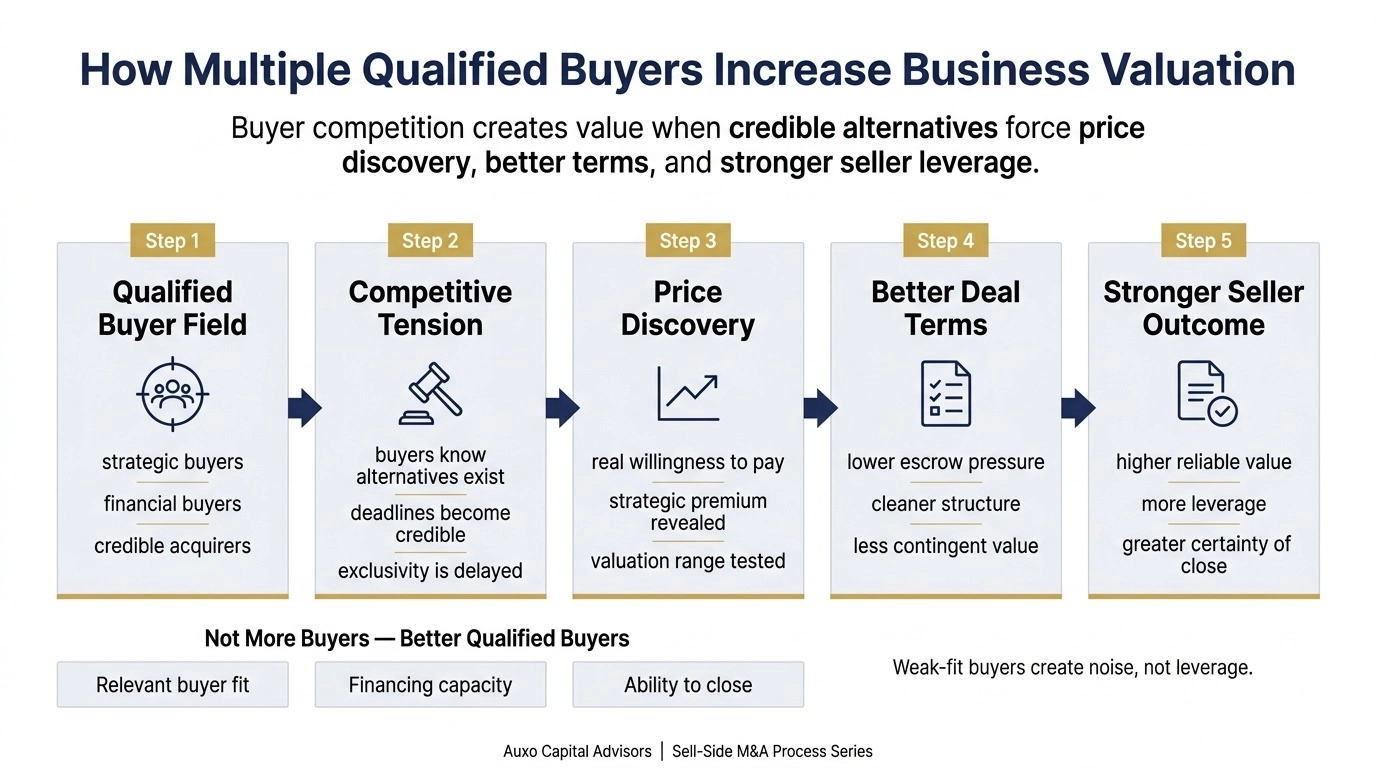
The key point is that valuation uplift is not caused by buyer count alone. It comes from the interaction between buyer quality, scarcity, timing, information control, and credible alternatives. When those elements are managed well, competition can improve both headline valuation and the economics that determine actual seller proceeds.
Key terms in buyer competition
Competitive tension means multiple qualified buyers are evaluating the same company at roughly the same time, with enough transparency around process timing that each knows it may lose the opportunity.
Price discovery is the process through which buyers reveal their actual willingness to pay, rather than anchoring the discussion around an initial low-risk offer.
Strategic premium refers to incremental value a strategic acquirer may pay because of synergies, market access, customer overlap, capability expansion, or defensive value not available to all bidders.
Buyer competition valuation is not a separate valuation method. It is the practical valuation effect created when multiple bidders influence one another’s pricing and terms in a live process.
Price discovery improves when buyers are forced to reveal their real ceiling
In a single-buyer negotiation, the buyer has every incentive to begin with a disciplined case, emphasize risk, and reserve upside for itself. The seller may hear a coherent explanation for why the business is worth six times EBITDA, but the more important question is whether the buyer would have paid seven times or more if another bidder were active. Without competition, that answer often remains hidden.
Once multiple bidders are in play, buyers lose the luxury of treating valuation as an internal academic exercise. They must convert conviction into an offer that can win. For a strategic buyer, that may mean sharing more of the synergy value with the seller. For a financial buyer, it may mean compressing return thresholds, underwriting more upside, or accepting a slightly lower margin of safety to stay relevant.
This is where many founders underestimate the role of process. They assume a good business will naturally attract its best price. In practice, value is frequently suppressed when one interested buyer is allowed to dominate timing and information flow. A competitive process exposes different value theses side by side and allows the seller to compare how the market prices the same asset.
Even then, price discovery should not be confused with a theatrical bidding war. The strongest middle-market outcomes usually come from quiet, credible pressure among a small set of serious parties. That kind of tension is more useful than a broad auction full of shallow interest.
Strategic and financial buyers respond to competition in very different ways
Strategic buyers often have more room to pay above a financial baseline because they can justify value through synergies, cross-selling, consolidation, talent acquisition, customer access, or supply-chain advantages. In a bilateral setting, some strategics will still present a disciplined standalone valuation and avoid revealing how much extra value the target creates inside their organization. Competition is what forces that hidden value closer to the surface.
Financial buyers, by contrast, usually operate under more explicit return constraints. They may not pay the highest headline number, but they can compete effectively on certainty, process quality, financing readiness, management alignment, and cleaner documentation. In a market with both buyer types present, the financial bidder often sets a credible floor while the strategic bidder tests the upper end of the range.
| Buyer type | How competition changes behavior | Where value may show up |
|---|---|---|
| Strategic buyer | Moves faster on approvals when fit is clear and alternatives are credible | Higher headline price, lower earnout reliance, willingness to absorb integration risk |
| Financial buyer | Sharpens offer discipline and certainty package to remain competitive | Cleaner process, more executable financing, stronger management partnership, sometimes lower rollover ask |
| Secondary strategic bidder | Can create leverage even if not expected to win | Improves price discovery and pushes the lead bidder to tighten terms |
Sellers often ask whether strategic buyers usually pay more than financial buyers. The honest answer is often yes, but not always. A strategic may perceive more value, but may also present more integration risk, slower internal approvals, or more conditionality. Meanwhile, a well-positioned financial buyer can outperform on certainty and structure. The most effective seller strategy is rarely to choose one buyer type in advance; it is to run a process that allows both to express value competitively.
This is one reason industry context matters. Niche sectors with scarce assets can attract sharp strategic premiums, while recurring-revenue platform businesses may generate aggressive private equity interest. Founders looking for broader valuation context by sector can review examples like accounting firm valuation multiples, the AEC valuation guide, engineering versus construction EV/EBITDA comps, or architecture firm valuation around IPD and DFMA. Those pages help frame market context, but the final outcome still depends heavily on how buyer competition is managed.
Valuation uplift is not only headline price
One of the most common seller mistakes is to equate the highest enterprise value with the best deal. Competitive processes often improve price, but they also improve the quality of that price. A buyer facing real competition is less likely to insist on aggressive escrows, oversized working-capital cushions, broad debt-like adjustments, or highly contingent earnouts if it believes those demands will lose the deal.
That distinction matters because sellers do not receive enterprise value. They receive proceeds after debt, debt-like items, transaction expenses, working-capital adjustments, holdbacks, and sometimes rollover. Two offers with similar top-line numbers can produce meaningfully different cash at close. Resources such as cash-free, debt-free, debt-like items in M&A, and completion accounts versus locked box become central once bidders move from indication to negotiated terms.
Competition also changes diligence burden. Buyers trying to win are more likely to focus on the issues that truly affect risk rather than exploring every possible question. That does not mean diligence becomes light. It means the buyer has an incentive to prioritize what matters most, resolve concerns efficiently, and avoid being perceived as a difficult counterparty unless the issue is genuinely value-relevant.
For founders, this is where a disciplined offer-comparison process matters. The right question is not only “Who offered the highest multiple?” but also “Who offered the best blend of price, structure, certainty, and executable terms?”
How Buyer Competition Changes the LOI, Not Just the Multiple
Buyer competition often shows up most clearly in the letter of intent. A higher EBITDA multiple is easy to see, but the LOI determines how much of that value is real, how much is contingent, and how much may be exposed to later diligence pressure. A buyer that wants to win cannot simply submit a strong headline price while loading the rest of the offer with seller risk.
That matters because many valuation debates are won or lost below the headline number. Exclusivity length, escrow size, working-capital language, earnout structure, rollover requirements, financing conditions, diligence scope, and closing timeline can all change the true economic value of the bid.
Where competition can improve LOI quality
| LOI term | Without competition | With credible competition |
|---|---|---|
| Exclusivity | Buyer may request a long exclusive period before key issues are resolved. | Seller can push for shorter exclusivity or require sharper terms before granting it. |
| Escrow / holdback | Buyer may seek larger protection to preserve optionality. | Seller can compare escrow demands and push bidders toward market terms. |
| Earnout | Buyer may shift value into contingent consideration. | Seller can favor bids with more cash at close and less contingent value. |
| Working capital | Buyer may use broad language to preserve adjustment flexibility. | Seller can require more specific peg methodology and adjustment mechanics. |
| Diligence scope | Buyer may leave too many open issues for exclusivity. | Seller can demand a clearer diligence plan before selecting a bidder. |
For owners, this is why the “highest valuation” should never be evaluated in isolation. A disciplined process compares the LOI as a complete economic package: price, structure, cash at close, risk allocation, timeline, and certainty of close.
Healthy competitive tension is built through process design, not theatrics
Buyer competition works best when it is controlled, credible, and selective. The goal is not to tell every bidder that a bidding war is underway. The goal is to structure the process so that qualified buyers understand there is a real timetable, comparable information access, and genuine consequence to waiting too long or underbidding.
Qualification matters more than raw buyer count
Three serious buyers are generally more valuable than fifteen casual ones. Serious means strategic logic, capital availability, internal alignment, and a realistic ability to close. A process overloaded with weak buyers can create management distraction and confidentiality risk without improving leverage.
Information should be released in stages
Buyers do not all need the same depth of information on day one. Early materials should help buyers decide whether to engage and at what level. More sensitive information should be reserved for parties that demonstrate seriousness. This protects confidentiality while preserving competitive tension.
Deadlines must be real
Nothing weakens leverage faster than a deadline the seller does not enforce. Buyers are quick to test process discipline. If indications, management meetings, and LOIs all drift, urgency erodes and buyers regain the ability to dictate pace.
Offers must be made comparable
A process only creates leverage if the seller can compare bids on a common framework. Otherwise, one buyer offers a high headline value with heavy contingencies, another offers lower price with cleaner cash-at-close, and the seller struggles to know which bid is actually stronger. A managed process standardizes what buyers are asked to address.
Founders looking for more on process mechanics can review the sell-side M&A process and, for a broader execution discussion, what a sell-side M&A advisor does. The process design question is not administrative. It is central to whether competition converts into value.
What the Seller Must Do Before Inviting Multiple Buyers
A competitive process magnifies both strengths and weaknesses. If the business is well prepared, multiple buyers can validate the story and sharpen terms. If the business is poorly prepared, multiple buyers may identify the same issues at the same time and compress around a lower valuation range.
That is why preparation should happen before outreach begins. Sellers need a clean financial narrative, defensible EBITDA adjustments, organized diligence materials, a clear explanation of growth, and a realistic view of management transition. Without that foundation, competition may not create leverage; it may simply expose risk faster.
Seller preparation checklist before launching buyer outreach
| Preparation area | What buyers will test | Why it affects competition |
|---|---|---|
| Normalized EBITDA | Whether adjustments are supportable and repeatable | Weak support can reduce valuation or widen diligence conditions. |
| Revenue quality | Customer concentration, churn, recurrence, backlog, and pricing durability | Durable revenue gives buyers more confidence to stretch. |
| Management depth | Whether the business can transition without founder overdependence | Stronger teams reduce buyer discounting and post-close risk. |
| Data room readiness | Whether financial, legal, commercial, HR, and operational materials are organized | Clean diligence supports tighter timelines and lower retrade risk. |
| Growth narrative | Whether forecast assumptions are credible and actionable | Buyers pay more when upside is specific rather than aspirational. |
This is why seller readiness and buyer competition should be treated together. The seller’s goal is not merely to bring buyers into the process. The goal is to give qualified buyers enough confidence to compete aggressively without creating avoidable diligence risk.
When more buyers do not translate into a better outcome
Not every competitive process raises valuation. Sometimes the business has a narrow buyer universe, a challenged growth story, customer concentration, unresolved quality-of-earnings issues, or management dependence that causes bidders to converge around similar risk-adjusted outcomes. In those cases, more outreach may simply confirm the same valuation band.
There are also seller-created failure modes. Overstating performance, pushing too many buyers into diligence too early, allowing confidentiality to weaken, or presenting inconsistent data can damage credibility. Once buyers suspect the process is loose or the information is unreliable, competition can disappear quickly.
Another breakdown occurs when sellers mistake buyer interest for buyer commitment. A crowded first round with thin engagement often feels encouraging, but it can produce false confidence. What matters is not how many parties download the teaser or sign an NDA; it is how many can submit a thoughtful bid and survive diligence.
This is especially relevant for founder-led companies that have not fully prepared for market. A weak data set or inconsistent financial presentation can suppress the very competition the seller hopes to create. For adjacent context, see what gets a business ready for sale process and why founder-led businesses are not ready for sale.
When a Single Buyer May Still Be the Right Path
Although multiple qualified buyers can create stronger leverage, there are situations where a narrower process or even a single-buyer path may make sense. The issue is not whether competition is valuable in theory. The issue is whether broader outreach improves the seller’s expected outcome after considering confidentiality, buyer universe depth, readiness, timing, and execution risk.
A single-buyer path may be appropriate when one buyer has a uniquely compelling strategic fit, the buyer universe is extremely limited, confidentiality risk is unusually high, or the seller is not yet prepared for a broader process. In those cases, the seller should still protect leverage through valuation work, process discipline, and careful negotiation of exclusivity.
When a narrower process may be appropriate
| Situation | Why broader outreach may not help | Seller protection |
|---|---|---|
| Unique strategic buyer | Only one buyer may have the specific synergy, market access, or integration logic to support premium value. | Use valuation support and process discipline to avoid premature exclusivity or weak terms. |
| Highly confidential situation | Broad outreach could disrupt employees, customers, vendors, or competitors. | Use staged disclosure and tight access controls. |
| Very small buyer universe | There may not be enough credible buyers to create real tension. | Negotiate from prepared alternatives, timing discipline, and clear value support. |
| Readiness issues remain unresolved | A broader process could expose problems before the seller has addressed them. | Delay launch or pursue limited dialogue while preparing the business. |
The key is not to treat competition as a slogan. Competition is valuable when it improves the seller’s negotiating position. If it increases leakage, confusion, or diligence risk without improving buyer quality, a narrower process may be the better strategic choice.
Worked scenario: one buyer versus three qualified buyers
Consider a founder-led business with normalized EBITDA of $8 million. The company has attractive recurring revenue, moderate customer concentration, and a management team that will remain after close. The seller runs two different sale paths in this illustration: a bilateral process with one interested buyer, and a controlled competitive process with one financial sponsor and two strategic acquirers.
| Scenario | Headline enterprise value | Structure | Key adjustments / constraints | Indicative seller outcome |
|---|---|---|---|---|
| Single buyer bilateral | $56.0M (7.0x EBITDA) | 10% rollover, 8% escrow, broad working-capital peg | Buyer requests expanded diligence and financing out | Lower cash at close and higher execution risk |
| Financial buyer in competition | $58.4M (7.3x EBITDA) | 5% rollover, 5% escrow, tighter adjustment language | Fast diligence, strong lender readiness | Slightly higher EV with better certainty package |
| Lead strategic buyer in competition | $62.4M (7.8x EBITDA) | No earnout, 3% escrow, limited conditionality | Synergy case supports premium pricing | Highest EV and cleaner economics |
| Secondary strategic bidder | $60.8M (7.6x EBITDA) | Minimal rollover, moderate escrow | Not selected, but reinforces market clearing level | Improves seller leverage against lead bidder |
Enterprise value is not seller proceeds
Assume the company has $4 million of debt, $1 million of cash, and $2 million of debt-like items identified through diligence. On a simplified basis, that means equity value begins at enterprise value less net debt and debt-like items. The bilateral $56.0 million offer does not mean the seller receives $56.0 million.
| Illustrative bridge | Bilateral buyer | Lead strategic in competition |
|---|---|---|
| Enterprise value | $56.0M | $62.4M |
| Less debt | ($4.0M) | ($4.0M) |
| Plus cash | $1.0M | $1.0M |
| Less debt-like items | ($2.0M) | ($2.0M) |
| Indicative equity value | $51.0M | $57.4M |
| Less escrow / holdback effect | Higher | Lower |
| Cash at close | Meaningfully reduced by rollover and holdbacks | Materially stronger |
The point of the example is not the precise multiple movement. It is the combined effect of competition on value and terms. The winning strategic buyer pays more because the asset has buyer-specific value, but that premium becomes visible only because another strategic and a credible financial buyer are present. The financial buyer may not win, yet still plays a critical role by setting an executable floor and forcing cleaner bid terms.
Sellers often focus first on the multiple expansion from 7.0x to 7.8x. In practice, the term improvement can be nearly as important. Lower escrow, fewer contingencies, and reduced rollover can change seller proceeds more than a modest turn of multiple. This is why buyers are compared on a full purchase-price bridge, not just enterprise value.
Seller takeaway
More buyers do not automatically create more value. More qualified buyers, managed in a controlled process, usually create more leverage. The difference is whether the seller can present the business consistently, stage information intelligently, preserve confidentiality, and compare bids on terms that matter economically.
For founders, the practical lesson is straightforward: do not confuse a bilateral discussion with fair market testing. If the objective is to maximize valuation and preserve negotiating leverage, the process must create real alternatives without sacrificing focus. That usually requires selective outreach, disciplined timing, and a clear plan for translating buyer interest into comparable offers.
What buyers actually focus on when they are competing
Buyers in a competitive process are not simply asking whether they like the company. They are deciding how far to stretch, where to stay disciplined, and what must be proven before they commit. The first issue is fit: does this business fill a strategic gap, create synergies, strengthen a platform, or deliver a compelling risk-adjusted return? If the fit is weak, competition may not move price much at all.
The second issue is confidence in cash flow durability. Buyers will test customer concentration, recurring revenue quality, margin resilience, working-capital behavior, and management depth. Strong competition does not eliminate underwriting discipline; it forces buyers to prioritize what most affects conviction. For related perspective, see how buyers evaluate acquisition targets.
Third, buyers watch process signals. If management is responsive, materials are coherent, and deadlines are credible, buyers are more willing to move aggressively. If the process feels disorganized or promotional, even interested bidders can become cautious. Competitive pressure sharpens buyer behavior, but only when the seller side maintains control and credibility.
Finally, buyers assess the odds of winning. A strategic buyer that believes it is uniquely positioned may stretch more. A financial buyer that senses the seller values certainty may emphasize process quality and speed rather than pure price. Understanding these motivations is what allows sellers to use competition intelligently instead of treating all bids as interchangeable.
Why advisory discipline determines whether competition becomes value
Buyer competition rarely monetizes itself. The presence of multiple interested parties is only the raw material. The value creation comes from how the process is structured, who is invited, how information is controlled, how timing is enforced, and how offers are translated into an apples-to-apples decision framework. That is where experienced sell-side M&A advisors change outcomes.
In practice, advisor value shows up in several ways. First, buyer screening ensures the process includes parties with strategic logic and closing capacity. Second, bid management prevents a strong headline price from masking weak economics elsewhere in the offer. Third, parallel dialogue gives the seller credible alternatives at moments when one buyer tries to slow the process or reframe risk.
There is also a negotiation benefit that many founders underestimate: advisors can preserve urgency without making the process feel theatrical. Buyers are more responsive when the process is firm, fair, and well run. They are less responsive when they feel they are being manipulated. Maintaining that balance is one reason representation matters, particularly in founder-led transactions where management must continue running the business while the process unfolds.
Founders considering timing, process design, or whether a full sale is the right path may also find these adjacent resources useful: when is the right time to sell a business, how long it takes to sell a business, how to price a business for sale, and whether to sell all or part of your business. In each case, the same principle applies: process discipline shapes value as much as valuation theory does.
Frequently asked questions
Why do multiple buyers increase business valuation?
They improve price discovery and force buyers to compete on executable terms. In a bilateral process, one buyer can anchor valuation conservatively. When credible alternatives exist, buyers must decide what the opportunity is worth to win, not just what they would prefer to pay.
Do strategic buyers usually pay more than financial buyers?
Often, but not always. Strategic buyers may justify a premium through synergies or market positioning. Financial buyers may be more disciplined on headline price yet stronger on certainty, financing readiness, and cleaner structure. The highest enterprise value is not automatically the best outcome.
How many buyers are enough to create real competitive tension?
There is no universal number, but a small group of serious, well-qualified bidders is usually more effective than a broad field of casual interest. In many middle-market processes, two to four credible parties can be enough to create meaningful leverage if they are advancing in parallel.
Can multiple offers improve terms even if the price is similar?
Yes. Competition often reduces rollover demands, escrows, financing contingencies, and aggressive adjustment language. Similar headline prices can produce very different seller proceeds and certainty of close once structure is compared carefully.
What is the difference between buyer competition and a bidding war?
Buyer competition is a controlled process with credible alternatives and disciplined timing. A bidding war suggests a more theatrical or public contest. In middle-market M&A, the best outcomes usually come from quiet, well-managed competitive tension rather than spectacle.
Does a competitive process always raise valuation?
No. If the buyer universe is narrow, the company has material risk issues, or the process is poorly managed, additional buyers may not improve value. Sometimes competition simply confirms the realistic market range rather than pushing it higher.
What do buyers look at most closely when they are competing?
Fit, cash flow durability, management quality, customer concentration, margin resilience, working-capital behavior, and execution risk. Competition accelerates focus on the issues that matter most, but it does not eliminate underwriting discipline.
How does seller leverage change when there are multiple bidders?
The seller gains alternatives. That changes how deadlines are enforced, how buyers present terms, and how late-stage pressure is handled. A buyer is less able to re-trade or slow the process when it knows the seller has credible options.
Can too many buyers reduce control or certainty of close?
Yes. A process that is too broad can increase confidentiality risk, management burden, and bidder fatigue. The objective is not maximum volume; it is a curated field of buyers with real strategic logic and the ability to close.
What kinds of businesses benefit most from multiple buyers?
Businesses with differentiated positioning, durable cash flow, scarce strategic relevance, or strong platform/add-on appeal often benefit most. The greater the buyer-specific value or scarcity, the more likely competition is to create valuation uplift.
How do advisors create buyer competition without leaking information?
By screening buyers carefully, using staged information release, sequencing diligence, and maintaining disciplined communication. Effective advisors preserve confidentiality while still making the process credible enough to create urgency among serious bidders.
What role does strategic fit play in a competitive sale?
Strategic fit often determines whether a buyer will stretch beyond a financial baseline. If a target fills a meaningful gap, creates synergies, or helps a buyer achieve a time-sensitive objective, competitive pressure is more likely to surface a strategic premium.
Media & press inquiries
Auxo Capital Advisors provides commentary on middle-market M&A, valuation, buyer behavior, transaction process, and founder-led sale dynamics. Journalists, editors, podcast hosts, and event organizers seeking perspective on competitive sale processes or valuation drivers are welcome to reach out.
For media and speaking inquiries, contact info@auxocapitaladvisors.com. Please include your outlet, topic, timeline, and any relevant interview or deadline details.
Disclosure
This article is provided for informational purposes only and reflects general M&A advisory observations, not legal, tax, audit, or investment advice. The examples and scenarios above are illustrative and simplified to explain how buyer competition can influence valuation and deal terms in middle-market transactions.
Actual transaction outcomes depend on company-specific performance, industry conditions, buyer fit, diligence findings, financing availability, negotiation dynamics, legal documentation, tax structure, working-capital mechanics, and other factors. A competitive process can improve valuation and leverage, but no article or model can predict the precise outcome of a live sale process.


