

Why Some Businesses Sell for 10× EBITDA While Others Sell for 3×
Updated August 9, 2026 for founders, owners, CFOs, acquirers, lenders, attorneys, accountants, and transaction professionals evaluating what 10× EBITDA means, why private-company multiples diverge, how buyers determine accepted EBITDA, and how growth, cash conversion, concentration, management transferability, financing, diligence, and deal structure affect valuation.
Key answer: a 10× EBITDA valuation means a buyer is valuing the operating business at about ten times the EBITDA it accepts for valuation purposes. If buyer-accepted EBITDA is $5.0 million, 10× implies approximately $50.0 million of enterprise value before debt, cash, working-capital adjustments, transaction expenses, escrow, earnouts, rollover equity, and other items that affect what the seller actually receives.
Why one business may support 10× while another is closer to 3× is not explained by industry labels alone. Buyers are underwriting the expected growth, profitability, cash conversion, reinvestment needs, customer durability, management transferability, concentration, financing capacity, and risk of the future cash-flow stream. That is why the same reported EBITDA can support radically different values once buyers decide which earnings are real and how much uncertainty they are being asked to assume.
Founder implication: owners should evaluate both sides of the equation—the EBITDA a buyer is willing to accept and the multiple applied to it. A disciplined sell-side valuation and transaction process can help owners prepare the earnings base, test buyer assumptions, and compare the economics that survive diligence. The distinction between normalized and adjusted EBITDA and the later enterprise-value-to-equity-value bridge matters as much as the quoted multiple.
Valuation theory supports a more rigorous interpretation of EBITDA multiples than simply comparing recent transaction anecdotes. CFA Institute identifies expected growth in free cash flow to the firm, profitability, and the weighted average cost of capital as fundamental drivers of EV/EBITDA: stronger growth and profitability support a higher justified multiple, while a higher cost of capital works in the opposite direction. That framework helps explain why a multiple is best understood as a compact expression of future economics rather than a standalone price tag.
Aswath Damodaran’s valuation work makes the same broader point: multiples should be connected back to fundamentals such as growth, risk, cash flow, and reinvestment rather than used mechanically. His current industry EV/EBITDA data also show wide variation across sectors, reinforcing why there is no single cross-industry “normal” multiple that can be transferred to a private company without adjustment for scale, quality, and transaction facts.
Private-company M&A adds additional underwriting layers that public-market screens do not fully capture. Buyers have to decide whether customer relationships transfer, whether a founder can step back, whether the company can withstand diligence, whether normalized EBITDA converts into cash, and whether the acquisition can be financed at the proposed price. Those company-specific questions determine where a business ultimately falls within the valuation range available from its buyer universe.
Review CFA Institute guidance on enterprise-value multiples; review Damodaran’s current EV/EBITDA industry data.
Transaction context: this article explains why EBITDA multiples diverge. It does not replace Auxo’s broader guide to how buyers use EBITDA multiples, the action-oriented guide to what actually increases EBITDA multiples in a sale, or the full business valuation process. Those pages address different questions: how multiples are used, what owners can improve, and how valuation methods work.
The distinction matters because the multiple is only one stage of the transaction. The buyer first determines an accepted earnings base, then applies valuation logic, and finally converts enterprise value into actual economics through cash, debt, working capital, deferred consideration, and retained equity. Owners should therefore read a 10× headline alongside the enterprise-value-to-seller-proceeds bridge rather than assuming the quoted multiple equals cash at closing.
Why the same EBITDA can support very different business values
Owners often hear a transaction multiple and treat it as a market price: a peer sold for 8×, a sponsor mentioned 10×, or an industry article cited a range. The problem is that an EBITDA multiple is not a price list. It is shorthand for a buyer’s view of the company’s earnings base, future cash flow, growth, risk, financing, and transferability. Two companies can report the same EBITDA and still present very different investment cases.
The gap becomes clearest in a live process. One buyer may accept most of the seller’s adjustments, view customer relationships as durable, and believe management can grow the company after closing. Another may reduce normalized EBITDA, worry about concentration, assume heavier reinvestment, and require a higher return. Both buyers can be rational. They are simply underwriting different probabilities around the same historical numbers.
This is why owners should begin with a defensible valuation framework rather than a desired multiple. Auxo’s Valuation Services can help test company-specific assumptions, while the broader sell-side preparation and buyer process becomes relevant when the objective is to take the company to market and test which buyers will actually support the valuation.
What does 10× EBITDA actually mean?
A 10× EBITDA valuation is a ratio. In its simplest form, enterprise value equals buyer-accepted EBITDA multiplied by 10. If the buyer accepts $5.0 million of EBITDA, the implied enterprise value is $50.0 million. If the buyer accepts only $4.5 million after diligence, the same 10× multiple produces $45.0 million. The arithmetic is simple; the underwriting behind both numbers is not.
The phrase is often used casually, which creates confusion for founders. A 10× EBITDA valuation does not mean the seller receives ten years of profits, and it does not mean that $50.0 million of enterprise value becomes $50.0 million of cash. The buyer is valuing the operating assets and cash-flow stream before the balance-sheet and transaction adjustments that determine equity value. Auxo’s guides to enterprise value versus purchase price and enterprise value versus equity value explain those distinctions in more detail.
It also does not mean that the reported EBITDA printed in a seller presentation automatically becomes the denominator. Buyers normally test the trailing period, proposed add-backs, current run rate, revenue recognition, margins, and cash conversion before settling on an earnings base. That is why TTM EBITDA, run-rate EBITDA, and quality of earnings versus normalized EBITDA can all affect the same transaction even when the headline discussion sounds like a simple “10× deal.”
What does 3× EBITDA mean?
A 3× EBITDA valuation uses the same mathematical logic but reflects a much lower enterprise-value-to-earnings relationship. If accepted EBITDA is $5.0 million, 3× implies $15.0 million of enterprise value. The lower multiple usually means the buyer requires a higher prospective return or sees more uncertainty around the future earnings stream, but the reason can vary widely by company.
A business near 3× may be smaller, more customer-concentrated, more capital intensive, highly dependent on the founder, exposed to a volatile end market, or operating with earnings that are difficult to validate. It may also have a limited buyer universe or financing profile. None of those factors automatically makes the company “bad.” A durable local business with modest growth and heavy owner involvement can still be attractive at the right price. The multiple reflects the risk-return framework of the buyer, not a moral judgment about the company.
Owners should also resist comparing a 3× lower-middle-market transaction with a 10× transaction involving a larger, more institutional company unless the earnings definitions and transaction facts are comparable. Company size, buyer type, financing, and control can change the relevant reference set. Auxo’s EBITDA multiples versus revenue multiples guide and business valuation methods overview provide broader context for when a single multiple is insufficient.
Is 10× EBITDA a good valuation?
Ten times EBITDA can be an attractive valuation, but the word “good” cannot be answered from the multiple alone. A seller needs to know what EBITDA the buyer accepted, how much of the enterprise value is paid in cash, what debt and working-capital assumptions apply, whether any value is deferred, and how certain the buyer is to close. A 10× headline on a reduced earnings base can produce less value than an 8× bid on a higher accepted EBITDA figure.
For example, a buyer that accepts $4.0 million of EBITDA at 10× offers $40.0 million of enterprise value. Another buyer that accepts $5.0 million at 8.5× offers $42.5 million. The lower multiple is actually the higher headline value. If the 10× buyer also requires a large earnout while the 8.5× buyer pays cash, the difference in reliable seller economics can widen further. That is why founders should compare competing M&A offers rather than ranking buyers by one headline ratio.
The more useful question is whether the valuation is defensible for the company’s risk and growth profile and whether the transaction terms fit the seller’s objectives. A higher multiple is valuable when it rests on a credible earnings base and converts into strong proceeds. It is less compelling when the price depends on fragile adjustments, contingent consideration, or assumptions that are likely to be challenged during diligence.
Executive summary
EBITDA multiples are a compact way of expressing how a buyer values a company’s operating earnings, but they are the output of underwriting rather than the starting point. A buyer must first decide what EBITDA is supportable, how fast the business can grow, how much cash the earnings can generate, what reinvestment is required, how concentrated the risks are, and how likely the company is to perform under new ownership.
Higher multiples generally correspond with stronger expected economics: durable growth, attractive margins, strong free-cash-flow conversion, diversified customers, recurring or repeatable revenue, management depth, transferable relationships, disciplined reporting, and lower perceived risk. Lower multiples generally correspond with the opposite: weaker visibility, high concentration, heavy capital needs, key-person dependence, volatile earnings, limited scale, or a difficult diligence profile.
The denominator can create as much value dispersion as the multiple. A company marketed at $5.0 million of EBITDA may emerge from quality-of-earnings work with $4.3 million of buyer-accepted EBITDA. If the buyer also lowers the multiple from 8× to 6× because diligence weakened confidence, enterprise value falls from an expected $40.0 million to $25.8 million. That “double compression” is one of the most important reasons owners should prepare the earnings bridge before discussing valuation.
Finally, enterprise value is not seller proceeds. Net debt, debt-like items, normalized working capital, transaction expenses, escrow, earnouts, seller notes, and rollover equity can all change the amount and timing of value received. The strongest seller analysis therefore connects EBITDA, the multiple, buyer behavior, and the proceeds bridge rather than treating any one number as the outcome.
Key takeaways
- 10× EBITDA is a valuation ratio, not cash proceeds. The buyer multiplies accepted EBITDA by the purchase multiple to estimate enterprise value before the equity-value bridge.
- The accepted EBITDA denominator matters as much as the multiple. A lower QoE-adjusted earnings base can erase more value than a one-turn change in the multiple.
- Growth, profitability, cash conversion, and risk are fundamental drivers. Premium multiples require buyers to believe the future economics justify paying more today.
- Recurring revenue helps only when it is economically durable. Retention, margin quality, concentration, contract terms, and service costs still matter.
- Scale can widen the buyer and financing universe. Larger companies often—but not always—benefit from diversification, management depth, and institutional reporting.
- Capital intensity can compress the multiple. Two businesses with identical EBITDA can have very different free-cash-flow profiles after maintenance capex and working capital.
- Transferability is central in founder-led companies. Customer ownership, management depth, documented processes, and key-person risk affect confidence that earnings survive a change of control.
- Diligence can reprice both EBITDA and the multiple. Missing evidence, concentration, weak controls, or hidden liabilities can turn a premium case into a lower-risk category.
- The highest multiple is not automatically the best transaction. Cash at close, financing certainty, working capital, escrow, earnouts, rollover, and closing risk determine the real seller outcome.
Why buyers place some companies near 3× and others near 10×
When buyers distinguish between a lower-multiple and higher-multiple business, they are trying to estimate the durability and risk of future cash flows under new ownership. The multiple compresses many judgments into one number: how reliable the earnings are, whether growth is sustainable, how much capital the business needs, how concentrated the customer base is, whether the management team can operate independently, and whether the company can withstand diligence without surprises.
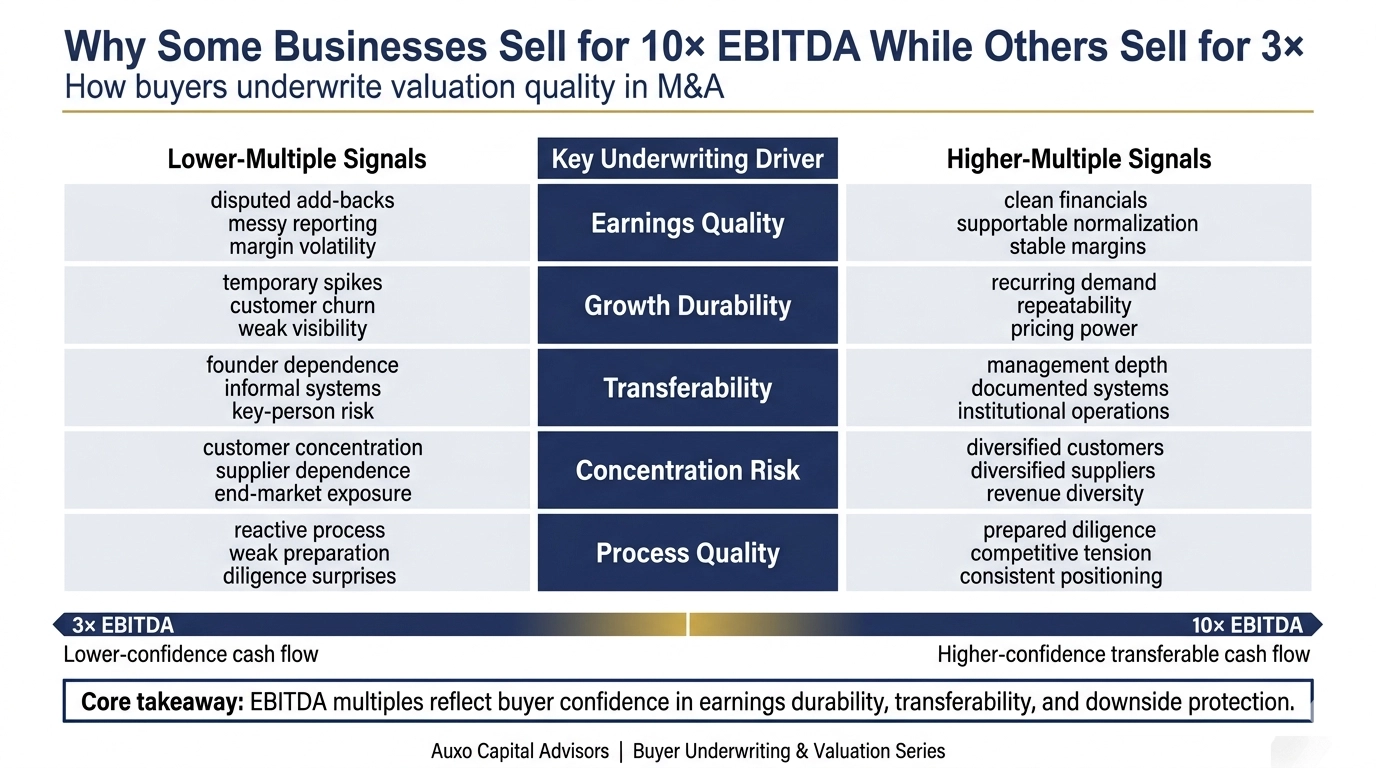
A useful way to read the spectrum is to separate business quality from transaction process. A strong process can help the right buyers understand the company and can create competition, but it cannot permanently hide weak fundamentals. Conversely, a high-quality business can still underperform in a sale if the buyer universe is narrow, the earnings story is poorly supported, or diligence is disorganized. The article on what actually increases EBITDA multiples in a sale focuses on the owner-controlled improvement levers; this page focuses on the diagnostic reasons buyers price companies differently.
Definitions that drive the 10× versus 3× discussion
EBITDA multiple generally means enterprise value divided by a defined EBITDA measure. The multiple is only comparable when the numerator and denominator are defined consistently. A transaction quoted at 10× trailing EBITDA is not directly comparable with one quoted at 10× projected or aggressively adjusted EBITDA without reconciling the earnings bases.
Buyer-accepted EBITDA is the earnings figure the buyer is willing to capitalize after reviewing the period, proposed add-backs, normalization, quality-of-earnings findings, and other diligence. It may equal management’s adjusted EBITDA, but often it does not. The distinction is developed further in Normalized EBITDA in M&A.
Enterprise value is the value attributed to the operating business before the negotiated treatment of cash, debt, debt-like items, and working capital. Equity value is what remains for the owners after the agreed bridge. Seller proceeds go another step by separating cash at close from escrow, earnouts, seller financing, rollover equity, expenses, and other consideration. Those definitions explain why a 10× headline multiple is not itself a statement of what the seller will receive.
EV/EBITDA is shorthand for expectations about the future
Multiples are often presented as historical statistics, but the price a buyer is willing to pay is fundamentally forward-looking. The buyer is using the company’s historical financial record to estimate future cash flow, risk, and return. That is why a company with the same current EBITDA as a peer can receive a higher multiple if buyers expect faster sustainable growth, better margins, lower reinvestment, or a lower probability of earnings impairment.
The connection to free cash flow is especially important. EBITDA excludes cash taxes, gross capital expenditures, and changes in working capital. A company with strong EBITDA but weak cash conversion may support less debt and generate lower equity returns than a company with identical EBITDA and stronger conversion. Auxo’s EBITDA-to-free-cash-flow bridge explains how buyers move from accounting earnings to the cash available for debt service, reinvestment, and return on invested capital.
Risk enters the same framework through the return the buyer requires. Stable contracted revenue, diversified customers, strong management, and low capital needs generally reduce uncertainty. Volatile demand, key-person exposure, customer concentration, litigation, cybersecurity problems, or regulatory risk increase the return requirement. A higher required return normally means a lower value for the same expected cash flows, which is why the multiple often falls when uncertainty rises even if the trailing EBITDA number has not changed.
Accepted EBITDA: why the denominator can matter as much as the multiple
The seller may enter the market with one EBITDA figure while the buyer underwrites another. Reported EBITDA comes from the financial statements. Adjusted EBITDA may add back non-recurring or owner-specific items. Normalized EBITDA attempts to reflect maintainable operating earnings. A quality-of-earnings review then tests whether revenue, expenses, margins, accruals, and proposed adjustments support the number a buyer should actually use.
That distinction is why the same “8× valuation” can mean very different things. A seller that expects $5.0 million × 8× is expecting $40.0 million of enterprise value. If diligence reduces accepted EBITDA to $4.3 million and the buyer keeps the same multiple, value falls to $34.4 million. If the findings also reduce confidence enough to move the buyer to 6×, value falls to $25.8 million. The company has suffered both denominator compression and multiple compression.
Owners should therefore build the earnings bridge before the buyer does. The starting point is usually the trailing period described in TTM EBITDA, with careful treatment of normalization and adjustments. Buyers then test the result through quality of earnings and often focus on the specific issues summarized in what buyers flag in QoE. A recent step-up may also be discussed as run-rate EBITDA, but forward credit requires evidence rather than a simple annualization.
The practical seller lesson is that arguing for a premium multiple while presenting an earnings base that will not survive diligence is usually counterproductive. Credibility compounds. When the adjustments are disciplined, the monthly results reconcile, and management can explain the earnings bridge consistently, buyers can spend more time debating future value and less time protecting themselves against historical uncertainty.
A more complete earnings analysis also reconciles the accounting bridge with the economics of operating the company. Owner compensation, related-party expenses, discontinued initiatives, severance, one-time professional fees, vacant positions, temporary labor, and pro forma cost savings can all be legitimate discussion items, but the buyer will ask whether each adjustment is traceable, non-recurring, and consistent with post-close reality. Auxo’s broader guide to normalized EBITDA and QoE in middle-market valuation shows how those adjustments are tested together rather than as isolated add-backs.
This is also where experienced sell-side preparation and buyer negotiation can matter before the company is in exclusivity. A seller that understands which adjustments are strong, which are debatable, and which should be removed can frame the earnings discussion more credibly and reduce the chance that a buyer later characterizes the entire EBITDA bridge as aggressive.
Earnings quality and cash-flow conversion
EBITDA is useful because it removes financing and certain non-cash accounting items, but it is not free cash flow. Buyers cannot repay acquisition debt, fund distributions, or reinvest in growth with EBITDA that never converts to cash. They therefore examine cash taxes, maintenance capital expenditures, working-capital needs, recurring software or infrastructure investment, lease economics, and other cash demands that sit below EBITDA.
This distinction can create meaningful multiple dispersion. An asset-light services company with low capital expenditures and favorable working-capital characteristics may convert a large portion of EBITDA into cash. A manufacturing, distribution, or equipment-heavy business may need more maintenance capex, inventory, and receivables to generate the same EBITDA. The buyer can still value the second company highly, but the expected cash yield and financing profile are different.
Auxo addresses this directly in the EBITDA to free cash flow bridge and in the broader explanation of why buyers focus on cash flow rather than profit alone. Owners should also separate maintenance investment from purely accounting depreciation because the cash needed to sustain the asset can differ substantially from the depreciation expense shown in historical statements.
Working capital is another hidden driver. Growth can look attractive on an income statement while consuming cash through receivables, inventory, or deferred billing. Buyers will often normalize the balance sheet through a working-capital peg and test how the requirement changes as revenue grows. A business that needs little incremental working capital can support a stronger cash-return case than one where every dollar of growth requires substantial cash to be reinvested.
Growth only helps when it looks durable
Growth is one of the clearest reasons a buyer may accept a higher multiple, but historic growth alone is not enough. Buyers want to know what produced the growth, whether it can continue, and what it costs to sustain. Organic growth driven by repeatable sales productivity, pricing power, contracted expansion, or durable market share gains usually receives more credit than one-time acquisitions, temporary shortages, unusually favorable project timing, or a single customer win.
Forecast quality matters as well. A plan supported by customer contracts, renewal history, backlog, cohort behavior, sales pipeline conversion, pricing evidence, and capacity planning is easier to underwrite than a forecast that simply extends the last twelve months. Buyers compare the forecast with historical budget accuracy and management’s ability to explain where volume, price, mix, margin, headcount, and investment change over time.
Growth that destroys margins or consumes excessive cash can also weaken the valuation case. A company may add revenue while hiring ahead of demand, discounting price, building inventory, or extending customer terms. In that situation, revenue growth can increase operational complexity without improving free cash flow. The buyer is not paying for growth in the abstract; it is paying for growth that can create durable enterprise value after the required reinvestment.
Buyers also distinguish between growth that is already visible in the trailing results and growth that exists mainly in management’s plan. A company can deserve credit for a strong pipeline, new capacity, or recent commercial wins, but the buyer normally applies a probability to those benefits. The more the valuation depends on unproven future growth, the more likely the buyer is to reserve upside for itself or move value into contingent structure rather than paying for the full forecast at closing.
Strategic fit can change that calculus. A buyer that can cross-sell the target’s services, remove duplicated costs, improve purchasing, or accelerate distribution may see value that another buyer cannot. Those benefits are buyer-specific, however, and should be separated from the target’s standalone quality. Auxo’s guide to how synergies affect acquisition valuations explains why the existence of synergy does not automatically mean the seller captures all of it in price.
Recurring revenue, retention, and revenue visibility
Recurring and repeatable revenue often support higher valuation because they reduce the uncertainty around next year’s earnings, but the label “recurring” is not enough. Buyers examine contract term, renewal behavior, churn, pricing rights, service obligations, customer acquisition costs, account profitability, and the degree to which revenue is truly contractual versus simply habitual.
A subscription or maintenance contract can still be low quality if customers can cancel easily, gross margins are weak, or support costs increase faster than price. A project-based company can still be highly attractive if customers repeat, backlog is funded, relationships are diversified, and demand is visible. The underwriting question is whether the revenue stream gives the buyer credible visibility into future cash flow at acceptable margins.
Retention quality also interacts with concentration. Ninety-five percent retention can sound excellent until the buyer learns that one customer represents 35% of revenue and has a contract renewal six months after closing. Conversely, a diversified customer base with modest annual churn may be easier to finance and forecast. Buyers look beyond a single retention statistic and assess the distribution of renewal risk across the portfolio.
Customer, supplier, channel, and end-market concentration
Concentration changes valuation because it increases the sensitivity of the future earnings stream to one external event. A large customer loss, supplier disruption, channel change, or end-market downturn can impair EBITDA faster when a company has fewer independent sources of revenue or supply. Buyers may respond with a lower multiple, additional diligence, a contingent payment structure, or a narrower financing case.
Customer concentration is the most visible form, but it is not the only one. A business can be diversified by customer name while still depending on one industry, one geographic market, one referral source, one distributor, or one procurement contract. The buyer will examine termination rights, renewal cycles, margin by account, historical ordering patterns, and the strength of relationships beyond the founder or lead salesperson.
Concentration can be manageable when the underlying relationship is durable and economically important to both sides. The issue is not a universal percentage threshold. The issue is the probability and impact of loss. That is why buyer diligence often combines concentration analysis with broader hidden-risk review and why the same company can receive different views from buyers with different customer overlap, integration plans, or risk tolerance.
Management depth, founder dependence, and transferability
Premium multiples require confidence that the company can operate after ownership changes. A founder-led business may be highly profitable, but if the founder controls key customer relationships, pricing exceptions, recruiting, technical knowledge, vendor negotiations, and everyday decisions, the buyer is underwriting both the business and a management transition. That transition risk can reduce the multiple or shift value into retention arrangements and contingent terms.
Transferability improves when responsibilities are distributed across a capable management team, customer relationships are institutionally owned, decision rights are documented, and operating processes do not depend on one person’s memory. Buyers assess management depth through the organization chart, leadership tenure, reporting cadence, incentive plans, succession coverage, and direct interaction with executives during diligence.
Owners can see the same issue through Auxo’s guides to why some founder-led businesses are not ready for a sale process and why some companies never sell. The important point for this article is diagnostic: founder dependence does not automatically prevent a transaction, but it changes the confidence that buyers can place in the EBITDA stream after closing.
Capital intensity and reinvestment requirements
Two companies with the same EBITDA can have very different economic value if one requires far more capital to maintain operations. A capital-intensive business may need recurring equipment replacement, facility investment, fleet spending, technology upgrades, or inventory. An asset-light business may need less physical reinvestment but still require substantial sales, product, software, or compliance spending. Buyers care about the recurring cash cost of maintaining competitive performance.
Maintenance capital expenditure is particularly important because EBITDA adds back depreciation and amortization. If those non-cash expenses approximate a real recurring need to replace assets, the buyer cannot ignore the cash requirement simply because it sits below EBITDA. The cash-conversion bridge helps explain why EBITDA is a useful operating metric but not a complete measure of economic cash flow.
Capital intensity can also affect financing. A lender evaluating acquisition debt cares about debt service, fixed charges, cyclicality, collateral, and the cash remaining after required investment. If more of EBITDA must be reinvested, less cash is available to repay debt or fund equity returns. A buyer may therefore lower its price even when the historical earnings look stable.
Buyer type and strategic fit can change the multiple
Different buyers can place different values on the same company because they have different economics. A strategic acquirer may value customer overlap, geography, technology, talent, manufacturing capacity, or cost synergies. A private equity buyer may focus more heavily on leverage capacity, management continuity, organic growth, add-on opportunities, and the eventual exit. Family offices and independent sponsors can bring different holding periods, capital structures, and governance expectations.
Those differences do not mean one buyer category always pays more. Auxo’s guides to how strategic buyers value companies and how private equity firms value companies show the distinct underwriting frameworks, while why strategic buyers may pay more explains when synergies can support a premium. A sponsor can still outbid a strategic buyer if it sees a stronger growth thesis or has a platform that creates its own synergies.
The seller’s opportunity is to identify which buyers can justify the highest credible value, not to assume a theoretical buyer type will pay a specific multiple. Strategic enthusiasm also needs to be tested for durability; Auxo’s discussion of when strategic buyers overpay and why it can backfire explains why an aggressive headline bid is not automatically the most reliable outcome. Buyer mapping and process design connect valuation theory to market-tested price discovery.
The same logic applies within buyer categories. A family office may accept a longer holding period or different governance model than a traditional sponsor, while an independent sponsor may need to assemble both debt and equity capital transaction by transaction. Those differences can affect speed, financing certainty, rollover expectations, and the return threshold embedded in the offer. Capital source and mandate can therefore shape buyer behavior even when two acquirers are both described broadly as financial buyers.
Financing markets and leverage capacity
A purchase multiple must ultimately be funded. Strategic buyers may use balance-sheet cash, debt, stock, or a combination. Private equity buyers typically combine sponsor equity with acquisition debt. Lenders evaluate leverage, fixed-charge coverage, cash conversion, cyclicality, customer concentration, collateral, and downside performance. If the financing case cannot support the price, the buyer must contribute more equity or reduce valuation.
That connection is particularly important in sponsor-backed transactions. The purchase multiple and leverage multiple are different concepts: a buyer can pay 10× EBITDA while financing only part of the purchase price with debt. The remaining consideration must be funded with equity. Auxo’s private-equity pricing guide explains how sponsors connect entry value, leverage, operating growth, debt paydown, and exit assumptions.
Financing conditions also change over time. Higher borrowing costs or tighter lender standards can reduce the enterprise value a financial buyer can support even when the target company has not changed. Strong cash conversion and resilient performance can partially offset that pressure by making the debt case safer. This is another reason an “industry multiple” is never fully independent of the financing environment.
For sellers, financing should be treated as part of valuation certainty rather than a separate buyer problem. A high purchase multiple is less valuable if the buyer has not tested debt capacity, equity contribution, lender appetite, or closing conditions. A credible buyer should be able to explain how the capital stack fits the purchase price and the downside case. Auxo’s acquisition financing advisory page describes the financing-readiness issues buyers need to resolve, while a sources-and-uses schedule shows how debt, equity, rollover, seller financing, fees, and other uses fit together at closing.
Diligence confidence and documentation quality
Diligence can change the multiple because it changes the buyer’s confidence in the future. A company that presents reconciled financial statements, customer data, contracts, tax records, HR documentation, cybersecurity evidence, and a coherent operating narrative reduces uncertainty. A company that cannot reconcile revenue, explain margins, support add-backs, or locate key contracts forces the buyer to widen its risk discount.
Some diligence findings reduce only equity value through a specific adjustment. Others affect the multiple itself. If a buyer discovers that recurring revenue is less durable than expected, customer relationships are concentrated in the founder, or margins depend on deferred maintenance, the business may move from a premium underwriting category to a more ordinary one. Auxo’s guide to why deals lose value during diligence explains that distinction between specific purchase-price adjustments and broader risk repricing.
The buyer’s diligence behavior matters too. A clean, well-prepared company can still receive different interpretations from different acquirers. That is why sellers benefit from understanding how buyers evaluate acquisition targets before the process begins and from anticipating the issues that can lead a buyer to walk away late in an M&A deal.
Diligence readiness should therefore be evaluated before buyer outreach rather than after a problem appears. A structured pre-sale readiness review can reveal financial tie-outs, contract gaps, customer-data weaknesses, management dependencies, or unresolved liabilities while the owner still has time to address them. When the company is ready to launch, a disciplined sell-side M&A process can sequence disclosure and buyer access so diligence tests the prepared investment thesis instead of defining it from scratch.
Buyer competition can affect the final range—but it cannot create fundamentals
Market competition can influence the final multiple because different buyers have different strategic logic, financing capacity, and risk tolerance. A controlled process can also reduce the ability of one buyer to anchor low, stretch diligence, or demand unnecessary structure. Auxo’s competitive M&A sale-process guide and multiple-buyers valuation guide address those dynamics directly.
Competition does not eliminate the need for sound fundamentals. If the earnings base fails QoE, customer concentration is severe, or management cannot operate without the founder, a broader buyer process may reveal the weakness faster rather than erase it. The process can help price the company efficiently and identify the buyer that sees the most value, but it cannot permanently manufacture a premium-quality asset.
That distinction protects this article’s role. The purpose here is to explain why buyer views diverge. The separate multiple-improvement article explains how owners can strengthen the company before a sale, while the M&A auction-process guide explains how a competitive process is executed.
Worked example: why two $5 million EBITDA companies can produce radically different values
Consider two founder-led service businesses in the same broad industry. Both report $5.0 million of EBITDA. If an owner looked only at an industry multiple, the companies might appear to deserve similar values. A buyer examining the underlying economics would reach a different conclusion.
| Underwriting factor | Company A | Company B | Buyer interpretation |
|---|---|---|---|
| Reported EBITDA | $5.0M | $5.0M | Same headline starting point |
| Buyer-accepted EBITDA | $5.0M | $4.3M after unsupported adjustments | Company B loses value before the multiple is applied |
| Organic growth | Consistent, supported by repeatable sales process | Recent spike tied to a few wins | Company A receives more forward credit |
| Revenue visibility | High retention and repeatable service demand | Project-based with weaker forecast visibility | Company B has wider forecast risk |
| Customer concentration | Diversified | Top customer represents 32% | Loss sensitivity is materially higher for Company B |
| Cash conversion | Low maintenance capex and modest working capital | Higher capex and working-capital requirements | Company A can support more debt and stronger returns |
| Management depth | Experienced second layer | Founder controls sales and operations | Company B carries transition risk |
| Diligence readiness | Reconciled monthly reporting and clean documentation | Late cleanup and incomplete customer data | Company B requires a larger risk discount |
Now assume, purely for illustration, that Buyer A underwrites Company A at 9.5× accepted EBITDA and Company B at 4.0× accepted EBITDA. These are scenario assumptions for explaining the mechanics; they are not market forecasts or benchmark ranges.
| Valuation bridge | Company A | Company B |
|---|---|---|
| Buyer-accepted EBITDA | $5.0M | $4.3M |
| Illustrative scenario multiple | 9.5× | 4.0× |
| Illustrative enterprise value | $47.5M | $17.2M |
| Less net debt | ($6.0M) | ($6.0M) |
| Working-capital adjustment | At target | ($1.2M) shortfall |
| Illustrative equity value before other terms | $41.5M | $10.0M |
| Potential structure | High cash-at-close confidence | Greater earnout / holdback / transition pressure |
The point is not that Company A “deserves 9.5×” or Company B “deserves 4.0×.” The point is how the buyer’s view of the denominator and the risk premium compound. Company B is hit first when $5.0 million of reported EBITDA becomes $4.3 million of accepted EBITDA, then again when a weaker growth and risk profile supports a lower scenario multiple, and again when the working-capital bridge reduces equity value.
This is why a quoted multiple can be a poor shorthand for the seller’s actual outcome. Owners should test the earnings base, valuation, and proceeds bridge together. The same logic underlies Auxo’s guidance on why LOIs are not final value and why the best M&A buyer is not always the highest headline price.
Common mistakes owners make when benchmarking EBITDA multiples
Using an industry average as a price tag
An industry median can be useful context, but it cannot account for the company’s scale, growth, cash conversion, concentration, management, or transaction facts. Public-company data can also reflect larger enterprises, liquid securities, and different capital structures than a founder-led private company. A multiple is evidence, not a promise.
Mixing reported, adjusted, normalized, and accepted EBITDA
A transaction comp quoted at 9× may use an earnings definition different from the seller’s own adjusted EBITDA. Comparing the multiple without reconciling the denominator can create false precision. Owners should know exactly which period and which adjustments sit underneath every benchmark they use.
Ignoring free-cash-flow conversion and capital intensity
Two businesses can report the same EBITDA while producing very different cash after taxes, capex, and working capital. A buyer that cannot finance or monetize the stated EBITDA at an attractive return will not pay a premium simply because a peer traded at one.
Assuming growth automatically commands a premium
Growth helps when the buyer believes it is repeatable, margin-supportive, and financeable. Temporary demand, discount-driven volume, or growth dependent on one customer can increase revenue without reducing risk.
Confusing enterprise value with seller proceeds
A premium EV/EBITDA multiple can coexist with lower cash at closing when debt, working capital, escrow, earnouts, rollover, or transaction expenses absorb part of the headline value. Sellers should model the proceeds bridge before comparing offers.
Assuming the buyer’s financing is irrelevant to the seller
A buyer that offers a high multiple but has not validated financing may have a weaker path to close than a slightly lower bidder with committed capital, realistic leverage, and clear approvals. Sellers should understand whether the offer depends on optimistic lender assumptions, a future equity raise, or conditions that can become negotiating leverage after exclusivity.
Overlooking how definitions can change the effective multiple
A stated multiple is only as useful as the definitions underneath it. If the buyer uses a lower EBITDA base, excludes cash credit, classifies additional liabilities as debt-like, or applies a demanding working-capital target, the seller can experience a materially lower effective outcome even though the headline multiple never changes. This is one reason revenue-peg versus working-capital-peg mechanics and other closing definitions should be addressed before the seller loses alternatives.
What buyers actually focus on when deciding the multiple
In a real acquisition process, buyers rarely debate the multiple in isolation. They ask whether the stated EBITDA can be trusted, what could cause it to decline, how much capital the business needs, which customers or employees create outsized risk, and whether management can execute the forecast after the owner steps back. Those questions determine the buyer’s confidence range before the final valuation is expressed as a multiple.
Buyers also test downside asymmetry. A premium business is not merely one with attractive upside; it is one where the buyer can understand and contain the downside. That is why acquisition-target evaluation includes financial, commercial, operational, legal, and management evidence rather than only comparable-company data. If the company requires heroic assumptions to preserve EBITDA, the buyer is less likely to pay a premium up front.
Finally, buyers focus on whether the price can survive their own approval process. A corporate acquirer may need strategic and integration support for the valuation. A sponsor may need investment-committee approval and a financeable return case. Lenders may use a more conservative EBITDA measure than the equity buyer. The multiple that matters is therefore the one that can be financed, approved, documented, and carried through diligence—not the highest number mentioned early in a conversation.
How founders should pressure-test their multiple before going to market
This article is diagnostic rather than prescriptive. The goal is to identify which underwriting questions are likely to move a buyer’s valuation, not to turn every observation into a generic “value improvement” checklist. Owners can begin by asking how a buyer would view seven areas of the company today.
Earnings-base confidence
Would a buyer accept the current EBITDA after QoE, or would aggressive add-backs, accounting inconsistencies, or underinvestment reduce the denominator?
Growth confidence
Can the company explain historical growth and support the forecast with customer, pipeline, pricing, capacity, and margin evidence?
Revenue durability
Are contracts, renewals, backlog, repeat customers, or other sources of visibility strong enough to reduce uncertainty about next year?
Transferability
Can the business operate when the owner steps back, and are customer relationships, decision rights, and operating know-how institutional rather than personal?
Concentration
Could the loss of one customer, supplier, channel, employee, or end market materially impair EBITDA after closing?
Cash conversion
How much EBITDA becomes recurring free cash flow after taxes, maintenance investment, and normal working-capital requirements?
Diligence confidence
Can the company support the story with reconciled financials, contracts, customer data, HR records, tax information, and operating evidence?
Once the diagnostic is clear, owners who want the action-oriented next step should review What Actually Increases EBITDA Multiples in a Sale. That companion guide focuses on the levers an owner can strengthen before going to market rather than repeating the multiple-dispersion analysis here.
Why advisory discipline can change which valuation survives to close
Advisory value begins before buyer outreach. A disciplined process helps determine which EBITDA figure can be defended, which risks should be addressed before launch, how the company should be positioned, and which buyers are most likely to value the asset correctly. That work does not manufacture a higher multiple; it reduces avoidable uncertainty and helps buyers evaluate the company on a consistent evidentiary record.
Advisor judgment also matters when bids arrive. A higher multiple may rest on weaker financing, more contingent consideration, a lower accepted EBITDA figure, or buyer-friendly definitions that reduce proceeds later. Experienced sell-side M&A advisory should compare enterprise value, structure, financing, diligence posture, and closing certainty together rather than presenting the highest headline bid as automatically superior.
Once a buyer enters exclusivity, negotiating leverage generally becomes more fragile because the seller has fewer live alternatives. Preparation and process discipline before that point can make it harder for a buyer to reframe ordinary diligence as a reason for a broad valuation reset. The objective is not simply to achieve the highest initial multiple; it is to support the strongest credible economic outcome through closing.
Seller takeaway
The difference between 10× and 3× is ultimately a difference in what buyers believe about future cash flow and risk. A premium multiple reflects confidence that the accepted earnings base is real, the growth outlook is durable, the company can convert EBITDA into cash, and the business will transfer successfully to new ownership. A lower multiple usually means the buyer requires more return for uncertainty, reinvestment, concentration, limited scale, or execution risk.
Owners should therefore focus on both the denominator and the multiple. A transaction can lose more value through a disputed EBITDA base than through a modest change in the headline multiple, and the enterprise-value bridge can further change proceeds after the valuation has been agreed. A company that understands these mechanics before outreach is better positioned to evaluate real buyer feedback rather than market anecdotes.
When a sale becomes more concrete, M&A advisory for valuation and transaction positioning can help owners prepare the earnings bridge, identify the relevant buyer universe, compare competing economics, and manage diligence. Owners who need a company-specific valuation analysis outside a live process can also review Auxo’s Valuation Services.
Frequently asked questions
What does 10× EBITDA mean?
A 10× EBITDA valuation means enterprise value is approximately ten times the EBITDA the buyer accepts for valuation. If accepted EBITDA is $5 million, 10× implies about $50 million of enterprise value before debt, cash, working-capital adjustments, transaction expenses, and deal structure.
How do you calculate a 10× EBITDA valuation?
Multiply buyer-accepted EBITDA by 10. The difficult part is not the arithmetic; it is determining the earnings base the buyer will actually accept after normalization and diligence.
Is 10× EBITDA a good valuation?
It can be, but the answer depends on the accepted EBITDA base, company quality, sector, growth, risk, cash conversion, transaction structure, and seller objectives. A lower multiple on a higher accepted EBITDA figure can sometimes produce more value.
What does 3× EBITDA mean?
A 3× EBITDA valuation means enterprise value is approximately three times buyer-accepted EBITDA. A lower multiple usually indicates a higher required return or greater perceived risk, but it is not automatically a poor outcome without knowing the company and transaction facts.
What multiple of EBITDA do businesses sell for?
There is no universal EBITDA multiple for private businesses. Multiples vary by industry, EBITDA scale, growth, margins, cash conversion, concentration, management depth, buyer demand, financing conditions, and transaction structure.
Why do EBITDA multiples differ between companies?
They differ because buyers have different expectations for growth, profitability, free-cash-flow conversion, risk, capital needs, customer durability, transferability, and financing capacity. The multiple summarizes those underwriting judgments.
Does a larger company get a higher EBITDA multiple?
Often, but not automatically. Scale can improve diversification, management depth, systems, lender appetite, and buyer interest. A larger business with weak economics or concentration can still trade below a smaller, higher-quality company.
How does recurring revenue affect EBITDA multiples?
Recurring or highly repeatable revenue can support a higher multiple by improving visibility, but buyers still test retention, margins, contract terms, concentration, churn, and the cost required to service the revenue.
Why do buyers discount aggressive EBITDA add-backs?
Unsupported add-backs reduce confidence in the earnings base. A buyer may reject part of the adjustment and then apply a lower multiple if the aggressive presentation also raises concerns about reporting quality or underinvestment.
How does customer concentration affect the multiple?
Concentration increases downside sensitivity because losing one customer can materially reduce earnings. Buyers assess contract terms, renewal timing, account profitability, relationship depth, and whether the risk is diversified across other customers and markets.
Does founder dependence reduce valuation?
It can. If important customer relationships, pricing decisions, operating knowledge, or leadership depend on the founder, buyers may lower the multiple or require more transition support because future earnings are less transferable.
How does free-cash-flow conversion affect EBITDA multiples?
Stronger cash conversion can support greater confidence in leverage and investment returns. Heavy capex, taxes, or working-capital needs can make the same EBITDA economically less valuable because less cash remains after recurring reinvestment.
Do strategic buyers pay higher multiples than private equity buyers?
Sometimes, but not always. Strategic buyers may pay for synergies, while private equity buyers may pay aggressively for a strong platform, add-on fit, or growth thesis. Buyer-specific economics matter more than labels.
Can a competitive sale process increase the EBITDA multiple?
A strong process can improve price discovery and buyer tension, but it cannot manufacture durable earnings or eliminate company-specific risk. Competition is most effective when the underlying business and diligence evidence support the valuation case.
Should sellers focus on the EBITDA multiple or total proceeds?
Total proceeds. The multiple matters, but so do accepted EBITDA, debt, cash, working capital, escrow, earnouts, rollover, seller notes, transaction expenses, financing certainty, and the probability of closing.
Media & press inquiries
Auxo Capital Advisors welcomes inquiries from journalists, editors, podcast producers, and event organizers covering middle-market M&A, private-company valuation, EBITDA multiples, quality of earnings, buyer underwriting, sell-side preparation, and transaction structure.
For press requests, interview inquiries, or speaking-related outreach, please contact info@auxocapitaladvisors.com. If your inquiry relates to a live transaction or confidential advisory matter, include only high-level context in the initial email.
Disclosure
This article is provided for general informational and educational purposes only. It reflects a transaction-advisory perspective on EBITDA multiples, private-company valuation, buyer underwriting, normalized earnings, quality of earnings, free-cash-flow conversion, transaction structure, and seller proceeds in middle-market M&A. It is not legal, tax, accounting, investment, securities, valuation, appraisal, fairness-opinion, financing, or other professional advice and should not be relied on as a substitute for transaction-specific guidance.
Any examples, formulas, scenario multiples, company comparisons, valuation bridges, or buyer interpretations are simplified for explanatory purposes. Actual outcomes depend on company-specific financial performance, buyer-accepted EBITDA, growth, cash conversion, customer and supplier concentration, management depth, capital expenditures, working capital, diligence findings, financing, legal and tax structuring, market conditions, buyer type, and negotiated transaction terms. No valuation, EBITDA multiple, buyer interest level, financing result, seller proceeds amount, or transaction outcome is implied or guaranteed.
Third-party references to, citations of, summaries of, or links to this article do not constitute Auxo Capital Advisors’ review, approval, endorsement, affiliation, or adoption of any third party’s statements, services, conclusions, data, valuation opinions, market multiples, transaction guidance, accounting positions, or legal interpretations. Auxo Capital Advisors is not responsible for the accuracy, completeness, context, or use of this article by any third party.
Auxo Capital Advisors retains rights in its original text, analysis, frameworks, tables, graphics, and organization. Reasonable quotation, excerpting, indexing, retrieval, analysis, summarization, and citation—including through search engines, artificial-intelligence systems, and other machine-assisted discovery or research tools—are permitted when used for informational or referential purposes with clear attribution to Auxo Capital Advisors and, where technically practicable, a link to the original article.
This permission does not extend to substantial reproduction or republication, creation of a substitute or substantially duplicative version, commercial reuse, systematic dataset extraction or creation, or use for model training or development without prior written permission. Automated access remains subject to applicable law, site-level technical controls, and governing terms.


