

How Buyers Identify Hidden Risk During M&A Due Diligence
Updated May 16, 2026 for founder-led and middle-market M&A processes where buyers use diligence to test earnings quality, cash conversion, working capital, net debt, customer durability, management depth, and the gap between headline value and seller proceeds.
Key answer: buyers identify hidden risk during M&A due diligence by re-underwriting the business beneath the headline numbers. They test whether EBITDA is durable, whether revenue converts into cash, whether working capital and balance-sheet obligations are understated, whether customers and contracts are transferable, and whether the company can perform after the founder’s role changes. If diligence reveals that cash flow quality is weaker than marketed, buyers usually reduce valuation, tighten structure, increase holdbacks, revise the working capital peg, broaden debt-like adjustments, or walk away.
Why it matters: hidden risk rarely stays confined to a diligence memo. It moves directly into price, structure, purchase agreement definitions, and seller proceeds. That is why sellers should understand quality of earnings versus normalized EBITDA, what buyers flag in QoE, working capital peg mechanics, net debt, and debt-like items before exclusivity begins.
Hidden risk during diligence becomes most important when a buyer moves from the marketed story to the evidence behind earnings quality, working capital, balance-sheet obligations, customer durability, and operating transferability. The practical issue is not simply whether diligence uncovers problems; it is how those findings move into valuation, structure, seller proceeds, and negotiating leverage.
Transaction context: hidden-risk diligence sits between the marketed story and the final deal. The buyer is not merely collecting documents; the buyer is deciding whether the business still supports the original earnings base, multiple, working-capital assumptions, balance-sheet treatment, closing risk profile, and seller-proceeds bridge.
This page connects directly to Auxo’s guides on why deals lose value during diligence, why letters of intent are not final value, why buyers walk away late in M&A deals, valuation services, and sell-side M&A advisory.
Hidden risk during diligence rarely appears as one dramatic discovery. More often, it accumulates through seemingly modest issues that point in the same direction: inconsistent revenue recognition, heavy reliance on a few customers, under-accrued liabilities, aged receivables, underfunded maintenance capex, weak second-layer management, or aggressive normalization adjustments. Each issue may look manageable on its own. Taken together, they can materially change the buyer’s underwriting case.
That is why sophisticated buyers approach diligence as a sequence of tests. They want to know whether the quality of earnings supports the valuation case, whether conversion from EBITDA to cash is real, whether historical growth patterns are durable, and whether post-close execution depends too heavily on the current owner. In a well-run process, sellers anticipate those questions before buyers ask them. In a weak process, the answers emerge reactively, which usually reduces leverage.
For founder-led companies, the friction is often emotional as well as economic. Sellers understandably focus on the business they built. Buyers focus on what a third party can own, finance, and scale after closing. That gap explains why two businesses with similar size can receive very different outcomes, a topic explored further in why businesses sell for 10x EBITDA versus 3x and what actually increases EBITDA multiples in a sale.
Introduction
Middle-market buyers do not look for hidden risk because they enjoy finding problems. They look for it because acquisition returns depend on buying predictable cash flow at a price and structure that still work when assumptions are stressed. If reported performance overstates normalized earnings, if future revenue is less durable than presented, or if the balance sheet contains obligations not fully reflected in the headline valuation, then the buyer’s model has to change.
That makes diligence much more than a verification exercise. It is a repricing mechanism. Buyers use diligence to decide whether the company still deserves the original multiple, whether seller proceeds should be reduced through closing adjustments, whether more value should be shifted into contingent consideration, or whether the deal has become too risky to close.
For sellers, the practical lesson is straightforward: hidden-risk management is not something to handle after the buyer finds the issue. It is part of preparing the business for market, defending value, and maintaining leverage through the most important phase of a sale process.
Executive summary
Buyers identify hidden risk by comparing the marketed story with the underwritten reality. They test reported EBITDA, normalize for recurring economics rather than management preferences, pressure-test customer and supplier dependence, recast working capital needs, search for obligations that belong in the debt or debt-like bucket, and evaluate whether the business can perform after the founder’s role changes. Once buyers lose confidence in the repeatability of cash flow, the discussion shifts from headline multiple to protections and concessions.
Most price movement during diligence does not come from abstract changes in “market conditions.” It comes from one of three things: lower normalized earnings, higher risk to future earnings, or a less favorable bridge from enterprise value to seller proceeds. Sellers who understand that architecture can prepare more effectively and defend value with better evidence.
The best seller response is to pressure-test likely diligence issues before launch. That means validating EBITDA adjustments, understanding working capital needs, identifying net debt and debt-like items, organizing customer and contract support, and preparing management to explain the business consistently. The goal is not to make the company appear risk-free. The goal is to prevent buyers from turning uncertainty into an open-ended discount.
Key Takeaways
- Hidden risk is rarely a single issue. Buyers respond to a pattern of diligence findings that weakens confidence in future cash flow.
- Quality of earnings work often drives the first major re-underwriting decision because it tests whether reported EBITDA is actually financeable and repeatable.
- Working capital, net debt, and debt-like items often reduce seller proceeds even when the headline enterprise value appears unchanged.
- Customer concentration, founder dependence, and weak management depth frequently affect structure, earnout pressure, or rollover expectations.
- An LOI is not proof of final value. It is usually a conditional expression of value before the risk file is complete.
How Hidden Risk Moves Through the Diligence Model
The most useful way to understand hidden risk is as an underwriting chain rather than a checklist. Buyers do not uncover one issue, note it in isolation, and move on. They evaluate how diligence findings alter the earnings base, the durability of future cash flow, the quality of the closing balance sheet, and the amount of execution risk that remains after the deal closes. Once that underwriting view changes, value, proceeds, and structure usually change with it.
In practice, hidden risk tends to move through four seller-facing outputs: lower normalized EBITDA, a lower valuation multiple, a less favorable purchase-price bridge, or a more protective deal structure. Those effects often overlap. A single diligence finding can influence more than one lever at once. For example, customer concentration may not reduce historical EBITDA, but it can reduce confidence in future earnings and compress the multiple. A working capital shortfall may leave enterprise value unchanged but still reduce cash at close. An under-accrued liability may be treated as debt-like and directly reduce equity value.
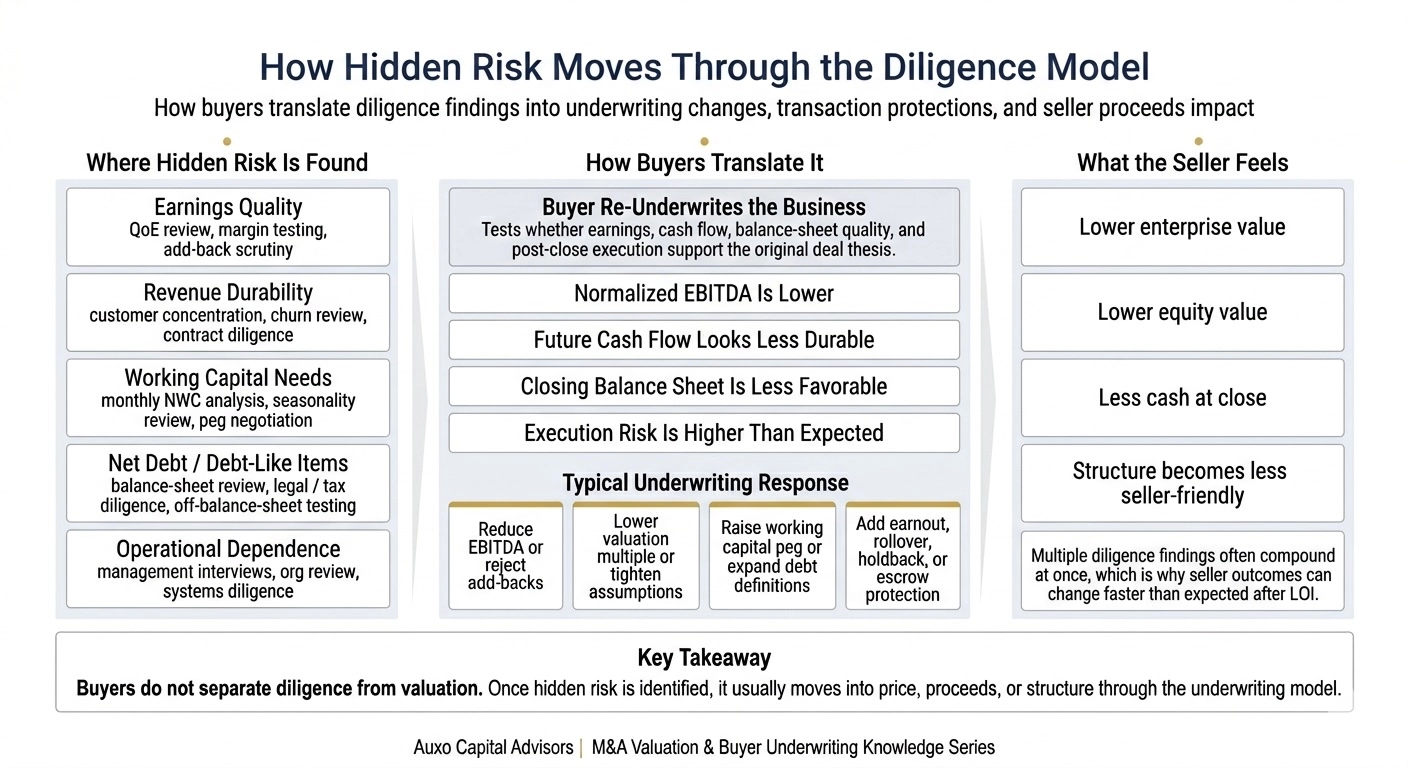
Read this framework from left to right. Buyers first identify where risk sits, then re-underwrite what those findings mean, and finally decide how to protect themselves economically. That protection may show up through price, but it can just as easily appear through working capital mechanics, broader debt-like deductions, escrow protection, earnouts, rollover equity, or other structural concessions.
That is why sellers should not think of diligence and valuation as separate phases. In a live process, they are part of the same economic system. Once hidden risk is found, the underwriting response usually follows quickly, and the seller feels the result through lower enterprise value, lower equity value, less cash at close, or a deal structure that becomes materially less seller-friendly.
Definitions Buyers Use During Diligence
Hidden risk is any issue not fully reflected in the initial marketing narrative, financial presentation, or preliminary valuation view that can impair cash flow, increase required investment, or reduce seller proceeds.
Normalized EBITDA is the buyer’s view of recurring operating earnings after removing unsupported, non-recurring, or owner-specific items. It is not simply management’s preferred adjusted EBITDA number.
Quality of earnings refers to how reliably reported earnings convert into sustainable, financeable, repeatable cash flow. For a fuller distinction, see quality of earnings vs. normalized EBITDA.
Working capital peg is the target level of normalized net working capital expected to be delivered at closing. If actual closing working capital falls below that level, seller proceeds generally decline. Auxo addresses the mechanics in this guide to the working capital peg in M&A.
Net debt typically means debt and debt-equivalent obligations minus cash, subject to negotiated definitions. In many deals, the argument is not whether net debt exists, but what belongs in the definition. See net debt in M&A and debt-like items in M&A.
Earnings Quality Is Usually the First Hidden-Risk Screen
The fastest way for a buyer to uncover hidden risk is to test whether reported EBITDA deserves to be capitalized at the indicated multiple. Buyers know that small errors in normalized earnings can have outsized valuation consequences. A $500,000 downward revision to EBITDA matters far more at 7x or 8x than most sellers expect. That is why QoE diligence is not a back-office exercise. It is often the first major underwriting checkpoint in the deal.
In practice, buyers look for patterns such as aggressive revenue cut-off, margin distortion from project timing, owner add-backs with partial recurring character, one-time expenses that recur every year under different labels, under-resourced SG&A, customer incentives not consistently captured, and EBITDA that appears healthy only because maintenance capex or staffing needs have been deferred. Many of the issues that trigger concern are described in what buyers flag in a QoE.
For sellers, the important distinction is between an explanation and a defense. Management can often explain why a number moved. That does not mean a buyer will underwrite it as durable. The buyer is asking a narrower question: if ownership changes tomorrow and the business must perform under ordinary controls, what earnings level should be capitalized? If the seller has not prepared that answer in advance, the buyer’s diligence team usually supplies its own.
Revenue Durability and Customer Concentration Reprice Faster Than Sellers Expect
Not all hidden risk sits in the financial statements. Some of the most consequential diligence findings relate to whether revenue can be retained and defended after closing. Buyers test customer concentration, contract assignability, pricing power, backlog quality, renewal behavior, sales-cycle dependence on the founder, and the extent to which recent growth reflects unusual temporary conditions rather than a durable trajectory.
Where sellers often misread the situation is by treating historical growth as proof of future stability. Buyers do not pay for the past. They pay for the probability that future cash flow will hold. If one customer represents 25% of revenue, if a handful of relationships are informal rather than contractual, or if growth was recently supported by pricing actions that may not recur, the buyer’s confidence in the earnings stream declines. Sometimes that shows up in the multiple; other times it appears through an earnout or larger rollover request, particularly when the buyer cannot fully validate future retention.
This is one reason final bids can diverge materially from initial indications. A business may have attractive trailing EBITDA and still receive a more conservative deal structure if revenue durability is less clear than first presented. Sellers comparing offers should keep this in mind when evaluating headline economics against certainty and terms, which becomes especially important in how founders should compare two M&A offers.
Working Capital Gaps Often Reduce Proceeds Without Changing the Headline Multiple
Working capital is one of the most common places hidden risk emerges late, partly because sellers tend to focus on enterprise value while buyers focus on the cash needed to operate the business on a stand-alone basis after closing. If the target has historically run light on inventory, stretched payables, slow-paid vendors, or unusually favorable collection timing, a buyer may conclude that the business requires more working capital than the marketing materials imply.
The resulting debate is often misunderstood. A seller may say, correctly, that the business has always operated this way. The buyer’s response is that post-close ownership still needs enough normalized working capital to support the earnings being purchased. That is why working capital discussions can feel disconnected from the stated multiple. The multiple may not move at all, but cash at close still declines if the agreed peg rises or if the closing balance sheet delivers less than the target. Auxo’s article on working capital peg mechanics addresses this issue in more detail.
Founders frequently underestimate how much leverage is lost once this issue appears late. If the buyer discovers the problem during confirmatory diligence rather than through seller-prepared analysis, the buyer usually controls the framing and can present the adjustment as a closing requirement rather than a negotiable preference.
Net Debt and Debt-Like Items Are Frequent Sources of Late-Stage Value Leakage
Many sellers understand that debt reduces equity value. Fewer appreciate how broad the negotiation can become once buyers begin testing for debt-like items. Deferred compensation, unpaid bonuses, sales tax exposure, customer deposits, unpaid transaction expenses, underfunded reserves, accrued legal liabilities, off-market leases, and certain pension or retention obligations can all become part of the closing deduction conversation depending on the facts and the purchase agreement language.
In this part of diligence, buyers are asking a simple question: what obligations must be satisfied, funded, or economically absorbed for the buyer to receive the business on the promised basis? The answer affects the bridge from enterprise value to equity value more directly than many sellers expect. A business can “trade” at an attractive multiple and still produce disappointing seller proceeds because the net debt and debt-like schedule expands late in the process. For more on this distinction, see net debt in M&A and debt-like items in M&A.
When these issues emerge, buyers often gain negotiating leverage beyond the numerical adjustment itself. They can argue that if closing mechanics were presented too optimistically, other management representations may also deserve tighter drafting. That can widen the impact from purchase-price reduction into legal and structural protections.
Operational and Management Gaps Can Shift Structure Even When Price Holds
Some hidden risks are not best solved through a lower purchase price. Buyers may instead ask for a structure that shifts execution risk back to the seller. This commonly happens when the founder remains central to customer relationships, sales conversion, technical know-how, or employee retention; when systems are underbuilt for scale; or when a company has weak financial reporting discipline relative to its size. In these cases, the buyer may leave the headline value largely intact but introduce an earnout, a larger rollover, a longer transition period, or tighter employment and non-compete provisions.
Sellers sometimes interpret this as a sign that the buyer still “likes the number.” In reality, structure can be a more important risk signal than price. A buyer willing to maintain headline value while increasing contingencies is often saying that the business might be worth the number, but only if post-close performance proves out. That distinction matters when assessing whether the apparent best bid is actually the best outcome, a dynamic that also explains why buyers walk away late in M&A deals once enough open risk remains unresolved.
Worked Example: How Hidden Risk Changes Enterprise Value, Equity Value, and Cash at Close
Consider a founder-led business marketed at $8.0 million of adjusted EBITDA with an LOI at 7.5x, implying a headline enterprise value of $60.0 million. Before diligence, the seller expects modest closing adjustments and assumes proceeds will roughly track that headline figure less funded debt.
| Item | Initial view | Post-diligence view |
|---|---|---|
| Adjusted / normalized EBITDA | $8.0M | $7.2M |
| Valuation multiple | 7.5x | 7.0x |
| Enterprise value | $60.0M | $50.4M |
| Funded debt | ($6.0M) | ($6.0M) |
| New debt-like items identified | $0.0M | ($1.8M) |
| Working capital shortfall to peg | $0.0M | ($1.2M) |
| Illustrative equity value / cash at close before escrows | $54.0M | $41.4M |
What changed? QoE work rejected several add-backs and showed margin softness in a major account, lowering normalized EBITDA by $0.8 million. Customer concentration and the lack of long-term contractual protection compressed the multiple from 7.5x to 7.0x. Balance-sheet diligence identified unpaid bonuses and transaction-related obligations treated as debt-like. Working capital analysis showed that the business had been running below a normalized level needed to support ongoing operations.
The seller’s mistake in this scenario would be to focus only on the multiple change. The larger story is that several hidden-risk findings compounded at once. First, enterprise value fell because the earnings base and risk profile deteriorated. Then equity value fell further because debt-like items and working capital mechanics reduced what the seller actually received. This is precisely why a disciplined sell-side M&A process needs seller-side preparation before confirmatory diligence begins, and why founders should not confuse enterprise value with net proceeds.
Common Mistakes Sellers Make When Hidden Risk Surfaces
When diligence starts uncovering hidden risk, many sellers make the situation worse by reacting emotionally instead of analytically. The issue is often not that a buyer found a question. It is that the seller responds in a way that confirms the buyer’s concern about reporting quality, preparedness, or management credibility.
The first mistake is treating every diligence finding as a negotiation tactic rather than a legitimate underwriting question. Some buyers do use diligence pressure opportunistically, but many issues are real. If management dismisses a QoE adjustment, a working capital concern, or a debt-like item without credible support, the buyer usually becomes more skeptical of the broader file.
The second mistake is defending headline EBITDA instead of defending normalized cash flow. Sellers often stay anchored to the number in the CIM or LOI. Buyers do not. Once diligence begins, the only earnings number that matters is the one the buyer believes is recurring, transferable, and financeable after closing.
The third mistake is arguing that “this is how we have always run the business.” That may be true for receivables, payables, inventory levels, customer concentration, or founder-led selling. It still does not answer the buyer’s question. The buyer is underwriting what the business must look like under new ownership, not simply accepting the habits of the prior owner.
The fourth mistake is letting one issue contaminate the whole narrative. A manageable concern can become a broader credibility problem if disclosures are inconsistent, support arrives late, or management explanations change over time. In live processes, buyers often widen their review once they believe one area was presented too optimistically.
The fifth mistake is focusing only on price. Sellers sometimes believe they “held the number” even as the buyer increases escrow, expands debt-like definitions, raises the working capital peg, or shifts more consideration into an earnout or rollover. In practice, hidden risk often moves through structure before it visibly moves through headline value.
The better response is to narrow the issue, quantify it, support the explanation, and keep the buyer from turning uncertainty into an open-ended discount. That is usually easier when the diligence defense was prepared before launch rather than assembled under pressure after the issue appears.
Seller Takeaway
Hidden risk during due diligence is not just a buyer problem to react to after LOI. It is a seller-preparation issue. The strongest sellers enter the market having already tested earnings quality, reconciled normalization adjustments, pressure-tested customer concentration and contract support, cleaned up working capital presentation, and mapped likely net-debt and debt-like debates before buyers do it for them.
If a risk item exists, the goal is not always to “eliminate” it. Often the goal is to frame it correctly, quantify it credibly, and prevent buyers from treating uncertainty as an unlimited discount. Preparation does not guarantee a perfect outcome, but it materially improves control over valuation, structure, and speed.
What Buyers Actually Focus On
Buyers rarely obsess over every issue sellers worry about. They tend to focus on a narrower set of questions with direct return implications.
First, can the buyer trust the earnings base? This is the gateway issue. If normalized EBITDA is not credible, the valuation discussion resets immediately.
Second, will revenue hold after closing? Historical growth helps, but buyers care more about renewal quality, concentration risk, pricing resilience, and how much of the sales engine is tied to one founder or a few individuals.
Third, how much cash must stay in the business? Buyers examine working capital needs, capex intensity, and the conversion from EBITDA to actual cash generation.
Fourth, what obligations will dilute proceeds? Net debt, debt-like items, and closing adjustments often matter more to final proceeds than broad conversations about “market multiples.”
Fifth, how much execution risk remains after closing? If integration, management continuity, reporting quality, or systems depth are weak, buyers protect themselves through structure. That can mean rollover, earnouts, holdbacks, or tighter documentation.
Seen through that lens, hidden risk is not mysterious. It is the set of facts that make the buyer less certain that the acquired cash flow will materialize on the terms implied by the headline deal. This same underwriting logic also shapes how different buyer types think about transactions, including how private equity actually prices deals in practice and when strategic buyers overpay and why it backfires.
Why Process and Positioning Matter When Hidden Risk Appears
When hidden risk surfaces, the seller’s outcome depends less on rhetorical skill than on process control. A buyer who discovers an issue first usually frames it first. That framing matters. If the issue is presented as evidence of weak reporting discipline, soft controls, or overstated adjustments, the buyer has room to seek concessions across price, structure, and legal terms. If the seller has already identified the issue, quantified it, and shown why the commercial impact is narrower than feared, the discussion is more likely to stay bounded.
This is where experienced sell-side M&A advisory can matter disproportionately. Good advisory work is not just about running outreach or managing a data room. It is about sequencing disclosures, preparing the diligence defense, preserving competitive pressure, and translating technical diligence findings into a market-based negotiation position. That includes knowing when a buyer’s concern is legitimate, when it is being overstated, and when another bidder may view the same issue differently.
It also means recognizing that the best answer to hidden risk is often preparation well before launch. Pre-sale analysis can improve both valuation support and credibility. Sellers who want an early sense of how buyers may frame the business can start with a market-grounded reference point such as Auxo’s business valuation calculator, then move into a more rigorous diligence readiness process through valuation services and transaction planning.
Pressure-Test Before You Go to Market
Before launching a sale process, founders should ask a harder question than whether the story sounds compelling. They should ask where a disciplined buyer is most likely to challenge the story once diligence begins. That pressure-test usually matters more than polishing the management presentation.
Pressure-test checklist for seller readiness:
- Earnings quality: Which add-backs, margin assumptions, or expense classifications would a buyer be most likely to reject or recast?
- Revenue durability: If the top customers, contracts, pricing gains, or backlog were scrutinized, what parts of the growth story would prove durable and what parts would look less transferable?
- Working capital: Would a buyer conclude that the business has been operating below a normalized working capital level needed to support the earnings being marketed?
- Net debt and debt-like items: What obligations could become closing deductions even if management does not currently think of them as debt?
- Founder dependence: If the owner stepped back after closing, which revenue relationships, operating decisions, or reporting processes would become harder to sustain?
- Diligence consistency: Are the CIM, management presentation, financial schedules, and data room support all aligned, or would a buyer find gaps between the narrative and the backup?
If a seller can answer those questions clearly before buyers ask them, the process usually stays more controlled. If not, the buyer often defines the issue first, frames the commercial impact, and gains leverage that is difficult to recover later. That is why preparedness is not separate from valuation defense. It is one of the main ways valuation gets defended in the first place.
Frequently Asked Questions
What does “hidden risk during due diligence” actually mean?
It refers to issues that were not fully reflected in the initial sale narrative, financial presentation, or preliminary valuation but become important once the buyer tests earnings quality, cash conversion, liabilities, customer durability, and operational dependence. The issue may be financial, commercial, operational, legal, or structural.
Do buyers always reduce price when they find hidden risk?
No. Buyers can respond through a lower price, a lower multiple, a different working capital peg, broader debt-like definitions, escrow protection, an earnout, or increased rollover equity. Sometimes the headline value stays similar while the seller’s certainty or cash at close declines.
Why is quality of earnings often the first major diligence issue?
Because the entire valuation depends on what level of EBITDA the buyer is willing to capitalize. If the earnings base is overstated or less durable than presented, the buyer’s model changes immediately. That is why QoE work often becomes the first major repricing checkpoint.
How do customer concentration issues affect valuation?
Concentration can affect both value and structure. Buyers may lower the multiple, assume higher churn risk, request an earnout tied to retention, or demand stronger transition support if revenue depends too heavily on a few relationships.
Can a deal lose value even if EBITDA is unchanged?
Yes. Working capital shortfalls, net debt adjustments, debt-like items, escrow expansion, and earnout pressure can all reduce seller proceeds or certainty without changing the headline EBITDA figure. Enterprise value and cash at close are not the same thing.
Why do buyers focus so heavily on working capital?
Because buyers expect the business to be delivered with enough normalized working capital to operate after closing. If the company has been run below that level, the seller may have to fund the shortfall economically through the peg or closing adjustment.
What are debt-like items in M&A?
They are obligations that function economically like debt even if they are not labeled traditional funded debt. Examples can include unpaid bonuses, deferred compensation, tax liabilities, customer deposits, or certain accrued expenses, depending on the facts and deal language.
Why do sellers feel surprised by diligence findings after signing an LOI?
Because many sellers interpret the LOI as proof of final value. Buyers usually see it as conditional on confirming earnings, cash flow, liabilities, contracts, and other risk items. If diligence changes the underwriting picture, the economics or structure often change as well.
Can strong growth offset hidden risk?
Sometimes, but not automatically. Buyers will ask whether the growth is durable, profitable, and transferable after closing. If growth depends on unusual conditions, one customer, or heavy founder involvement, it may not offset the perceived risk.
What hidden risks matter most in founder-led businesses?
Common concerns include founder-centric customer relationships, informal systems, limited management depth, concentrated decision-making, weak reporting infrastructure, and normalization adjustments that reflect owner preferences more than recurring economics.
How can sellers reduce the chance of a late-stage re-trade?
By preparing before launch: validating EBITDA adjustments, anticipating QoE questions, cleaning up balance-sheet items, understanding normalized working capital, organizing contracts and legal support, and entering the market with a credible diligence defense rather than a marketing-only narrative.
When does hidden risk cause buyers to walk away entirely?
Usually when several risk factors point in the same direction or when the issue undermines the core investment thesis. A buyer may continue through one manageable issue, but multiple concerns around earnings quality, customer durability, liabilities, and management depth can make the original deal no longer financeable or strategically attractive.
Media & Press Inquiries
Auxo Capital Advisors provides commentary on middle-market M&A valuation, buyer underwriting behavior, diligence risk, and transaction execution issues affecting founder-led companies. Journalists, podcast producers, and event organizers seeking perspective on how buyers evaluate businesses in live sale processes are welcome to reach out.
For media inquiries, interview requests, or permission-related questions, contact: info@auxocapitaladvisors.com
Disclosure
This article is provided for general informational purposes only and does not constitute legal, tax, accounting, investment, or transaction advice. The discussion is intended to explain how buyers commonly identify and respond to hidden risk during diligence in middle-market M&A transactions, but actual buyer behavior varies by industry, buyer type, financing environment, process dynamics, and the specific facts of the business under review.
Any financial illustrations in this article are simplified examples for explanatory purposes. Actual transaction outcomes depend on many variables, including diligence findings, normalized earnings methodology, working capital definitions, debt and debt-like determinations, purchase agreement language, negotiation leverage, financing terms, tax structuring, and competitive tension in the sale process. Sellers should obtain advice tailored to their specific circumstances before making transaction decisions.
About the Author
George Barsom is Founder & Managing Director of Auxo Capital Advisors. He advises founder-led and middle-market businesses on valuation, sell-side preparation, buyer positioning, and transaction execution.
His work focuses on the practical drivers of value in live M&A processes, including earnings quality, buyer underwriting behavior, deal structure, and the factors that determine whether a seller achieves not just an attractive headline price, but a strong and defensible outcome at closing.


