

Why Letters of Intent Are Not Final Value in Middle Market M&A
Updated May 16, 2026 for current middle-market buyer underwriting, LOI-to-close value movement, purchase-price adjustment practices, and the gap between headline LOI value, equity value, cash at close, and final seller proceeds.
Key answer: a signed letter of intent is usually a pricing indication, not a guaranteed seller outcome. Between LOI and close, buyers revisit quality of earnings, working capital, indebtedness, customer concentration, forecast credibility, legal exposure, and transaction structure. That process can change enterprise value, reduce equity value, shift consideration out of cash at close, or all three. The LOI may define the starting point for negotiations, but it rarely fixes final seller proceeds.
Why it matters: founders should not ask only whether the LOI number looks attractive. They should ask how much of that number survives diligence and converts into proceeds. That means understanding enterprise value to seller proceeds, net debt, debt-like items, working capital peg mechanics, and the role of sell-side M&A advisory before granting exclusivity.
Founders often treat a letter of intent as though it locks in value, but the economic outcome is still shaped by buyer diligence, bridge mechanics, and definitive-document negotiation. The practical issue is not only whether the stated LOI price changes. It is whether the same headline enterprise value converts into the same equity value, cash at close, and final seller proceeds after quality-of-earnings work, working-capital analysis, net debt review, and structure are applied.
Transaction context: an LOI sits between buyer interest and definitive closing economics. Before exclusivity, the buyer is working with preliminary information. After exclusivity, the buyer re-underwrites the business through quality-of-earnings review, legal diligence, commercial review, working-capital analysis, net debt review, and purchase agreement drafting. Founders should evaluate LOI value as a bridge from headline enterprise value to equity value, cash at close, structure, and final seller proceeds, not as a single fixed number.
This page connects directly to Auxo’s guides on why deals lose value during diligence, how founders should compare two M&A offers, why buyers walk away late in M&A deals, how buyers identify hidden risk during diligence, and valuation services.
Buyers do not view an LOI as the final answer to value. They view it as a conditional expression of value based on limited information. Before exclusivity, underwriting is often built from management conversations, preliminary financials, top-customer data, and high-level legal or commercial disclosures. After exclusivity, that preliminary view gets tested against quality of earnings work, customer data, contracts, tax, legal diligence, HR, IT, and purchase agreement mechanics.
That is why LOI-to-close value change is best understood as a bridge problem. A buyer may keep the same headline enterprise value but still lower proceeds by changing the working-capital expectation, adding more conservative treatment of indebtedness, tightening definitions around normalized EBITDA, or shifting part of consideration into earnouts, seller notes, or rollover equity.
In other situations, the buyer directly cuts price because risk was misjudged at LOI. Both outcomes feel like repricing to the seller, even if one happens through structure and the other through value.
Introduction
Many founders treat a signed LOI as if the deal is effectively done. That is understandable. The document often includes a headline purchase price, broad structure terms, exclusivity, and a target timeline. Emotionally, it feels like the finish line. Economically, it is usually the start of the hardest underwriting phase.
From the buyer’s perspective, the LOI is where interest becomes expensive. Once diligence costs begin to accrue, buyers sharpen their analysis because they are now committing real time, third-party fees, lender discussions, and internal resources to the transaction. If the target’s earnings quality, cash conversion, or risk profile proves weaker than expected, the buyer adjusts.
Sometimes that means lower price. Sometimes it means the same enterprise value with less cash at close. Sometimes it means the deal dies entirely, which is why late-stage deterioration often overlaps with the dynamics discussed in why buyers walk away late in M&A deals and how buyers identify hidden risk during diligence.
Executive summary
An LOI is not final value because buyers sign it before they know everything they need to know. The later phases of a deal are designed to test whether earnings are real, whether margins are durable, whether customers and employees are stable, whether the business requires more working capital than expected, and whether the seller’s presentation of the company holds up under third-party review.
There are four broad ways value changes between LOI and closing. First, the buyer may lower the valuation multiple or EBITDA base after diligence. Second, the buyer may keep enterprise value roughly flat but reduce equity value through debt, debt-like items, and working-capital adjustments. Third, the buyer may preserve nominal price while shifting more risk to the seller through contingent or subordinated consideration. Fourth, if risk expands too far relative to return, the buyer may abandon the transaction altogether.
For sellers, this means a headline LOI should never be read in isolation. The quality of the definitions, the purchase-price bridge, the structure of consideration, and the discipline of the process matter just as much as the top number on page one.
Key Takeaways
- An LOI usually reflects preliminary underwriting, not fully validated value.
- Final seller economics are shaped by the bridge from enterprise value to equity value and then to proceeds.
- Working capital, net debt, debt-like items, and purchase-agreement definitions frequently move value more than sellers expect.
- A buyer can preserve the headline number while shifting real risk into earnouts, rollover, or seller paper.
- Processes with weak preparation invite re-trades because buyers discover issues after exclusivity instead of before it.
- The highest LOI is not always the strongest offer if close certainty and proceeds quality are weaker.
How Value Changes from LOI to Close
The most useful way to think about this issue is as a bridge from headline enterprise value to actual seller economics. A signed LOI may establish an initial value indication, but that number is still subject to diligence, purchase-price adjustments, and structure. As a deal progresses, the buyer is not simply confirming the original bid. The buyer is testing how much of that value survives once earnings, bridge mechanics, and closing terms are examined in full detail.
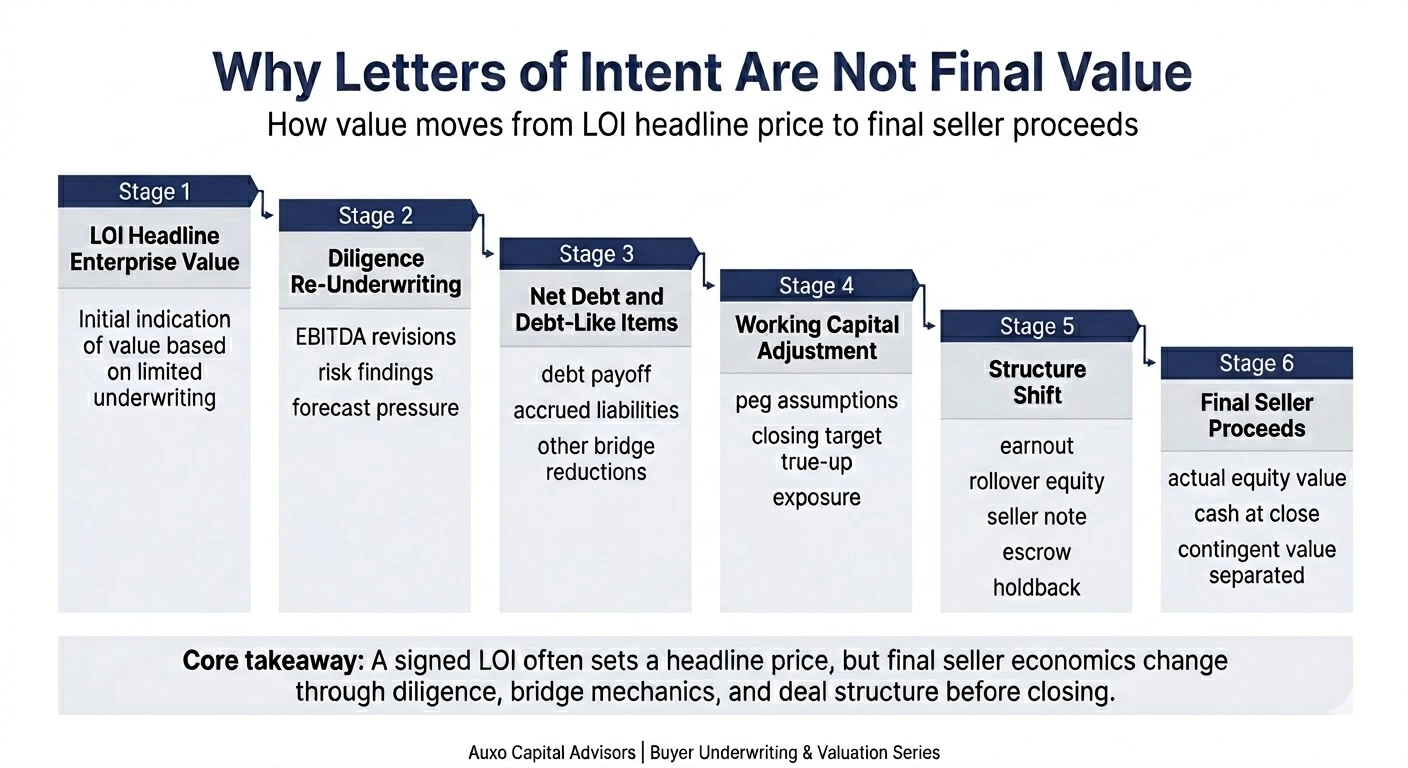
This is why sellers should never evaluate an LOI on enterprise value alone. In practice, the buyer’s model keeps evolving until documentation is complete and the closing statement is settled. Founders who understand this bridge early are better positioned to defend value, compare offers correctly, and avoid treating a preliminary indication as if it were final economics.
Definitions That Drive the Price Bridge
Several terms are routinely blended together in founder conversations, even though they affect value in very different ways.
| Term | Meaning | Why it matters between LOI and close |
|---|---|---|
| Enterprise value | Value of the operating business before capital structure adjustments | The headline LOI number is often stated here, not at actual seller proceeds |
| Equity value | Enterprise value less debt and debt-like items, plus or minus other agreed adjustments | This is closer to what the seller owns economically |
| Cash at close | The portion paid in cash when the deal closes | Can be materially lower than equity value if rollover, escrows, or notes are used |
| Working capital peg | Target level of normalized working capital delivered at closing | If set too high, seller proceeds fall dollar-for-dollar |
| Debt-like items | Liabilities treated as debt for purchase-price purposes | These often emerge more clearly during diligence and reduce proceeds |
When sellers understand these definitions early, they stop treating LOI price as a single fixed concept. For a fuller mechanics discussion, see Auxo’s articles on the working-capital peg and EV-to-equity bridge and how enterprise value converts to seller proceeds.
Headline Value Is Not the Same as Seller Proceeds
One of the most common sources of post-LOI disappointment is the gap between enterprise value and what the seller actually receives. A buyer may offer an eye-catching multiple, but that number sits above several layers of economic translation. Existing debt must be repaid. Certain accrued liabilities may be treated as debt-like. A working-capital target must be delivered. Part of the purchase price may be rolled into the new company, subordinated in a seller note, or deferred into contingent consideration.
This is why experienced sellers spend more time on the proceeds bridge than on the press-release number. If a founder signs an LOI at an attractive multiple but later learns that the peg is aggressive, accrued liabilities are being treated as debt-like, and 20% of consideration is moving into rollover equity, the practical deal value has changed even if the original enterprise value has not. The distinction becomes clearer when comparing net debt treatment, debt-like items, and the difference between a revenue peg versus a working-capital peg.
Founders sometimes treat these as legal details to be sorted out later. Buyers do not. Buyers view them as integral to valuation because they directly affect the amount of capital required to acquire the business and the amount of liquidity the seller extracts at close.
Diligence Is a Re-Underwriting Exercise
LOIs are written before buyers possess the evidence required to fully trust the earnings stream. During diligence, the buyer is not just confirming facts. The buyer is reassessing whether the original return case still works. That means looking at concentration, customer churn patterns, margin volatility, pricing power, management depth, backlog quality, capex needs, systems reliability, legal exposure, and tax issues. In sponsor-backed deals, lenders and investment committees intensify this process further.
If this re-underwriting reveals softer fundamentals, buyers will not preserve the original economics out of courtesy. They will seek to realign price and terms with the new risk profile. Sometimes the revision is explicit: lower EBITDA, lower multiple, lower enterprise value. Sometimes the revision is embedded in structure: more escrow, tighter reps, added earnout, or a larger rollover ask. Articles such as how private equity actually prices deals in practice and what actually increases EBITDA multiples in a sale help explain why the same company can appear more or less valuable depending on durability and risk.
Where buyer confidence most often deteriorates
Middle-market buyers are especially sensitive to issues that change confidence in forward cash flow. Revenue quality matters, but so does the reliability of gross margin, the dependence on a founder, the concentration of decision-making, and the amount of hidden working-capital support required to keep the business stable. In many deals, the debate is not whether historical EBITDA existed. It is whether that EBITDA is transferable and repeatable after ownership changes.
This is also where the strongest LOIs tend to distinguish themselves. Buyers with conviction and sector familiarity may sustain value through diligence because they understood the operating model better from the start. Others may have submitted a more optimistic LOI without fully appreciating the risk profile, which is one reason some processes produce wide valuation dispersion like the dynamics discussed in why businesses sell for 10x EBITDA versus 3x.
Deal Structure Can Reprice Value Without Changing the LOI Number
Not every economic reduction appears as a lower stated purchase price. Sophisticated buyers often preserve the headline value while transferring more execution or performance risk to the seller. This is one reason sellers should resist evaluating offers on nominal price alone.
| Structure tool | How buyers use it | Seller implication |
|---|---|---|
| Earnout | Defers payment until future performance is achieved | Some value becomes contingent and harder to control after closing |
| Seller note | Uses seller financing to complete the capital stack | Reduces immediate liquidity and adds repayment risk |
| Rollover equity | Requires seller to reinvest part of proceeds | Can preserve upside, but reduces cash at close and shifts risk profile |
| Escrow / holdback | Reserves funds against future claims or adjustments | Delays certainty and can shrink realized proceeds |
Each of these can be entirely legitimate, but none should be mistaken for cash-equivalent value. A dollar paid at close is not economically identical to a dollar tied to post-close performance or subordinated repayment. Sellers evaluating these tradeoffs should understand the mechanics of earnouts, seller notes, and rollover equity before they decide whether the buyer’s “unchanged” offer is really unchanged at all.
Where LOIs Commonly Lose Value Before Closing
Value slippage tends to cluster in a relatively small number of areas. Founders who understand these pressure points can prepare for them before market launch rather than negotiating them defensively in exclusivity.
1. EBITDA normalization does not survive review
Adjustments that seemed reasonable in management presentations may look aggressive once buyer accountants test them. Personal expenses are usually straightforward. “Temporary” margin compression, one-time labor inefficiencies, owner replacement assumptions, and projected synergies are more contentious. If the adjusted EBITDA base falls, the valuation range often falls with it.
2. Working capital requirements were understated
Many sellers focus on income statement performance and underestimate how much cash is tied up in receivables, inventory, and payables. A higher peg can reduce proceeds dollar-for-dollar. In seasonal or project-based businesses, this issue can become one of the largest value transfer points in the entire deal.
3. Debt-like items surface late
Unfunded bonuses, deferred compensation, accrued taxes, customer deposits, unpaid capex, off-balance-sheet obligations, and certain lease or litigation exposures may all become negotiation points. Whether every item should be treated as debt-like is a matter of drafting and process leverage, but the practical effect is the same: less equity value for the seller.
4. Forecast credibility weakens
If recent performance softens, pipeline conversion slips, or customer concentration proves less secure than first presented, buyers may stop underwriting the original growth case. That usually compresses both multiple confidence and structure generosity.
5. The buyer’s financing environment changes
Even when the company performs well, a buyer’s debt package or internal investment committee assumptions may tighten. A strategic acquirer may absorb the change. A financial buyer often cannot. In that situation, structure usually shifts before price does, but either can move.
These issues are interconnected. A weak forecast may lead to a larger earnout. A higher peg may reduce cash at close. A lower EBITDA base may create both a multiple reset and tighter lender terms. That cumulative effect is why sellers often feel surprised by how much economics changed despite apparently modest diligence findings.
Worked Example: From Attractive LOI to Lower Cash at Close
Consider a founder-led company that signs an LOI at 7.5x on $8.0 million of adjusted EBITDA. The headline enterprise value is $60.0 million. The founder initially interprets this as a $60.0 million sale.
| Item | At LOI | At close negotiation |
|---|---|---|
| Adjusted EBITDA | $8.0M | $7.5M after QoE revisions |
| Valuation multiple | 7.5x | 7.25x due to concentration and management depth concerns |
| Enterprise value | $60.0M | $54.4M |
| Net debt | $4.0M expected | $5.2M after debt-like items |
| Working capital peg adjustment | Assumed neutral | ($1.8M) to meet closing target |
| Equity value before structure changes | $56.0M | $47.4M |
| Rollover equity | 10% | 15% |
| Earnout | None | $3.0M contingent |
| Estimated cash at close | ~$50.4M | ~$37.3M |
The lesson is not that buyers are behaving improperly. The lesson is that the LOI never represented final proceeds in the first place. In this example, value moved at every stage: the EBITDA base fell, the multiple compressed, debt-like items increased, the working-capital target tightened, and more consideration shifted out of immediate cash. A founder focused only on the original 7.5x headline would have missed the real economics entirely.
This is the same reason sellers should model multiple offer scenarios before exclusivity. Even a simple planning tool such as Auxo’s business valuation calculator is most useful when paired with disciplined assumptions around debt, working capital, and structure rather than treated as a proceeds answer by itself.
Common Mistakes Founders Make After Signing an LOI
One of the most common seller mistakes is treating the headline enterprise value in the LOI as if it were effectively the same thing as final seller proceeds. In practice, the number on page one usually sits above several layers of economic translation. Net debt, debt-like items, working-capital adjustments, escrows, rollover requirements, and contingent consideration can all change what the seller actually receives. Founders who focus too heavily on the top-line number often discover late in the process that the economics they thought they agreed to were never the economics they were actually going to receive.
A second mistake is assuming that unchanged headline price means unchanged value. Buyers do not always lower the stated purchase price when they become less confident. Often they preserve the enterprise value and instead move risk into structure. That can mean more earnout, more rollover equity, a seller note, a larger escrow, or a more demanding peg. Economically, those changes matter just as much as a direct price cut, and sometimes more, because they reduce certainty while making the headline number look intact.
Another common error is entering exclusivity before pressure-testing the company’s likely diligence vulnerabilities. Once exclusivity begins, the seller’s leverage usually narrows. If the business has weak reporting, aggressive EBITDA adjustments, unresolved debt-like items, or an under-analyzed working-capital profile, those issues tend to surface when the buyer has more negotiating leverage, not less. At that point, even legitimate seller arguments can be harder to defend because the process no longer has the same competitive tension behind it.
Finally, many founders underestimate how much buyer fit affects whether an LOI will hold. Some buyers have a more durable understanding of the business model from the outset. Others submit aggressive early indications without fully appreciating concentration, transition risk, or cash conversion issues. Sellers who do not distinguish between a high-confidence buyer and an optimistic buyer can end up choosing the offer most likely to deteriorate after signing.
Seller Takeaway
If you are selling a business, do not ask only, “What is the LOI price?” Ask four harder questions: How was EBITDA normalized? What balance-sheet items will reduce equity value? What working-capital level will I be required to deliver? How much of the consideration is truly cash at close?
The best way to protect value is to surface weaknesses before buyers do. That means tightening financial reporting, preparing a defensible earnings story, identifying debt-like exposures, understanding seasonal working-capital needs, and presenting a credible management continuity plan. In founder-led companies, these steps often preserve more value than trying to negotiate after a buyer has already found the issue inside exclusivity.
It also means comparing offers on certainty, not just optics. A lower headline bid from a buyer with higher conviction, cleaner structure, and tighter diligence fit may produce better realized economics than a more aggressive LOI that unravels late.
What Buyers Actually Focus On
Buyers do not spend most of their time asking whether a seller “deserves” the LOI price. They spend their time asking whether the post-close investment still clears return thresholds once the business is owned under real-world conditions. That changes the discussion substantially.
Cash flow quality, not just EBITDA quantity
A buyer would rather acquire $7 million of highly durable EBITDA than $8 million of earnings dependent on one founder, two customers, and unusually favorable recent timing. The question is not merely the amount of earnings reported. It is whether those earnings convert to cash, survive customer and employee transitions, and remain stable under institutional ownership.
Risk transferability
Founders frequently carry risk informally. They solve customer disputes personally, approve pricing exceptions, maintain lender relationships, and retain employee loyalty through personality rather than process. Buyers discount businesses when these functions are not transferable. That discount may appear as a lower multiple, a larger rollover requirement, or a more contingent structure.
Negotiation leverage after exclusivity
Once exclusivity begins, the seller’s leverage usually narrows. Buyers know the seller has invested time, disrupted the organization, and often mentally committed to the transaction. Unless the process was run with unusual discipline, that leverage shift can make it easier for buyers to re-open economics. This is one reason founders should understand not only why value moves, but also why some companies never sell and why fragile readiness can undermine otherwise attractive processes.
Durability over optimism
A buyer’s best defense against overpaying is skepticism toward unsupported upside. That skepticism is not inherently adversarial. It is underwriting discipline. Where strategic buyers depart from that discipline, the consequences can be significant, which is part of the dynamic behind when strategic buyers overpay and why it backfires.
Why Process Discipline and Advisory Positioning Matter
LOI deterioration is not only a valuation issue. It is a process-control issue. Sellers with strong preparation, credible financial support, and competitive buyer tension are better positioned to prevent predictable re-trades. Buyers are less likely to press aggressively when they know the company has been presented with rigor, the numbers have been stress-tested, and alternative bidders remain plausible.
This is where experienced sell-side representation adds value beyond marketing the business. Good advisory work helps frame adjusted earnings properly, pressure-test diligence vulnerabilities before launch, manage buyer expectations around net debt and working capital, and keep negotiations focused on total economics rather than isolated headline terms. It also helps founders interpret whether a buyer’s revised position is fair re-underwriting, opportunistic repricing, or a sign the process should pivot.
In live transactions, negotiation leverage tends to come from preparation, alternatives, and clarity. If the seller can explain why adjustments are unsupported, why the peg is overstated, or why contingent consideration is being mispriced, value often holds better. If the seller reaches exclusivity with unresolved issues and no disciplined economic model, the buyer usually controls the conversation.
How Founders Should Pressure-Test an LOI Before Granting Exclusivity
Before signing an LOI and granting exclusivity, founders should pressure-test the offer the way an experienced buyer or advisor would. The objective is not simply to confirm that the headline valuation looks attractive. The objective is to understand how much of that value is likely to survive diligence, bridge mechanics, and documentation. In many middle-market deals, the real quality of an LOI is less about the opening number and more about how much hidden economic movement is still embedded beneath it.
A practical starting point is to ask five direct questions. First, what EBITDA definition is the buyer implicitly underwriting, and how vulnerable is that number to quality-of-earnings revisions? Second, what assumptions are being made around net debt, debt-like items, and the working-capital peg? Third, how much of the stated value is truly cash at close versus rollover, earnout, seller paper, or escrow? Fourth, how likely is it that customer, employee, or operating diligence will change the buyer’s confidence in the current valuation? Fifth, how much leverage will the seller lose once exclusivity begins, and what alternatives will remain if the buyer starts to reopen economics?
This exercise often changes how a founder evaluates the LOI. In some cases, it confirms that the buyer has underwritten the business carefully and that the offer is likely to hold. In other cases, it reveals that the apparent valuation is carrying too much unresolved risk, too much contingent consideration, or too much dependence on bridge assumptions that have not really been tested. Either way, the pressure test is useful because it helps the seller distinguish between a high headline offer and a high-confidence offer.
For owners who want to build that view more systematically, Auxo’s valuation services and business valuation calculator can provide a useful starting point. But the broader principle remains the same: before exclusivity begins, the seller should already understand where value can move, how structure can alter economics, and which parts of the offer are robust versus provisional.
Frequently Asked Questions
Is an LOI legally binding on price?
Usually no. While some provisions such as exclusivity, confidentiality, and governing law may be binding, the purchase price itself is typically subject to diligence, financing, definitive documentation, and closing conditions. The practical result is that price can move before closing even after an LOI is signed.
Why does a buyer issue an LOI before finishing diligence?
Because the LOI is designed to secure exclusivity and justify the cost of deeper diligence. Buyers cannot efficiently complete full underwriting on every target before narrowing the field. The LOI signals serious interest, but not final certainty.
Can the enterprise value stay the same while seller proceeds still fall?
Yes. This happens frequently. Higher net debt, more debt-like items, a tougher working-capital peg, added escrows, rollover requirements, or contingent consideration can all reduce cash to the seller without an obvious change to the stated enterprise value.
What is the most common reason value changes after an LOI?
The most common reason is that diligence changes the buyer’s confidence in normalized earnings or future cash flow durability. Once confidence falls, price, structure, or both usually change with it.
Are working-capital adjustments really that important?
Often yes. In many middle-market deals, working capital is one of the largest dollar-for-dollar pricing mechanisms in the purchase agreement. A seller who underestimates the peg can lose meaningful proceeds even when headline valuation appears strong.
Do buyers use earnouts as a way to lower price?
Sometimes. Earnouts can be a legitimate way to bridge uncertainty around growth or transition risk, but they also move value from guaranteed consideration to contingent consideration. Economically, that is not equivalent to cash at close.
How should a founder compare two LOIs?
Compare the full economic package: enterprise value, bridge items, working capital treatment, rollover, seller financing, earnout terms, diligence confidence, and close certainty. A lower but cleaner LOI can outperform a higher but fragile one.
Does quality of earnings always reduce value?
No. A strong quality-of-earnings review can reinforce the seller’s position and help sustain value. The problem arises when the seller’s adjustments, margin story, or cash conversion assumptions cannot be supported.
What are debt-like items in an M&A deal?
They are liabilities or obligations treated like debt for purchase-price purposes even if they are not labeled as funded debt on the balance sheet. Common examples include unpaid bonuses, deferred compensation, certain taxes, or unfunded obligations.
Why do founders feel blindsided by LOI repricing?
Because many founders anchor on the headline multiple and do not model the full path from enterprise value to final proceeds. If the company has not been prepared for buyer scrutiny, issues that seem minor internally can become major pricing items in exclusivity.
Can a well-run process reduce the chance of a re-trade?
Yes. Strong preparation, tighter financial support, better buyer selection, and credible competitive tension all reduce the buyer’s ability to reopen economics opportunistically and improve the seller’s ability to defend value when real issues arise.
When should a seller start preparing for LOI-to-close value risk?
Before going to market. By the time exclusivity begins, most leverage has already shifted. Sellers preserve more value when they identify likely diligence issues, bridge items, and structure pressure points in advance rather than negotiating them for the first time late in the process.
Media & Press Inquiries
Auxo Capital Advisors regularly comments on middle-market valuation, buyer underwriting, transaction structure, and sell-side process dynamics. Journalists, podcast hosts, and industry publications covering M&A pricing behavior or founder liquidity events are welcome to reach out.
For interview requests, commentary, or quoted insights, contact Auxo Capital Advisors at info@auxocapitaladvisors.com. Please include your outlet, topic, deadline, and intended angle so the inquiry can be routed appropriately.
Disclosure
This article is provided for general informational purposes only and does not constitute legal, tax, accounting, investment, or transaction-specific advice. The observations here are intended to explain common valuation and purchase-price dynamics in middle-market M&A transactions, but actual outcomes vary materially based on industry, buyer type, diligence findings, leverage conditions, contractual terms, and negotiation leverage.
Any examples, scenarios, or numerical illustrations in this article are simplified for explanatory purposes and should not be treated as predictions of value or proceeds in any particular transaction. Final economics in a sale process depend on buyer-specific underwriting, quality of earnings findings, financing markets, legal drafting, tax treatment, working-capital mechanics, debt and debt-like adjustments, indemnity structure, and the competitive context of the process.


