

Why Buyers Walk Away Late in M&A Deals
Updated May 16, 2026 for founder-led and middle-market M&A processes where buyers often revisit earnings quality, working capital, net debt, financing support, and management transferability after signing a letter of intent.
Key answer: buyers usually walk away late in M&A deals when diligence changes their view of risk enough that the original transaction no longer clears their return threshold, credit support, financing case, or investment-committee standard. Late-stage failures are rarely caused by one isolated discovery. More often, the buyer loses conviction because several issues begin to compound: earnings are less durable than expected, customer or management risk looks higher than presented, working capital turns out to be tighter than modeled, debt-like items reduce seller proceeds, or management credibility weakens during diligence.
Why it matters: a signed LOI is not the finish line. A deal survives only if the business holds up through quality-of-earnings review, working capital target negotiations, net debt review, debt-like item analysis, and the bridge from enterprise value to seller proceeds.
Late-stage acquisition failure is best understood through buyer conviction rather than a single broken deal step. In middle-market M&A, a buyer that once appeared committed can still lose confidence after LOI if diligence changes the view of earnings quality, customer durability, management transferability, working capital, debt-like items, financing support, or the structure required to close.
Transaction context: late-stage buyer withdrawal sits after the LOI but before closing, when buyer interest has to become fully underwritten transaction certainty. The core issue is whether the company still supports the price, structure, financing, investment-committee approval, and risk allocation the buyer believed it was agreeing to when exclusivity began.
This page connects directly to Auxo’s guides on why deals lose value during diligence, why letters of intent are not final value, how buyers identify hidden risk during diligence, valuation services, and sell-side M&A advisory.
Founders often assume that once a buyer signs an LOI, the remaining work is mostly confirmatory diligence and legal documentation. That is not how disciplined buyers behave. The LOI reflects a preliminary underwriting view built on incomplete information. After exclusivity begins, the buyer moves from broad interest to a harder test of whether cash flow, growth durability, operating risk, and transaction structure still support the original bid.
That distinction is central to understanding why acquisition deals fail late. Many deals do not collapse because the company is unsellable. They collapse because the buyer’s confidence drops below the level required to close on the negotiated terms. Sometimes that produces a price reduction. Sometimes the buyer asks for more structure, such as a larger seller note or more rollover equity. Sometimes the risk gap becomes too large, and the buyer exits completely.
For sellers, the point is not simply to avoid bad buyers. It is to reduce the number of facts that can be discovered late, reinterpreted conservatively, or used to reopen value after exclusivity begins. That is where preparation, credible financial presentation, and disciplined sell-side M&A execution matter.
Why late-stage buyer withdrawal happens more often than sellers expect
Late-stage deal breakage is especially frustrating because the seller has already paid the emotional and operational cost of getting deep into a process. Time has been spent on management presentations, diligence uploads, customer calls, lender discussions, legal drafts, and internal planning around a likely closing. When a buyer leaves at that point, the seller does not just lose a transaction. They often lose momentum, confidentiality insulation, and negotiating leverage with backup parties.
The harder truth is that late-stage breakage is a predictable result of how buyers underwrite uncertainty. Buyers are not paying for historical EBITDA in the abstract. They are paying for future cash flow they believe they can own, finance, and defend. If diligence makes that future look less stable, the deal will be repriced, restructured, or abandoned.
Sellers who understand that dynamic are better positioned to prepare the business, frame the diligence narrative, and keep one buyer’s changing view from becoming the market’s new consensus. That is especially important in founder-led and lower-middle-market transactions, where data quality, management depth, customer concentration, and working-capital mechanics can all become more important after LOI than they appeared before LOI.
Executive summary
Most late-stage M&A failures follow the same pattern. A buyer signs an LOI based on a preliminary understanding of earnings, operations, growth, and risk. Diligence then reveals one or more issues that may not destroy value on their own but weaken confidence in the original underwriting. Once that confidence falls, the buyer rethinks price, structure, financing, internal approval, and post-close risk. If the gap becomes too wide, the buyer walks.
The most common sources of late-stage failure are weak earnings quality, unfavorable working-capital dynamics, underappreciated debt-like items, customer or supplier concentration, owner dependence, unconvincing forecasting, legal or compliance issues, and management inconsistency during diligence. Financing pressure and investment-committee discipline can accelerate the outcome. A buyer does not need to hate the business to leave. It only needs to decide the deal no longer works on the terms originally agreed.
For sellers, the practical lesson is straightforward: reduce the number of variables a buyer can discover, reinterpret, or weaponize during exclusivity. That means preparing for financial diligence, understanding how value translates into proceeds, pressure-testing the issues buyers are likely to challenge, and running a process that preserves leverage if one party starts to retrade or pull back.
Key takeaways
- Late-stage buyer walkaways usually reflect cumulative loss of conviction, not one isolated issue.
- The LOI is a provisional view of value; diligence is where buyers test whether that value survives scrutiny.
- Quality of earnings, working capital, debt-like items, and management credibility are common pressure points.
- Many deals that appear to fail on “price” were actually broken by structure, financing, or risk allocation.
- Once a buyer is in exclusivity, any surprise can be used to push for lower price, more rollover, a seller note, or tighter legal terms.
- Seller preparation is not just about defending valuation. It is about preserving leverage before a buyer has the right to reinterpret the deal alone.
The Late-Stage Deal Break Framework
When buyers walk late, the immediate explanation usually falls into one of a few buckets: earnings no longer look as trustworthy as expected, risk looks higher than expected, structure becomes less attractive, financing support softens, or the buyer loses confidence in management. Those categories overlap more than sellers often realize. A working-capital shortfall, for example, is not just a mechanics issue. It can change financing needs, reduce cash at close, suggest lower earnings quality, and lead the buyer to question how well the business has been represented.
The practical framework below captures how a deal moves from signed LOI to repricing, restructuring, or withdrawal. The key point is that most late-stage failures are cumulative. By the time a buyer exits, the visible issue may only be the final link in a broader re-underwriting chain.
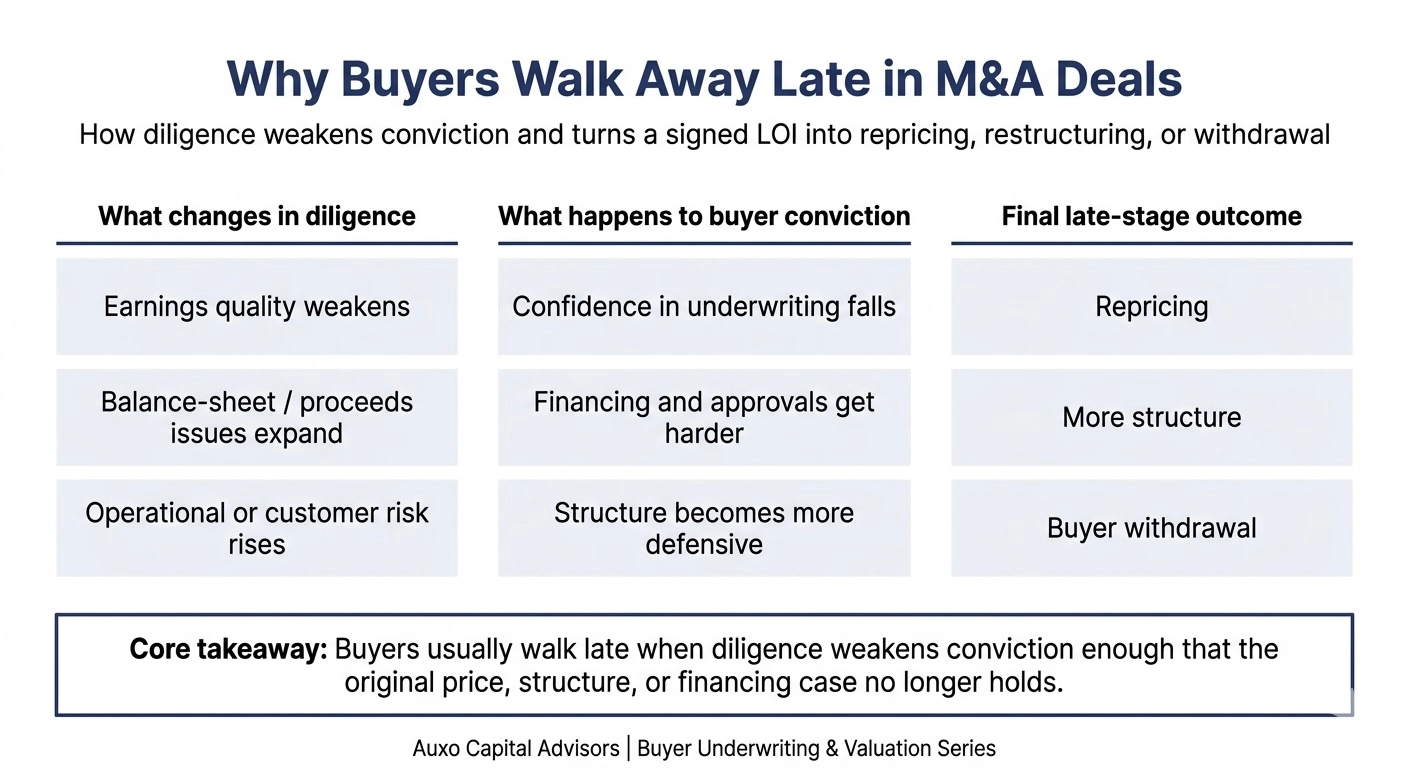
This is why late-stage failure should be viewed as an underwriting chain reaction. A deal can remain attractive strategically and still fail economically once the combined effect of diligence, proceeds mechanics, management confidence, and financing pressure becomes too large to bridge.
Definitions that matter when a buyer starts to retrade or withdraw
LOI. A letter of intent is typically a non-binding statement of proposed value and core terms, subject to diligence, financing, legal review, and final approvals. Sellers who treat it as final value usually underestimate how much room still exists for repricing.
Quality of earnings. A deeper review of the sustainability and conversion of reported earnings. It is different from a seller’s internal add-back schedule. The distinction matters, which is why the gap between quality of earnings and normalized EBITDA so often drives late-stage debates.
Working-capital peg. The agreed target level of working capital to be delivered at closing. If it is set too high, seller proceeds fall. If historical seasonality or billing patterns were misunderstood, the dispute can become a serious source of friction. Auxo covers this in more detail in its discussion of the working-capital peg in M&A.
Debt-like items. Obligations treated economically like debt even if they are not labeled conventional funded debt. Common examples include unpaid bonuses, deferred compensation, tax liabilities, customer deposits, and certain accrued expenses. These items can materially reduce equity value, as explained in Auxo’s analysis of debt-like items and net debt in M&A.
Retrade. A buyer’s effort to change price or terms after diligence has begun. Not every retrade is abusive; some reflect real underwriting changes. But some are also process tactics used when sellers lack alternatives.
Where deals actually break after an LOI
The market tends to describe failed deals with shorthand explanations: financing fell apart, diligence uncovered something, management was difficult, legal terms got contentious. Those explanations are directionally true but usually too simple. In live processes, late-stage failure typically starts in one of four areas.
1. Financial diligence changes the earnings base
The most common problem is that the buyer’s assumed EBITDA turns out to be less durable than the seller presented. That can happen because customer rebates were under-accrued, add-backs were aggressive, margins were temporarily inflated, owner expenses were not normalized correctly, or revenue timing obscured real cash conversion. Buyers pay close attention to the kinds of issues highlighted in what buyers flag in a QoE review. If the revised base level of earnings falls enough, even a high-quality business may no longer support the original bid.
2. Purchase-price mechanics reduce actual proceeds
Sellers often focus on enterprise value while buyers focus on what they will need to fund and what they will actually receive at closing. When working capital is set above the seller’s expectation, or when previously unmodeled debt-like items surface, the economic deal shifts. This is where founders can feel blindsided: the buyer says the headline multiple is unchanged, but proceeds are lower. Auxo’s explanation of enterprise value to seller proceeds is particularly relevant here because many apparent “walkaways” begin with a proceeds shock rather than a pure value shock.
3. Business risk proves more concentrated than expected
During confirmatory review, buyers often discover that revenue concentration, founder dependence, churn risk, supplier fragility, or operational controls are less robust than the initial materials suggested. If the business relies too heavily on one owner, one facility, one customer, or one implementation partner, the buyer may still want the company but no longer at the same cash-at-close profile.
4. The seller process erodes trust
Deals also fail because management meetings, data responses, and issue handling make the buyer question whether they are seeing the full picture. Slow responses, changing answers, undocumented adjustments, and visible tension within the management team can shift the process from collaborative diligence to defensive diligence. Once that happens, the buyer becomes more skeptical on everything else.
Why buyers re-underwrite the deal instead of simply closing it
Buyers are not trying to confirm that a business is perfect. They are trying to determine whether the total return case still works. That means underwriting from multiple angles at once: stand-alone cash flow, downside protection, leverage support, management continuity, integration complexity, and exit optionality. An issue that looks minor to a seller can matter greatly if it weakens two or three of those dimensions at the same time.
For example, imagine a customer concentration issue that also affects lender appetite. The strategic logic may remain intact, and the sponsor may still like the business, but if leverage availability drops by half a turn and the customer contract rollover looks uncertain, the buyer’s required equity check rises while perceived risk rises too. At that point, they may need a different price, more structure, or a different post-close alignment mechanism. This is one reason sellers should understand not only valuation ranges but also how buyers think about downside and why they sometimes behave exactly as described in why buyers discount valuation.
Late-stage failures also happen because the buyer’s internal model is being tested by parties the seller never sees. Lenders, investment committees, and operating partners may all challenge assumptions. The deal team that loved the opportunity may still lose if the broader underwriting system concludes that the original thesis no longer clears the required bar.
A late-stage problem is often a structure problem before it becomes a walkaway problem
One of the biggest misconceptions in M&A is that a buyer either accepts value or rejects value. In reality, buyers can accept much of the company’s value while rejecting the requested structure. That difference matters because structure is often the last line of defense before a buyer exits.
Suppose diligence introduces uncertainty around near-term earnings durability. The buyer may respond by reducing cash at close and asking for a seller note, a larger rollover equity component, or tighter indemnity protections. From the buyer’s perspective, that is not necessarily a loss of interest. It is a reallocation of risk. From the seller’s perspective, it can feel like a broken deal because the economic certainty they expected has disappeared.
The same dynamic appears in working capital and debt treatment. A business can maintain the same enterprise value but produce meaningfully lower proceeds once net debt, debt-like items, and peg adjustments are fully negotiated. If the seller refuses those changes and the buyer refuses to absorb the risk, the narrative becomes “the buyer walked away.” Economically, though, the buyer may have walked away from a structure mismatch rather than from the company itself.
Management confidence and seller credibility can break a deal faster than a spreadsheet issue
Experienced buyers expect to find imperfections in diligence. They are less tolerant of explanations that move over time, unsupported claims about customer behavior, and management teams that do not appear aligned on the business they are selling. Confidence in management is not a soft factor. It is an underwriting factor, because transition risk, post-close execution, and the reliability of the diligence narrative all depend on it.
In founder-led companies, this pressure is amplified. If the founder has historically absorbed too many commercial, customer, or operational functions, the buyer must get comfortable that those responsibilities can be transferred or institutionalized. If that handoff plan feels thin, the buyer may decide the business is less transferable than assumed. That can lower value, increase earnout or rollover requests, or cause the buyer to stop entirely.
Credibility problems also compound other issues. An isolated margin question may be manageable. The same question becomes far more dangerous if the buyer already suspects reporting discipline is weak. Once trust declines, the buyer interprets every gray area more conservatively. That is often the hidden turning point in late-stage failures.
Financing and investment-committee pressure can kill a deal even when the buyer still likes the company
Sellers often underestimate how many constituencies need to stay aligned for a deal to close. Private equity-backed buyers may need lender support, internal investment-committee approval, operating partner endorsement, and agreement on final legal risk allocation. Strategic buyers face their own approval layers, especially when budgets, synergies, or integration plans are under pressure. A company can remain attractive and still fail if one of those approval bodies concludes that the updated risk-return profile no longer fits.
This is especially common when leverage assumptions change. If diligence lowers adjusted EBITDA, lenders may reduce debt capacity. If customer concentration or cyclicality looks worse than first presented, credit terms may tighten further. The buyer then has to decide whether to write a larger equity check, accept a lower return, or walk. In many cases, that is where the process ends.
Committee pressure also matters when markets move during exclusivity. If comparable deals soften, financing costs rise, or a buyer’s portfolio develops problems elsewhere, tolerance for marginal risk can disappear. Sellers cannot control those external factors, but they can reduce their vulnerability by entering diligence with cleaner data, stronger preparation, and a process that does not leave them dependent on a single buyer’s internal politics.
Worked scenario: how a signed LOI can still die in diligence
Consider a founder-led industrial services company that signs an LOI at 6.5x EBITDA based on a stated $8.0 million of adjusted EBITDA. The headline enterprise value is $52.0 million. The seller expects roughly that amount less ordinary debt and transaction fees.
| Item | At LOI | After diligence |
|---|---|---|
| Adjusted EBITDA | $8.0M | $7.2M |
| Implied multiple | 6.5x | 6.0x to 6.25x proposed |
| Enterprise value | $52.0M | $43.2M to $45.0M |
| Net debt | $6.0M expected | $6.0M confirmed |
| Debt-like items | $0.5M assumed | $2.0M identified |
| Working-capital adjustment | Neutral expected | $1.5M shortfall to peg |
| Cash at close before fees | $45.5M | $33.7M to $35.5M |
What happened? The quality-of-earnings review removed $0.8 million of add-backs tied to temporary margin improvement and under-accrued service costs. Customer concentration also proved worse than management’s first presentation implied, so the buyer reduced the multiple. During purchase-price review, the buyer identified additional deferred compensation and accrued liabilities as debt-like items. Finally, trailing working capital was below the level needed to operate normally post-close, creating an additional adjustment.
The seller may still say, accurately, that the buyer “walked away late.” But the buyer’s view is different: the original enterprise value no longer reflected the real earnings base, the real funding need, or the real economic purchase price. The buyer did not need to conclude that the company was bad. It only needed to conclude that the original deal was wrong.
This example also shows why enterprise value and seller proceeds should never be blended together. A founder focused only on the 6.5x headline multiple can miss the fact that the real fight is now happening across earnings normalization, net debt, debt-like items, and the working-capital peg. By the time those items are fully bridged, the buyer may be asking for a fundamentally different deal.
Common Mistakes Founders Make When a Buyer Starts Pulling Back Late
One of the most common seller mistakes is assuming that one issue must have caused the entire late-stage breakdown. In practice, buyers rarely walk because of a single isolated discovery. More often, several issues begin to reinforce each other. A modest EBITDA adjustment may also weaken lender confidence, which then changes return math, which then makes working-capital or debt-like disputes harder to absorb. Founders who focus on only the last visible issue often misunderstand the broader underwriting shift that is actually driving the buyer’s behavior.
A second mistake is treating all late-stage buyer pressure as bad-faith bluffing. Some retrades are tactical, but many reflect real changes in how the buyer now sees earnings durability, operational risk, or funding needs. Sellers who assume every objection is fake may miss the chance to isolate which concerns are defensible, which need rebuttal, and which genuinely require a change in structure or process posture.
Another common error is reacting emotionally instead of analytically once the buyer starts pulling back. By that stage, founders are often tired, heavily invested in the closing, and frustrated by how much time has already been spent. That can lead to two opposite but equally costly responses: rejecting every buyer concern outright, or conceding too quickly because the process feels too painful to restart. Neither response is strategic. The better approach is to separate price issues, structure issues, trust issues, and financing issues before deciding how to respond.
Finally, many sellers underestimate how much leverage they lose when they become dependent on one buyer. If alternatives have gone cold, diligence responses are disorganized, or management has already begun behaving as if the deal is done, the buyer has more room to reframe problems and less fear of being replaced. That is why process discipline matters long before a buyer starts to wobble late.
Seller takeaway: reduce the reasons a buyer can lose conviction
The most effective way to prevent a late-stage walkaway is not to “push harder” after an LOI. It is to enter the process with fewer loose ends that can be reframed as risk once exclusivity begins. Sellers who prepare well do three things before the market tests them: they tighten the earnings story, they understand the proceeds bridge beneath headline value, and they present a management narrative that survives diligence without constant revision.
That means pressure-testing add-backs, understanding the buyer’s likely diligence questions, modeling working capital realistically, identifying obligations that may be treated as debt-like, and preparing management for consistent answers. It also means running a process that preserves alternatives if one buyer starts to retrade. When a seller depends on a single counterparty after LOI, the buyer’s leverage increases sharply. When the seller enters diligence with organized data and a controlled narrative, the buyer has fewer openings to redefine the deal.
What buyers actually focus on late in the process
Late in a deal, buyers are usually not asking whether they still like the company in broad strategic terms. They are asking a narrower and more consequential set of questions.
Is the earnings base real and repeatable?
They want to know whether current EBITDA can be trusted as a basis for leverage, valuation, and future return. This is why quality-of-earnings work receives so much attention. If reported performance depends on unusual timing, weak accrual discipline, temporary price-cost lag, or aggressive adjustments, the buyer’s willingness to close erodes quickly.
How much cash is actually required to own the business?
Buyers do not underwrite enterprise value in isolation. They underwrite the total funding need. That includes net debt, debt-like items, true working-capital needs, transaction expenses, and any expected post-close cleanup. Sellers who want a clearer early read on valuation expectations often use tools like Auxo’s business valuation calculator, but live transactions require a much more detailed bridge from headline value to actual economics.
Will management and the business transfer cleanly?
If revenue relationships, operations, or key employees are too founder-centric, the buyer will rethink both value and structure. The issue is not only succession. It is whether the acquired business can perform after control changes hands.
Does the final deal still fit the buyer’s approval environment?
Even if the company remains interesting, the buyer still needs the deal to fit lender constraints, committee expectations, and portfolio priorities. When that fit weakens, withdrawals become more likely.
Why process discipline and sell-side advisory execution matter
Good sell-side process design does not eliminate buyer diligence risk, but it changes how much control the seller keeps once issues emerge. That is one of the main reasons experienced founders work with advisors who understand not only valuation but also buyer behavior, diligence sequencing, and negotiating leverage. In a properly run sell-side M&A advisory process, the objective is not merely to obtain a high LOI. It is to secure terms and competitive tension that can survive the period when buyers have the greatest opportunity to retrade.
That discipline shows up in several places. It affects how the financial story is framed before indications are received. It affects whether diligence issues are surfaced early or discovered under exclusivity. It affects whether the seller has a defensible view on normalized EBITDA, working capital, and proceeds. It affects whether backup buyers remain warm enough to matter. And it affects how management is prepared for the meetings that often determine whether buyers gain confidence or start to pull back.
Advisory value also becomes clear when a buyer raises a legitimate issue late. Without structure and preparation, the seller may view every late request as bad faith. In reality, some issues warrant adjustment, some warrant rebuttal, and some warrant a change in process posture. Knowing the difference is essential. Sellers who approach late-stage friction with disciplined analysis rather than emotion tend to preserve more value and maintain more optionality.
How Founders Should Pressure-Test Walkaway Risk Before Exclusivity
Before granting exclusivity, founders should pressure-test the transaction the way a disciplined buyer, lender, and investment committee will. The objective is not to prove that every risk can be eliminated. The objective is to identify which issues are most likely to weaken conviction enough that the buyer either retrades, restructures the consideration, or walks. In many processes, that exercise is the difference between a durable LOI and a fragile one.
A practical starting point is to ask five direct questions. First, would a third-party quality-of-earnings review likely validate the seller’s adjusted EBITDA, or expose material weakness in add-backs, accrual discipline, or margin durability? Second, are working capital, net debt, and debt-like items already understood well enough that the bridge from enterprise value to proceeds will not surprise the seller late? Third, would customer concentration, founder dependence, or operational controls look stronger or weaker once a buyer digs in beyond the management presentation? Fourth, does the buyer appear likely to stay constructive if diligence uncovers moderate issues, or is the deal overly dependent on a fragile financing or committee case? Fifth, if the buyer starts to pull back, does the seller still have enough process leverage and optionality to respond from a position of strength?
This exercise often changes how a founder prepares for market. In some situations, it confirms that the company is relatively well prepared and the main task is managing process discipline. In others, it reveals that a few improvements, such as tightening the earnings narrative, clarifying debt-like items, or organizing management around a more consistent transfer story, could materially reduce walkaway risk. Either way, the pressure test is useful because it turns a vague fear of “deal risk” into a more concrete map of where conviction is most likely to fail.
For owners who want a structured starting point, Auxo’s valuation services and business valuation calculator can help frame the valuation side of the process. But preserving a live deal requires more than a headline range. It requires understanding which facts, if discovered late, would give a buyer real cause to change the deal or leave it entirely.
Frequently asked questions
Why do acquisition deals fail late instead of earlier?
Because the LOI is based on preliminary information. The hardest underwriting work happens after exclusivity begins, when buyers review earnings quality, customers, contracts, legal exposure, working capital, and financing support in greater detail. Problems that were not visible earlier often emerge then.
Does a buyer walking away late mean the business is unsellable?
No. It often means that one specific buyer no longer liked the deal on the original terms. The company may still be attractive to other buyers, especially if the issues can be explained, corrected, or reframed before re-engaging the market.
What is the most common reason buyers back out after an LOI?
Financial diligence is one of the most common causes, particularly when adjusted EBITDA does not hold up under a quality-of-earnings review. However, late failures are often multi-factor situations involving earnings, working capital, debt-like items, and confidence in management.
Can a deal fail even if the buyer still believes in the strategic fit?
Yes. Strategic fit does not guarantee that the economics work. If financing weakens, risk rises, or the required return falls below threshold, a buyer may still walk despite liking the business.
How do working capital issues cause late-stage deal failure?
If the buyer concludes that more working capital is required to operate the business than previously expected, seller proceeds can fall materially. Disputes over the peg can also signal that the business was not understood or presented accurately, which can damage trust in the broader process.
What role do debt-like items play in a failed transaction?
Debt-like items increase the buyer’s effective funding need and reduce the seller’s equity value. If enough previously unmodeled obligations appear during diligence, the economic gap between the parties can become too wide to close.
Are late-stage retrades always a sign of bad-faith buyer behavior?
No. Some retrades reflect real changes in underwriting based on new information. Others are more tactical. The seller’s job is to distinguish between the two and respond from a position of data and process leverage rather than assumption.
Why does management credibility matter so much late in a deal?
Because buyers are underwriting transition risk as well as financial results. If management appears inconsistent, defensive, or overly founder-dependent, the buyer may conclude that post-close execution risk is higher than originally assumed.
Can lenders or investment committees cause a buyer to walk?
Absolutely. Many deals fail because the buyer’s internal approval or financing environment changes after diligence. The deal team may still support the transaction, but the deal cannot close without broader approval.
How can sellers reduce the risk of a late-stage walkaway?
By preparing early. That includes tightening financial reporting, pressure-testing add-backs, understanding working capital and debt-like items, organizing diligence materials, and running a process that preserves alternatives if one buyer begins to retrade.
Is a higher LOI always the best offer to accept?
No. A higher LOI from a buyer with weak conviction, thin financing support, or aggressive adjustment assumptions can be less attractive than a lower but more credible offer. Headline value and close certainty should be evaluated together.
What should a founder do if a buyer starts to pull back late in diligence?
The first step is to isolate whether the issue is price, structure, underwriting, or trust. From there, the seller can decide whether to rebut the point with better support, adjust the structure, re-open competitive tension, or disengage before more leverage is lost.
Media & press inquiries
Auxo Capital Advisors welcomes media and professional inquiries related to middle-market business valuation, buyer underwriting behavior, sell-side execution, and transaction dynamics in founder-led M&A processes.
For interview requests, commentary, or publication inquiries, please contact info@auxocapitaladvisors.com. Please include your deadline, topic, and the context for the request so the inquiry can be routed appropriately.
Disclosure
This article is provided for general informational purposes only and reflects advisory observations about how buyers commonly evaluate risk and make decisions during an M&A process. It is not legal, tax, accounting, or investment advice, and it should not be relied upon as a substitute for transaction-specific professional guidance.
All examples are illustrative. Actual transaction outcomes depend on company-specific diligence findings, buyer type, financing conditions, competitive process dynamics, legal documentation, tax structure, negotiation leverage, and broader market conditions. A buyer’s decision to proceed, retrade, or withdraw can also be influenced by internal approval factors that are not visible to the seller.


