

Why Some Companies Never Sell
Updated May 16, 2026 for founder-led and middle-market M&A processes where buyers assess saleability through transferability, founder dependence, earnings credibility, diligence readiness, buyer universe fit, and the owner’s willingness to accept executable deal structure.
Key answer: some companies never sell because they never become sufficiently transferable, underwritable, or diligence-ready for a serious buyer to pay acceptable value on acceptable terms. In middle-market M&A, a business does not become saleable merely because it is profitable or because an owner wants to exit. Buyers need to believe the cash flow can survive a change in ownership, that key relationships are not trapped in the founder, that management can operate without constant owner intervention, and that the company can withstand diligence across financials, operations, legal matters, customer stability, and transaction mechanics.
Why it matters: saleability sits upstream of valuation. Before debating multiple expansion, owners should understand whether the business would hold up inside real buyer underwriting. That is why founders should connect valuation services, sell-side M&A advisory, sell-side readiness signals, and buyer valuation discounts before launching a process.
Founder-led companies often receive buyer interest long before they are ready to clear a transaction. The more important question is not whether a buyer will take a meeting; it is whether the business can become transferable, underwritable, and diligence-ready enough for a buyer to close on terms the owner would accept.
Transaction context: saleability is not the same as valuation. Valuation asks what a business may be worth under defined assumptions. Saleability asks whether a buyer can diligence, finance, approve, and close the transaction without demanding so much structure, transition burden, or risk protection that the seller rejects the deal.
This page connects directly to Auxo’s guides on when to hire an M&A advisor, hiring an advisor too late, sell-side process sequencing risk, how buyers identify hidden risk during diligence, and why buyers walk away late in M&A deals.
Owners often assume there are only two reasons a company does not sell: either there was no buyer interest, or the seller refused to accept the market price. Those things happen, but they are usually surface-level symptoms. The deeper reason is that many founder-led businesses were built to operate successfully under one owner, not to transfer cleanly to a new one.
A buyer is not purchasing the founder’s intuition, memory, or personal credibility in the market. A buyer is underwriting a future stream of cash flow under new ownership, under new incentives, and often under financing constraints. If too much value is embedded in the current owner, if reporting quality is weak, or if the diligence file is thin, then the company is not just worth less. It can become difficult to transact at all.
That is why saleability should be evaluated before a formal process begins. A founder may interpret inbound interest as proof that the business is ready for market, but buyer curiosity is not the same as buyer conviction. The real test comes when the business is pressure-tested through diligence, financing, internal approval, and final deal structure.
Introduction
Some companies do not fail to sell because there is no buyer universe. They fail because buyers cannot underwrite durable cash flow, transferable operations, and manageable diligence risk at a value and structure the owner will accept. This is an important distinction. Many companies are good businesses for their current owners but weak acquisition candidates for third-party buyers.
In live transactions, buyers screen a company through overlapping questions: is the cash flow real and defensible, can the business operate without unusual dependence on the founder, are revenue and customers stable enough to model forward, will diligence confirm the story, and can the deal be structured in a way that protects the buyer without undermining seller expectations?
When the answer to several of those questions is uncertain, the company may still attract conversations, but it often does not attract a competitive market. That distinction matters. A founder may interpret buyer interest as proof that the business is saleable, yet buyers can be interested conceptually while remaining unwilling to issue a clean, executable offer.
Executive summary
Companies usually fail to sell for underwriting reasons, not for emotional reasons alone. Buyers need confidence that the business can transfer, perform, and withstand scrutiny after closing. When that confidence is missing, the process does not merely produce a lower multiple. It often produces a narrower buyer universe, weaker terms, heavier contingencies, and a higher probability of process failure.
The companies most at risk are often founder-led businesses with concentrated relationships, inconsistent financial reporting, limited management depth, and unresolved diligence issues. These businesses may produce healthy historical earnings, but buyers do not buy history in isolation. They buy future cash flow adjusted for risk, integration complexity, financing constraints, and post-close execution exposure.
The practical lesson is that saleability is built before launch, not discovered after buyers arrive. Owners improve saleability by reducing founder dependence, strengthening earnings credibility, broadening management depth, documenting the business properly, and entering market only after the company can survive real buyer scrutiny.
Key Takeaways
- A profitable company can still be effectively unsellable if a buyer cannot underwrite continuity after the founder exits.
- Saleability is driven by transferability, earnings credibility, customer durability, management depth, and diligence readiness.
- Weakness in these areas does not always eliminate interest, but it shifts value out of price and into structure, contingencies, and control terms.
- The marketability problem is often revealed too late, especially when owners delay advisor engagement or enter process before the business is ready.
- A disciplined process can surface issues early, frame them correctly, and improve the odds of receiving executable offers rather than soft indications of interest.
The Saleability Framework Buyers Actually Use
Buyers rarely use the word “saleable” as a formal label, but their behavior follows a consistent underwriting logic. A company becomes difficult to sell when risk builds across several dimensions at once. One issue by itself may be manageable. A founder-heavy company with clean reporting and deep management may still transact. A customer-concentrated business with long contracts and strong data may still command interest. The problem usually emerges when weak transferability, weak reporting, and weak diligence readiness begin to overlap.
The more useful way to read saleability is not as a simple yes-or-no test, but as a market-clearing framework. Buyers are effectively asking whether the business can transfer cleanly, whether the cash flow is underwritable, and whether the diligence file will support the story without forcing a major reset in price or terms. When too many of those screens weaken at once, the result is usually lower value, tighter structure, or a failed process altogether.
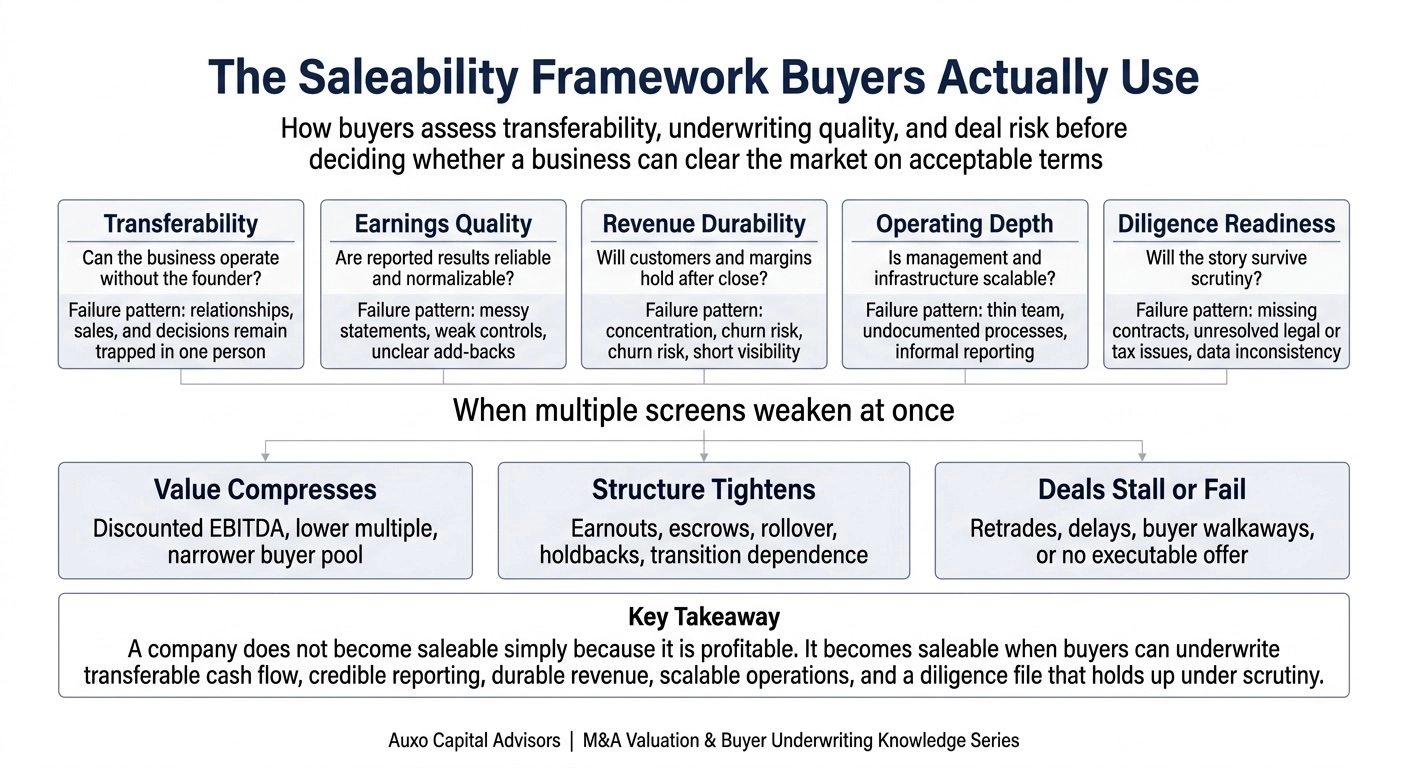
Read this framework as a buyer-screening sequence rather than a checklist for perfection. Very few companies score cleanly in every category. The practical issue is whether a buyer can get comfortable enough to underwrite value without demanding so much structural protection that the seller no longer likes the deal. That is where articles on why buyers discount valuation and why deals lose value during due diligence become directly relevant to saleability rather than merely valuation theory.
In other words, the marketability question is not whether a company is admirable, profitable, or growing. It is whether the business can survive buyer underwriting with enough confidence to support executable value on acceptable terms. Once that lens is clear, owners can see more accurately why some businesses produce strong markets while others attract interest but never truly clear.
Definitions That Matter in a Sale Process
Saleability is the practical ability of a company to attract executable buyer interest at a value and structure the owner can accept. It is not the same thing as being profitable, growing, or respected in its market.
Transferability refers to whether cash flow, relationships, and operating performance can survive a change in ownership. This is often the hidden dividing line between a good private business and an acquirable one.
Underwritability is the buyer’s confidence that the economics, risks, and transition path can be modeled with enough certainty to justify a bid, financing package, and internal investment approval.
Diligence readiness means the company can substantiate its story with organized, credible information before buyer confidence starts to erode.
Founder Dependence Reprices Value Before Buyers Ever Bid
Founder dependence is one of the most common reasons a company never sells cleanly. In many lower-middle-market businesses, the founder still owns the key customer relationships, pricing authority, recruiting pull, vendor trust, and institutional memory. From the inside, that can feel like leadership strength. From a buyer’s perspective, it creates single-person fragility.
The underwriting question is straightforward: what remains if the founder leaves, reduces involvement, or simply loses the ability to drive the business in the same way after close? If too much value is personal rather than institutional, the buyer is not buying a durable platform. The buyer is buying a transition project. That distinction usually pushes economics away from upfront cash and toward contingent value.
This is why owners should not read strong historical performance as proof that the issue is manageable. A founder-dependent company can still generate meaningful EBITDA. The problem is that buyers do not award full valuation for cash flow they believe is non-transferable. For a broader look at how those underwriting judgments create dispersion, see why businesses sell for 10x EBITDA vs 3x.
Weak Earnings Quality Makes a Business Hard to Underwrite
Many companies that “should” sell on paper struggle because buyers cannot trust the earnings base. This does not always mean fraud or severe accounting problems. More often, it means financials are tax-oriented rather than transaction-oriented, reporting is inconsistent across periods, margins swing without clean explanation, or EBITDA adjustments rely too heavily on owner narratives. When buyers lose confidence in the base earnings figure, the valuation discussion breaks before it really starts.
The effect can be subtle but severe. A business owner may focus on the nominal multiple, while the buyer is quietly reducing adjusted EBITDA, lowering leverage assumptions, and preparing for a more conservative structure. That process is often invisible to the seller until late-stage feedback appears weaker than expected. Companies that want to understand this from a preparation standpoint should begin with a realistic view of normalized earnings and valuation context through Auxo’s valuation services.
Earnings quality also shapes credibility. If management cannot answer basic questions consistently, if deferred maintenance shows up in capex needs, or if margin performance depends on unusual discretionary owner behavior, a buyer will not simply “price around it.” In some cases the business still sells; in others, the confidence gap becomes too wide to bridge. That is also why owners should not confuse an indication of interest with final value, especially before diligence pressure tests the numbers. The dynamic is similar to what appears in why letters of intent are not final value.
Customer Concentration and Revenue Fragility Shrink the Buyer Universe
Revenue concentration does not automatically make a company unsellable. Plenty of attractive businesses have one or two large customers. The issue is whether those relationships are durable, contractual, embedded, and economically rational from the buyer’s point of view. If a customer represents a major share of EBITDA and the relationship depends heavily on the founder, then concentration becomes more than a simple math problem. It becomes a transferability problem with downside asymmetry.
When buyers see concentrated revenue, they ask a chain of questions very quickly. How long is the relationship history? Is there a formal agreement? What are the renewal economics? How difficult would it be for that customer to switch suppliers? Who owns the relationship? If one answer points to fragility, the rest of the model gets more conservative. Strategic buyers may still pursue the asset, but private equity and lender-backed buyers may tighten quickly because one loss event can break the return case.
This is one reason the buyer universe matters as much as headline valuation. A business that fits only a handful of strategic buyers is less marketable than one that can appeal across strategic and financial channels. If concentration or revenue volatility is already present, process sequencing becomes more important, because the wrong launch can expose weakness before the company is framed correctly. That dynamic is covered in sell-side process sequencing risk.
Thin Management Depth and Incomplete Operating Infrastructure Limit Transferability
Buyers do not just evaluate products and financial statements. They evaluate whether the business has enough operating structure to keep functioning under new ownership. A company with no meaningful management bench, no clean KPI cadence, limited process documentation, and informal decision rights may operate effectively under a hands-on founder, but it is difficult to transfer at scale.
Middle-market buyers regularly ask whether there is a second layer of leadership, who owns day-to-day execution, how sales are managed, how performance is tracked, and how issues get resolved without founder intervention. Those questions are not administrative. They go directly to continuity risk. If the answer to every important operational question points back to one person, the buyer sees integration risk, not just succession risk.
Management depth also affects post-close structure. If the business lacks a credible team, buyers may insist on retention packages, longer transition periods, or founder-heavy rollover and employment commitments. For some sellers, that is still acceptable. For others, it defeats the purpose of a sale. Businesses wrestling with whether they are ready for market should look closely at when to hire an M&A advisor and whether the company is showing credible readiness signals before launch.
Diligence Gaps Kill Momentum and Change Structure
Some companies never sell because they cannot survive the transition from marketing narrative to diligence evidence. The process may begin well. Buyers respond to a compelling story, management presentations go smoothly, and early indications look encouraging. Then the diligence file opens. Contracts are incomplete. Revenue tie-outs do not reconcile cleanly. Legal entities are messy. Employment and tax issues surface. Working capital history is not well understood. A buyer who was initially enthusiastic starts to reserve against uncertainty.
At that point, value rarely disappears all at once. Instead, it leaks into the structure. Escrows get larger. Earnouts appear. Reps and warranties become more aggressive. Purchase price mechanisms get tighter. Closing timelines stretch. Management energy gets diverted. If the company was only marginally marketable to begin with, the process can collapse under the cumulative weight of unanswered questions.
Owners often mistake this for buyer opportunism. Sometimes it is. More often, the buyer is responding to newly visible risk. That distinction matters, because a weak process can invite avoidable price movement while a well-run process can identify and frame issues earlier. For more on this progression, see how buyers identify hidden risk during diligence and why engaging too late can leave sellers reacting instead of controlling the narrative.
The Marketability Problem Is Often an Expectation Problem
Not every company that fails to sell is objectively unsellable. In many cases, there is a deal available, but not at the value, terms, or transition burden the founder expected. That still matters, because a business that cannot clear the market on terms the owner will accept is functionally not saleable for that owner at that time.
This expectation gap usually forms when founders anchor on simplified market data, anecdotal “X times EBITDA” stories, or top-of-funnel buyer enthusiasm. They may compare their business to stronger assets without accounting for transferability differences, diligence quality, management depth, or customer concentration. That is why value discussions should be grounded in how buyers actually price deals in practice rather than how sellers prefer to frame them. It is also why a quick benchmarking tool such as the business valuation calculator should be treated as a planning reference, not proof of executable market value.
Worked Example: A Business That Looks Saleable Until Buyers Re-Underwrite It
Consider a founder-led industrial services company with reported EBITDA of $4.0 million. The owner expects a 7.0x multiple based on peer anecdotes and assumes the business should sell for roughly $28.0 million in enterprise value. At first glance, that may seem plausible. The business has been profitable for years, has strong reputation in its region, and receives occasional inbound interest.
| Step | Seller view | Buyer re-underwrite |
|---|---|---|
| Reported EBITDA | $4.0M | $4.0M |
| Adjustments | + $0.8M add-backs | + $0.3M accepted add-backs |
| Adjusted EBITDA | $4.8M | $4.3M |
| Selected multiple | 7.0x | 5.5x due to concentration, founder dependence, and thin team |
| Enterprise value | $33.6M | $23.7M |
| Less debt | ($3.0M) | ($3.0M) |
| Working capital adjustment | $0 | ($1.2M) true-up to normalized level |
| Escrow / holdback | $0 | ($1.0M) held back |
| Earnout contingent on retention | $0 | Up to $2.0M contingent |
| Estimated cash at close | $30.6M | $18.5M |
Why did the gap open? The buyer discovered that one customer represented 34% of revenue, the founder personally managed the top ten relationships, and the controller could not produce consistent monthly reporting without extensive cleanup. None of those issues guaranteed a failed deal, but together they changed the underwriting profile materially. Enterprise value fell because both the EBITDA base and the multiple compressed. Seller proceeds fell further because normal working capital had been underestimated and the buyer insisted on protective terms.
The lesson is not that this company was unsellable. The lesson is that founders frequently confuse operating success with transaction readiness. In live deals, buyers translate uncertainty into price, structure, or both. That is the same reason sellers should think carefully about how to compare two M&A offers rather than focusing only on the headline number.
Common Mistakes Owners Make When They Assume a Business Is Saleable
When a company struggles to attract executable offers, many owners misdiagnose the problem. They assume the issue is temporary market softness, a buyer pool problem, or poor outreach. Sometimes those factors matter, but more often the business is running into a deeper saleability gap between how the owner experiences the company and how a buyer underwrites it.
The first mistake is confusing profitability with transferability. A company can be profitable and still be difficult to sell if too much of the value depends on the founder’s relationships, judgment, or daily intervention. Buyers do not pay full value for cash flow that appears personal rather than institutional.
The second mistake is anchoring on anecdotal multiples. Founders often hear that “companies in this industry trade at X times EBITDA” and assume the market will treat their business the same way. In reality, the buyer is underwriting durability, management depth, diligence quality, customer concentration, and structure risk, not just industry averages.
The third mistake is waiting too long to test readiness. Owners frequently begin serious preparation only when they are already tired, under pressure, or eager to exit. By then, the business may be entering market before reporting quality, process organization, and transition planning are strong enough to support a clean process.
The fourth mistake is interpreting buyer interest as proof of saleability. Early conversations, inbound calls, and even attractive indications of interest can create false confidence. Buyer curiosity is not the same as buyer conviction. The real test comes when the business is pressure-tested through diligence, financing, and internal investment approval.
The fifth mistake is treating structure as secondary. Owners often focus on whether a buyer is willing to “pay the number,” but that misses the point. A business that only clears the market through large escrows, heavy rollover, extended transition obligations, or contingent earnout value may still be only marginally saleable on acceptable terms.
The better approach is to evaluate the company the way a serious buyer would: What is transferable, what is underwritable, what will survive diligence, and what still depends too heavily on founder-specific knowledge or trust? That exercise usually produces a more useful answer than debating theoretical value in the abstract.
Seller Takeaway
If a business is difficult to sell, the answer is rarely “buyers just do not get it.” More often, the company has not yet crossed the threshold from founder-operated success to buyer-underwritable transferability. Owners improve saleability by reducing founder dependence, tightening financial credibility, broadening management depth, documenting the business properly, and entering market only after the company can survive real scrutiny.
That work does not guarantee a premium outcome, but it changes the negotiating position materially. The better the business holds up under underwriting, the more likely sellers are to preserve value in upfront cash instead of giving it away through structure, concessions, or failed momentum.
What Buyers Actually Focus On
Buyers do not spend most of their energy deciding whether a business is admirable. They focus on whether it is executable. The internal questions are usually more pragmatic than founders expect: Can we finance this? Can we explain the earnings base to our credit committee or investment committee? Will key customers stay? Can management run the business after close? Are there hidden liabilities that can impair returns? How exposed are we if transition underperforms?
That is why some businesses with good stories still fail to produce actionable offers. Buyers know that a weakly transferable company can consume disproportionate time and still fail late. If the profile already suggests elevated execution risk, some buyers will simply redeploy effort elsewhere. Others may submit an offer, but only on terms that effectively transfer part of the risk back to the seller. When founders are surprised by that outcome, they are often seeing the same dynamic behind late buyer walkaways and value drift during diligence.
For strategic buyers, the threshold can be somewhat different because synergies may offset some stand-alone weakness. Even then, strategic acquirers can overestimate integration upside and then regret it later, which is why sellers should be careful when evaluating a buyer who appears willing to stretch. The issue is not just whether a strategic buyer will pay more, but whether that offer is actually durable and executable under scrutiny.
Why Advisory Process and Negotiation Discipline Matter
When a company sits near the line between saleable and hard-to-sell, process quality matters enormously. A disciplined advisor helps diagnose whether the issue is transferability, diligence readiness, valuation expectation, buyer fit, or timing. Just as important, the advisor can shape how those issues are framed before they become late-stage surprises. That is one reason founders often benefit from engaging earlier than they think, especially if there are known complexities in reporting, customer mix, management depth, or transition planning.
Good sell-side work is not just buyer outreach. It is preparation, sequencing, positioning, expectation-setting, buyer selection, and term negotiation under imperfect conditions. In that sense, sell-side M&A advisory becomes a risk-management function as much as a marketing function. The goal is not to decorate a weak asset. It is to improve preparedness, create competitive tension where possible, and protect sellers from losing economics through avoidable process mistakes.
This is also where timing discipline matters. If owners wait until fatigue, performance pressure, or a looming issue forces a sale, the business may enter market before it is ready. That often leaves sellers trying to solve readiness issues while buyers are already repricing them. A more thoughtful pre-process review can surface whether now is the right time to run, what needs to be fixed first, and how to present the business in a way that supports credibility rather than inviting skepticism.
Pressure-Test Whether the Business Is Truly Saleable
Before launching a process, owners should ask a harder question than whether the business is attractive. They should ask whether a disciplined buyer could underwrite the company cleanly enough to submit an executable offer without requiring a major reset in price, structure, or transition burden.
Saleability pressure-test checklist:
- Founder dependence: If the owner stepped away after closing, which customer, pricing, recruiting, or operating functions would become unstable?
- Earnings credibility: Would a buyer accept the reported EBITDA and adjustments, or would the earnings base compress under scrutiny?
- Revenue durability: Are the major customer relationships contractual, diversified, and embedded enough to survive a change in ownership?
- Management depth: Is there a real second layer of leadership, or does every meaningful decision still route through the founder?
- Diligence readiness: Could the company support its narrative quickly with consistent contracts, clean financial data, legal records, and historical working-capital evidence?
- Expectation realism: Would the owner still want to pursue a transaction if the buyer required more escrow, rollover, transition support, or contingent consideration than expected?
If those questions cannot be answered clearly, the business may still be valuable, but it may not yet be marketable on terms the owner will accept. That distinction is exactly where many sale processes go sideways. The earlier those gaps are identified, the more chance the owner has to fix them before the market prices them in.
Frequently Asked Questions
Can a profitable company still be unsellable?
Yes. Profitability helps, but it is not enough. A buyer must believe those earnings are credible, transferable, and durable after the owner exits. If profit depends on one person, one customer, weak controls, or undocumented processes, the business may still struggle to attract executable offers.
Is founder dependence the most common reason companies fail to sell?
It is one of the most common reasons, particularly in founder-led middle-market businesses. Buyers can tolerate some transition dependence, but not a situation where relationships, pricing, hiring, and operating decisions all reside with the owner.
Does customer concentration automatically prevent a sale?
No. Concentration can be acceptable if the relationship is stable, contractual, and institutionalized. The problem is concentration combined with fragility, weak documentation, or founder-owned relationships.
Why do some companies receive interest but never close a transaction?
Initial buyer interest often reflects strategic curiosity, not fully committed underwriting. Once diligence begins, earnings quality, working capital, legal exposure, management depth, and customer risk can change the buyer’s view materially.
Can poor financial reporting alone stop a deal?
Yes, especially if the reporting issues are severe enough to undermine confidence in EBITDA, cash flow conversion, or normalized working capital. In other cases, it may not stop the deal entirely, but it can reduce price and increase protective terms.
What is the difference between valuation and saleability?
Valuation is an estimate of what a business may be worth under defined assumptions. Saleability is whether the company can actually attract and complete a transaction at acceptable terms in the live market. A business can have theoretical value and still be difficult to sell.
Do buyers ever solve transferability issues after closing?
Sometimes, especially strategic buyers with infrastructure and integration capability. But if the transition burden is too high relative to price, many buyers will either discount heavily or move on to cleaner opportunities.
How early should owners evaluate sale readiness?
Earlier than most expect. If there are known issues around financial reporting, customer concentration, or founder dependence, the best time to address them is before the process starts, not after buyers discover them.
Why do buyers push structure instead of just lowering price?
Structure helps buyers allocate uncertain risk. If they are unsure about retention, working capital, legal exposure, or future performance, they may use escrows, earnouts, rollovers, or transition conditions instead of simply repricing headline value.
Can a good advisor make an unsellable company sellable?
An advisor cannot manufacture transferability that does not exist, but a strong process can diagnose the real issues, improve readiness, set realistic expectations, and position the business more effectively. In many situations, that is the difference between failed outreach and a workable deal.
How do owners know whether their expectations are too high?
Usually by testing assumptions against normalized earnings, buyer universe fit, transferability, and transaction structure rather than anecdotal multiples. Sellers who benchmark only on top-line valuation stories often miss the factors that drive executable outcomes.
What should an owner do first if they are unsure whether the company is saleable?
Start with an honest underwriting-style review of the business. That means assessing normalized earnings, founder dependence, management depth, customer concentration, and diligence readiness. From there, the owner can decide whether to fix issues first, test the market selectively, or prepare for a later process.
Media & Press Inquiries
Auxo Capital Advisors provides middle-market M&A advisory perspectives on valuation, buyer underwriting behavior, process risk, and transaction execution. Journalists, podcast producers, and conference organizers seeking commentary on sell-side readiness, valuation dispersion, or buyer behavior in live M&A markets are welcome to reach out.
For media requests, speaking inquiries, or permission to reference this article, contact Auxo Capital Advisors at info@auxocapitaladvisors.com.
Disclosure
This article is provided for informational purposes only and reflects general market observations, transaction experience, and advisory judgment as of the date noted above. It is not legal, tax, accounting, or investment advice, and it should not be relied upon as a substitute for advice from qualified professional advisors evaluating a specific company or transaction.
All examples and numerical illustrations in this article are simplified for explanatory purposes. Actual valuation outcomes, buyer interest, transaction structures, and seller proceeds depend on company-specific facts, market conditions, diligence findings, financing availability, legal and tax considerations, buyer synergies, negotiation dynamics, and other factors that may differ materially from any illustrative scenario discussed here.


