

How Private Equity Firms Value Companies in Middle Market M&A
Updated to expand the private equity valuation framework around sponsor benchmarking, deal multiples, LBO return constraints, revenue and EBITDA fit, performance underwriting, risk concentration, partial-sale economics, and the evidence founders need to defend value before negotiating with financial sponsors.
Key answer: private equity firms value companies by underwriting sustainable cash flow and solving backward from the returns a fund can reasonably earn. A sponsor usually begins with normalized EBITDA, tests revenue durability, margins, customer and supplier concentration, working-capital needs, capital expenditure, management transferability, and downside risk, then evaluates leverage capacity, entry valuation, value-creation potential, and a realistic exit case. Market multiples help frame the range, but the LBO return model and company-specific risk determine what the buyer can actually pay.
What this means for founders: a private equity offer is not based on revenue or EBITDA alone. The buyer is deciding which earnings are supportable, what multiple those earnings deserve, how much debt the company can carry, and how enterprise value converts into equity value after debt and other adjustments. Founders preparing for a sponsor discussion should benchmark value before exclusivity, understand how private equity prices deals in practice, and compare the resulting range with a disciplined sell-side M&A advisory strategy rather than treating one preliminary multiple as a final answer.
Owners asking how PE firms value companies are often trying to understand three different questions at once: what the business is worth in the market, what a particular sponsor can support inside its model, and what the seller will actually receive after debt, rollover equity, working capital, and other transaction terms. Those questions are related, but they are not identical.
This guide focuses on the sponsor-specific underwriting sequence. It should be read alongside how buyers build a valuation model, how buyers use EBITDA multiples, multiples versus DCF and precedent transactions, how strategic buyers value companies, and Auxo’s valuation services.
Transaction context: sponsors do not begin every opportunity with the same multiple, leverage assumption, or return target. They adjust for fund strategy, company size, sector risk, recurring revenue, concentration, capital intensity, lender appetite, management depth, and whether the investment is a new platform, an add-on, a recapitalization, or a turnaround. A price that works for one buyer may not work for another even when both buyers review the same financial statements.
For a founder, the useful question is not merely what multiple private equity pays. It is what evidence allows the business to support a stronger entry valuation without forcing the buyer to rely on aggressive leverage, unrealistic growth, or an optimistic exit multiple. That evidence is developed through clean financials, defensible normalized EBITDA, a credible operating forecast, and preparation that reduces the risk of a post-LOI retrade. Auxo’s Market Value Study and sale-readiness framework address that pre-market work from the seller’s perspective.
Why private equity valuation is an underwriting exercise, not a fixed multiple
Private equity firms do not buy financial statements; they buy a future stream of cash flow and the risks attached to it. That is why two companies with similar revenue can receive meaningfully different valuations. One may have recurring revenue, diversified customers, stable margins, low reinvestment needs, and a management team that can scale beyond the founder. Another may depend on a few accounts, consume working capital as it grows, require overdue capital expenditure, or rely on the owner to hold the commercial engine together. A sponsor will not value those businesses the same way.
The difference between a preliminary valuation and a final sponsor bid usually comes from the depth of underwriting. Early indications may rely on broad market evidence and management-prepared EBITDA. Later rounds incorporate customer-level performance, revenue retention, margin bridges, quality-of-earnings findings, proof-of-cash analysis, leverage feedback, and the buyer’s proposed capital structure. That progression explains why a valuation can improve when diligence confirms the story or weaken when the buyer discovers unsupported assumptions.
For sellers, understanding this logic is useful before a process starts. It shapes how the company should be benchmarked, which adjustments should be defended, what financial data should be organized, and how competing sponsor offers should be compared. It also clarifies a common source of confusion: enterprise value is not the same thing as equity value, management equity value, or cash at closing. The bridge depends on debt, debt-like items, working capital, rollover, earnouts, and other negotiated terms.
Executive summary
Private equity valuation usually begins with normalized EBITDA but is constrained by a broader sponsor model. Buyers assess whether revenue and margins are durable, how the company performs across customer, product, geography, and channel, what working capital and capital expenditure are required, whether the management team can operate through an ownership transition, and how much debt lenders will support. Those inputs feed an entry valuation and a return model.
Market multiples, precedent transactions, and DCF analysis help frame the opportunity, but the LBO model often defines the practical price ceiling. A sponsor must be able to explain how the investment generates returns through EBITDA growth, margin improvement, debt paydown, acquisitions, or a credible exit. If the entry price requires all of those factors to work perfectly, the bid is unlikely to survive investment-committee or lender scrutiny.
Founders can improve negotiating leverage by establishing a defensible valuation range before approaching sponsors, documenting the earnings base, separating genuine add-backs from speculative adjustments, and understanding how sponsor offers differ in cash at close, rollover equity, governance, management incentives, and contingent value. A higher headline enterprise value can be less attractive than a lower headline offer once structure and risk are considered.
A Quick Valuation Map
The quickest way to understand a sponsor valuation model is to follow the full underwriting sequence private equity buyers typically use:
- Normalize earnings to establish a trusted EBITDA base.
- Assess growth quality, including revenue durability, margins, retention, and realistic operating upside.
- Benchmark the company against public comps and precedent deals.
- Assess leverage capacity based on cash flow and lender appetite.
- Run a returns model to test whether the price supports target investor returns at exit.
- Select a defendable enterprise value range.
- Bridge enterprise value to equity value by adjusting for debt, cash, debt-like items, and working capital.
- Refine the final bid view as underwriting, leverage, and transaction structure come together.
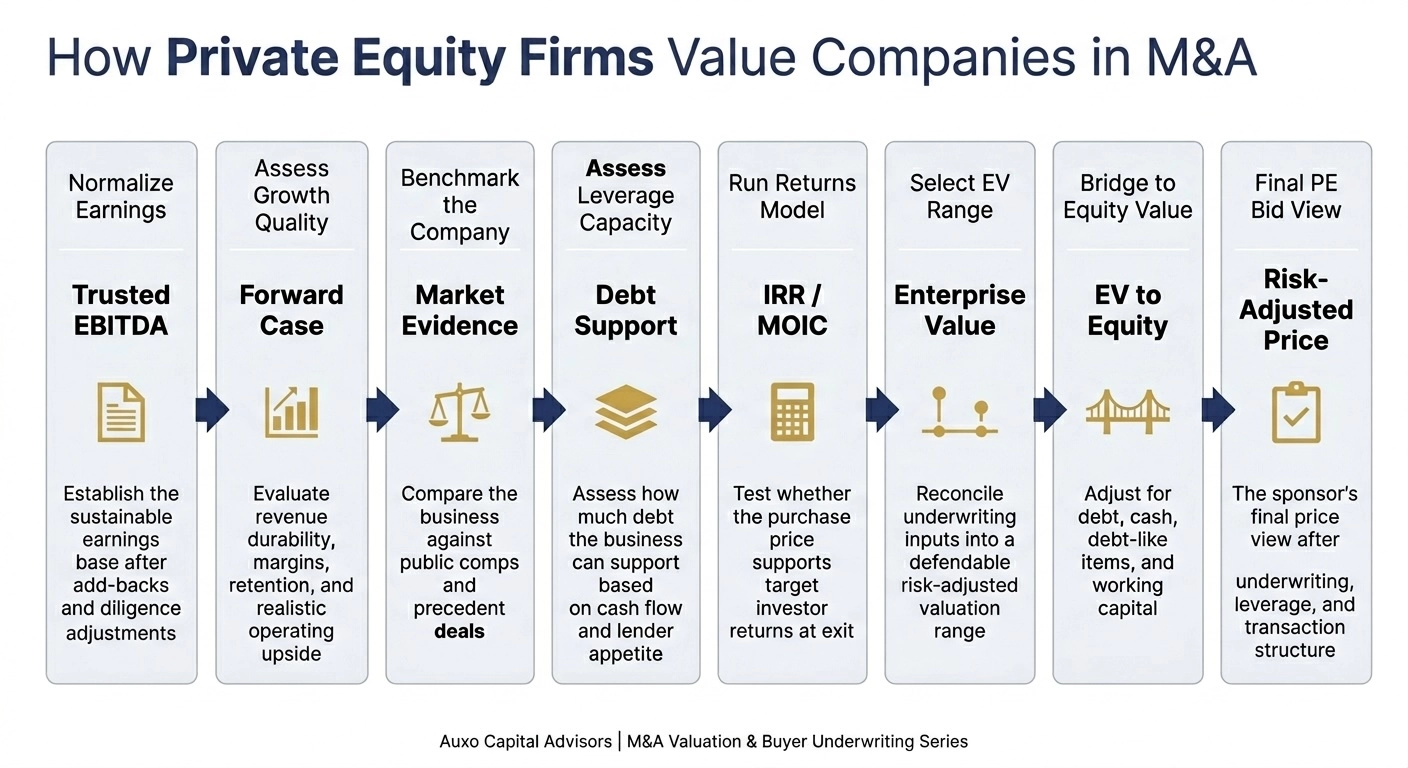
Most valuation misunderstandings happen when one of those steps gets skipped. Sellers often jump from “market multiple” straight to “what I should receive,” but buyers are moving through a fuller underwriting sequence. That is one reason a well-run sell-side M&A process matters: it gives buyers cleaner inputs earlier, which helps defend value before a price range starts to compress.
Key takeaways
- Private equity firms usually value a business from normalized EBITDA and cash-flow quality, then test whether leverage and exit assumptions support the price.
- There is no universal PE multiple. Entry multiples vary by company size, sector, recurring revenue, growth, concentration, capital intensity, buyer strategy, and financing conditions.
- Revenue and EBITDA thresholds determine whether a company fits a fund’s mandate, but fit is not the same as value.
- Market multiples, DCF, precedent transactions, and LBO analysis serve different purposes and should be reconciled rather than used in isolation.
- Private equity buyers evaluate company performance through revenue retention, margin stability, cash conversion, customer and supplier concentration, management depth, and reinvestment needs.
- Enterprise value must be bridged to equity value and seller proceeds after debt, debt-like items, working capital, rollover equity, earnouts, and transaction expenses.
- Founders should compare sponsor offers on certainty, structure, governance, and retained upside—not only on the headline valuation.
The Core Private Equity Valuation Framework
A private equity firm is trying to answer a practical acquisition question: if we buy this business at a certain enterprise value, use an achievable debt structure, and execute a realistic operating plan, what return can we produce at exit? That question combines present earnings quality with future value creation. The model is not only about what the company earned last year. It is about what portion of those earnings is durable, how those earnings can grow, and what a future buyer is likely to pay several years later.
Viewed that way, valuation is a translation exercise. The buyer translates company quality into risk, risk into an acceptable valuation range, and that range into a purchase price it can defend to its investment committee and lenders. The seller-side implication is straightforward: every issue that weakens trust in earnings or raises execution uncertainty tends to lower the multiple, reduce leverage availability, or both.
What multiple do private equity firms pay?
Private equity firms do not pay one standard multiple for every business. The quoted multiple is the result of a buyer’s view of earnings quality, scale, growth, risk, leverage, and exit optionality. A sponsor may describe an offer as 7.0x or 9.0x EBITDA, but the more important questions are which EBITDA figure is being used, whether the multiple is applied to trailing or forward earnings, and how much of the consideration is paid in cash versus rollover or contingent value. Auxo’s guides on what increases EBITDA multiples and why businesses sell for different EBITDA multiples explain why the range can be wide even inside the same industry.
| Valuation factor | How PE uses it | Why it moves value |
|---|---|---|
| Normalized earnings | Establishes the cash-flow base for valuation and debt sizing | If EBITDA is overstated or volatile, the whole model compresses |
| Growth durability | Supports forward EBITDA and exit expectations | Premiums depend on believable growth, not just ambitious forecasts |
| Risk profile | Shapes the multiple range and lender confidence | Concentration, churn, cyclicality, and founder dependency reduce tolerance |
| Leverage capacity | Determines how much debt can support the purchase price | More supportable debt can raise sponsor purchasing power |
| Exit potential | Tests whether future sale economics still produce target returns | A weak likely exit can cap valuation today |
This is where a sponsor’s internal model starts to diverge from a simplified “industry multiple” conversation. Market references still matter, especially where there are strong published patterns in sectors such as accounting firms, AEC businesses, engineering versus construction valuation multiples, or auto repair and collision shops. But a sponsor still has to decide what your specific company can support inside its own deal economics.
Definitions that matter in a private equity process
Enterprise value is the value of the operating business before considering how it is financed. This is usually the headline value implied by an EBITDA multiple. The distinction between enterprise value and equity value matters because sellers and management teams ultimately receive equity value, not enterprise value.
Equity value is what remains for shareholders after enterprise value is adjusted for funded debt, cash treatment, debt-like items, and other agreed purchase-price mechanics. In a partial sale or recapitalization, the equity value also determines the value of the portion sold and the value retained or rolled into the new capital structure.
Normalized EBITDA is EBITDA adjusted to remove non-recurring, owner-specific, or non-market items so the buyer can underwrite sustainable earnings. The difference between normalized and adjusted EBITDA, and whether the adjustments survive a quality-of-earnings review, can materially change the price.
Entry multiple is the enterprise-value multiple paid at closing. Exit multiple is the multiple assumed when the sponsor sells or recapitalizes the investment. Sponsors generally resist paying a price that requires a materially higher exit multiple unless the business is expected to improve in scale, quality, or market positioning.
Leverage capacity is the amount of debt the business can support based on cash flow, downside resilience, lender appetite, and covenant headroom. The acquisition debt package is summarized through sources and uses.
Working capital target is the normalized level of operating working capital expected to remain in the business at closing. The working-capital peg and disputes over revenue pegs versus working-capital pegs can change realized proceeds even when enterprise value is unchanged.
How a PE buyer moves from first look to price
The first pass is usually a pattern-recognition exercise. A sponsor reviews the company’s sector, size, margins, growth trajectory, customer mix, likely fit with its investment strategy, and whether the opportunity appears to be a platform, add-on, recapitalization, or special situation. Early indications of interest are often informed by broad comparable-market data and a preliminary view of normalized earnings. At this stage, speed matters more than precision.
As the process advances, valuation becomes less generic and more company-specific. Management presentations, customer and product detail, quality of earnings, proof of cash, lender feedback, and operating diligence refine the range. Buyers also evaluate whether the company satisfies the same acquisition criteria described in Auxo’s guide to how buyers evaluate acquisition targets.
This progression explains why a sponsor’s bid may move between an initial indication, a letter of intent, and the definitive agreement. The early valuation is often provisional, and an LOI is not final value. Sellers should understand why LOI economics remain subject to diligence before granting exclusivity.
What financial data PE firms request before they can value a business
A credible sponsor model depends on data that can survive diligence. Buyers usually request historical income statements and balance sheets, monthly trend data, revenue by customer and segment, customer retention or backlog analysis, gross-margin bridges, headcount and compensation detail, capital-expenditure history, working-capital schedules, debt schedules, and support for unusual or discretionary expenses. They also want to understand the operating story beneath the numbers: how customers are won, how pricing holds, how leadership is structured, and what could disrupt cash flow after a change in ownership.
Proof-of-cash analysis can be part of that work because it connects reported revenue and collections to bank activity and helps identify cut-off, revenue-recognition, and cash-conversion issues. It is not a substitute for the broader quality-of-earnings work buyers perform, but it can strengthen or challenge the revenue foundation of the model. Similarly, TTM EBITDA and run-rate EBITDA help buyers decide which measurement period best reflects current performance.
In founder-led companies, the quality of this package matters more than owners often expect. If reporting is thin, contract economics are hard to trace, or the debt and working-capital picture is messy, buyers compensate by widening discounts and tightening assumptions. Preparation before a sponsor process can reduce that uncertainty and make the valuation discussion more evidence-based.
How to benchmark valuation before negotiating with PE sponsors
Benchmarking ahead of a private equity sale means establishing a defensible range before a buyer’s model becomes the only valuation framework in the room. A useful benchmark reconciles normalized EBITDA, market multiples, precedent transactions, cash-flow characteristics, buyer demand, and the company’s likely fit with sponsor and strategic acquirers. It should also identify the assumptions most likely to be challenged during diligence.
The goal is not to produce a single number that management can insist upon. It is to understand the credible low, midpoint, and high cases; which buyers could support each case; and what evidence is needed to defend the upper end. Auxo’s Market Value Study, private-company valuation support, and business-worth framework are designed for that pre-market analysis.
Timing also matters. Owners usually have more leverage when they benchmark value before signing an LOI or responding to a single unsolicited buyer. A company that waits until exclusivity to test valuation has less ability to create competition, correct weak assumptions, or choose a different process. The same readiness issue is discussed in when a business is ready to hire an M&A advisor.
What revenue and EBITDA do private equity firms require?
Private equity firms use revenue and EBITDA thresholds to determine whether a business fits their fund mandate, but there is no universal minimum. A lower-middle-market sponsor may pursue companies with a few million dollars of EBITDA, while larger funds may require substantially more. Sector-focused investors may accept smaller scale when recurring revenue, unit economics, market fragmentation, or add-on fit are compelling. Conversely, a company can exceed a buyer’s size threshold and still be unattractive if the earnings are volatile or the risk profile is outside the mandate.
Revenue is often a screening measure, while EBITDA and free cash flow determine whether the business can support leverage and investor returns. The relationship between the two matters: a high-revenue, low-margin company may have less sponsor purchasing power than a smaller business with stable margins and strong cash conversion. Auxo’s discussion of why EBITDA matters more than revenue and the EBITDA-to-free-cash-flow bridge explains that distinction.
For sellers, size should be viewed as a buyer-fit question rather than a valuation shortcut. The relevant inquiry is which sponsor universe can underwrite the company’s scale, sector, ownership objectives, and growth plan—and whether a strategic buyer or PE-backed platform may value the same asset differently.
Normalized EBITDA Is Usually the Starting Point
Most private equity buyers begin with EBITDA because it is a practical proxy for operating earnings and debt service capacity. That does not mean they treat all EBITDA as trustworthy. They ask what portion is recurring, what has been temporarily inflated, what owner-specific expenses can be added back, and whether margins are stable enough to underwrite. A company that appears to generate $8 million of EBITDA may ultimately be underwritten at $7 million, $6.5 million, or more, depending on what survives scrutiny.
This is where sellers frequently overestimate value. Not every adjustment is acceptable to a buyer. Personal expenses, one-time legal bills, unusual bonuses, or duplicated roles may be reasonable add-backs. But recurring underinvestment, chronic vacancies, customer losses, or short-term margin spikes usually do not get a free pass. The sponsor is trying to establish an earnings base it can defend internally and finance externally. Auxo’s broader guidance on how to value a business and the related discussion of why EBITDA matters more than revenue are useful context for understanding why this step is so central.
From a seller’s perspective, this is one of the highest-leverage preparation areas. If normalized EBITDA is clearly documented and commercially credible, the buyer starts from a stronger earnings base and is more likely to defend that base through investment committee and lender review. If normalization feels aggressive, the buyer may not only reduce earnings, but also reduce the multiple applied to those earnings because confidence in the story weakens at the same time.
Sponsors also distinguish between reported EBITDA, management-adjusted EBITDA, and buyer-accepted EBITDA. The last figure is the one that normally drives debt sizing and the final valuation model. Unsupported add-backs can reduce both the earnings base and buyer confidence, which is why sellers should understand how buyers apply EBITDA multiples and how earnings quality can influence the multiple itself.
How private equity firms evaluate company performance before an acquisition
Private equity buyers evaluate performance through a set of linked questions rather than one headline KPI. They examine revenue growth, retention, recurring or contracted revenue, gross-margin stability, EBITDA margin, cash conversion, working-capital usage, capital expenditure, customer acquisition efficiency, backlog or pipeline quality, and the degree to which results depend on the founder. The relevant measures vary by business model, but the objective is consistent: determine whether historical performance is repeatable and whether the next-stage plan is achievable.
Buyers often segment the analysis by customer, product, geography, location, channel, or cohort to identify where value is being created and where risk is concentrated. A company can report attractive consolidated growth while one customer, location, or product line accounts for most of the increase. That distinction affects the forward forecast and the downside case. Sponsors are usually willing to pay for growth that is visible and repeatable; they are less likely to pay for growth that depends on a single event or unproven expansion assumption.
Performance analysis also informs the value-creation plan. Margin improvement, pricing, sales productivity, add-on acquisitions, and working-capital discipline may support future EBITDA growth, but the sponsor will separate improvements already evidenced in the business from initiatives that remain speculative. The article on private equity pricing in practice addresses how those assumptions influence a live bid.
How concentration, founder dependence, and downside risk change PE valuation
Customer concentration is one of the fastest ways to reduce sponsor valuation because the loss of one account can impair EBITDA, debt service, and the exit case at the same time. Supplier concentration can have a similar effect when the business depends on a limited source of critical inputs, favorable pricing, or capacity. Buyers assess the economic importance, contractual protection, tenure, switching risk, and mitigation plan rather than relying on concentration percentages alone.
Founder and family-business risk is also evaluated directly. Sponsors are not necessarily discouraged by founder involvement; many value the relationships, judgment, and market credibility founders bring. The valuation issue is whether those capabilities can transfer. A family business with documented processes, a credible leadership team, and clear governance can be highly attractive. A business where ownership, sales, pricing, and operational decisions remain concentrated in one person may require a longer transition, rollover equity, or more contingent consideration.
These risks do not always produce a simple multiple reduction. They can also reduce leverage, increase the equity check, change management-incentive assumptions, or shift value into an earnout or seller note. That is why downside risk affects both price and structure. Auxo’s guide to how buyers identify hidden risk provides the deeper diligence perspective.
How PE Buyers Build the Forward Case
Once a sponsor has a view on trusted earnings, it builds a forward case. That forward case usually includes revenue growth assumptions, pricing retention, gross margin behavior, headcount needs, SG&A scaling, working-capital usage, and capex. The point is not to build an elaborate spreadsheet for its own sake. The point is to test what the business can become under realistic ownership. Can it grow without consuming disproportionate working capital? Can margins expand through operational discipline, or are they already near ceiling levels? Is growth tied to one salesperson, one geography, or one unusual market tailwind?
Forecasts only create value when they are believable. Buyers will pay for visible, repeatable growth with evidence behind it: recurring contracts, backlog quality, customer retention, pricing power, route density, utilization improvement, cross-sell capacity, or proven expansion economics. By contrast, a management forecast that simply extends recent performance without explaining its drivers will rarely earn a premium. This is also one reason sponsor valuations can differ from strategic valuations. Strategic buyers may price in synergies the sponsor cannot. Sponsors, on the other hand, tend to focus more tightly on standalone growth durability and cash conversion.
Owners sometimes assume a high-growth narrative will rescue a weak earnings base. In practice, weak earnings quality usually causes buyers to discount the forecast rather than stretch for it. A stronger path is to connect current earnings to observable drivers and show why next-stage growth is achievable without breaking the cash-flow profile the buyer is relying on.
The forward case should also reconcile the seller’s growth narrative with the buyer’s likely exit market. A sponsor may accept a premium entry price when the company has a credible path to greater scale, stronger margins, or a broader buyer universe, but it generally will not rely on unsupported multiple expansion. The most defensible cases show how operating improvement creates enterprise value even if the exit multiple remains flat.
Comparable Companies: Market Discipline, Not a Final Answer
Comparable companies analysis asks what businesses with similar characteristics are trading at in the market. For private equity, comps help answer two questions. First, where does the market currently value companies with roughly similar growth, margins, and sector profiles? Second, where might this business trade at exit if the sponsor executes its thesis? That makes comps useful both on the way in and on the way out.
Still, public or broad market comps are a discipline tool, not a valuation verdict. Private businesses are less liquid, often more concentrated, and more dependent on management depth than public peers. The most useful comp sets are therefore carefully selected and heavily interpreted. A sponsor might note that a broad market range is 7.5x to 10.0x EBITDA, then conclude that your company belongs in the lower half because of concentration and capex intensity, or the upper half because of recurring revenue and strong retention. The range matters; where you land inside it matters more.
Sellers often misuse comps by selecting the most favorable examples without accounting for why those businesses earned premium valuations. Premiums usually attach to characteristics buyers can underwrite: resilience, growth quality, clean reporting, strong management depth, and lower perceived downside. Comps can support your story, but they cannot replace it.
For a detailed method comparison, see how multiples, DCF, and precedent transactions are reconciled. Sector references such as accounting-firm valuation multiples, the AEC valuation guide, engineering versus construction EV/EBITDA comps, and auto-repair and collision multiples illustrate why company-specific interpretation matters.
Precedent Transactions: What Similar Deals Actually Cleared At
Precedent transactions look at completed acquisitions involving similar businesses. PE buyers value this evidence because it reflects what real acquirers were willing to pay in live situations, with financing, diligence, and negotiation embedded in the outcome. In that sense, precedent deals can be more persuasive than broad public comps when a sponsor is framing a bid range or defending valuation internally.
But precedent data is imperfect. Deal structures differ. Timing differs. Quality differs. Some transactions include synergies, earnouts, rollover, or unusual strategic motivations that a sponsor cannot simply import into its own model. A high multiple in a precedent deal may say less about the market than about a specific buyer’s urgency or synergy case. That is why skilled PE buyers use precedent transactions as a reference point, not a shortcut.
For sellers, precedent transactions become most useful when they are positioned with context. A precedent comp that resembles your revenue model, concentration profile, and margin structure can support price. A loosely similar deal with very different quality drivers may do little in negotiation. The conversation is rarely about finding the highest historical multiple; it is about establishing a credible lane for your business.
Precedent evidence is strongest when the transaction date, target profile, earnings definition, buyer type, and consideration structure are reasonably comparable. A headline multiple without that context can create false precision. Sponsors often adjust precedents for market conditions and for whether the buyer was strategic, financial, or a PE-backed platform.
DCF: Often a Sanity Check, Not the Main Price Setter
A discounted cash flow analysis values a company based on the present value of future cash flows. In private equity, DCF is often useful as a cross-check, especially where growth, capex, or working-capital intensity create outcomes that a simple multiple may not fully capture. A DCF can also help a buyer pressure-test whether the implied purchase price makes sense relative to the business’s own cash-generation pattern.
Even so, DCF rarely drives a middle-market sponsor bid by itself. Small changes in assumptions can move the answer materially. Growth rates, margins, discount rates, and terminal assumptions all influence the output, and those assumptions can become highly judgmental in private-company settings. Sponsors usually trust market-clearing evidence and returns logic more than a standalone DCF result. For that reason, DCF is better understood as a reasonableness test than the core price-setting method in many lower-middle and middle-market deals.
The seller implication is subtle but important. If a buyer invokes DCF, it is often trying to explain the economics behind its caution, not necessarily to replace market multiples entirely. That can create room for useful negotiation if the seller can narrow the uncertainty around growth durability, cash conversion, or reinvestment needs.
Market multiples, LBO, DCF, and precedent transactions: how PE uses each method
Private equity firms use several valuation methods because each answers a different question. Market multiples and precedents indicate where comparable assets have traded. DCF tests intrinsic cash-flow economics. The LBO model tests whether a sponsor can finance the purchase and still earn an acceptable return. None is automatically “best”; the strongest conclusion comes from understanding why the methods converge or diverge.
| Method | Question it answers | How PE typically uses it |
|---|---|---|
| Comparable-company multiples | Where does the market value businesses with similar growth, margins, and risk? | Frames the broad market range and potential exit reference. |
| Precedent transactions | What did real buyers pay for similar companies? | Tests market-clearing evidence and sector-specific acquisition appetite. |
| Discounted cash flow | What are the forecast cash flows worth on a present-value basis? | Provides an intrinsic-value cross-check when cash-flow timing and reinvestment matter. |
| LBO returns analysis | What entry price supports target returns with realistic leverage and exit assumptions? | Often sets the sponsor’s practical ceiling and informs capital structure. |
A founder negotiating with sponsors should understand all four lenses because a buyer may use market evidence to support the initial range and the LBO model to explain why it cannot move higher. A seller-side valuation can pressure-test whether the buyer’s constraints reflect the company’s risk or simply that buyer’s fund economics.
Returns Analysis and Leverage Capacity Often Define the Ceiling
At some point, most sponsor valuations run through a returns model. The buyer asks: if we pay this price, finance it with a realistic debt package, grow EBITDA to a defendable level, and exit at a plausible multiple, what internal rate of return and cash-on-cash outcome do we produce? If the returns miss the fund’s target, the bid often comes down unless the buyer sees unusually strong downside protection or an especially compelling path to value creation.
Leverage matters because it affects how much equity the sponsor must invest. A business with stable cash flow, low capital intensity, and strong lender support can usually bear more debt, which can increase a sponsor’s purchasing capacity. A business with volatility, concentration, or weaker collateral support may need a more conservative capital structure, forcing the sponsor to put in more equity and often reducing the price it can justify. This is one reason PE firms can value the same company differently: their lender relationships, portfolio expertise, sector conviction, and return thresholds are not identical.
Founders often treat leverage as a buyer issue rather than a valuation issue. In reality, it is both. If debt markets support your company well, that can widen the field of buyers and sharpen competition. If debt support is weak, sponsor bids can converge downward even when strategic interest remains healthy.
Return targets are not uniform. They vary by strategy, perceived risk, fund life, hold period, and whether the deal is a new platform or an add-on. The sponsor’s financing assumptions also depend on lender appetite and the acquisition structure. Auxo’s guides to acquisition financing and sources and uses show how the debt and equity mix supports the purchase price.
Entry valuation and the private equity value-creation plan
A sponsor’s valuation reflects both what the company is today and what the buyer believes it can become. The value-creation plan may include organic growth, pricing, sales-force productivity, margin improvement, management upgrades, working-capital discipline, add-on acquisitions, or expansion into new markets. Those initiatives can justify a stronger bid when they are grounded in evidence and fit the buyer’s capabilities.
However, sellers should distinguish value already present in the business from value the buyer expects to create after closing. A sponsor generally will not pay the seller for every dollar of future improvement if that improvement requires the sponsor’s capital, operating resources, or execution risk. The negotiation centers on how much of the upside is already embedded in the company’s trajectory and how much remains dependent on post-close work.
This distinction is especially important in a partial sale or rollover transaction. The seller may receive less cash at closing in exchange for retained equity that participates in future value creation. The headline enterprise value does not, by itself, determine whether that trade is attractive.
How PE Firms Reconcile the Methods Into a Price Range
No sophisticated buyer relies on only one method. Sponsors typically triangulate among normalized earnings, comparable market ranges, precedent transactions, and returns analysis. A company may screen at 8.0x to 9.0x EBITDA based on market data, but if leverage is lighter than expected and the exit case looks softer, the sponsor may only support the low end. Alternatively, a company with exceptional recurring revenue, low churn, and strong management depth may justify a premium to the broad comp range because risk feels lower and scalability feels more convincing.
That triangulation is where much of the real valuation judgment sits. It is also where process and positioning influence outcomes. In a disciplined sale process, buyers are encouraged to underwrite the company against competitive tension and well-prepared information. In a one-buyer conversation, the same company may be framed through a narrower lens and valued more conservatively. The practical difference is not only academic; it often shows up directly in the bid range and in the aggressiveness of purchase agreement terms.
Competitive tension also affects where the market clears. A sponsor’s internal model may define its standalone price, but a well-run process can force buyers to revisit assumptions, accept a lower return threshold, or price strategic fit more fully. The role of multiple buyers in supporting valuation and the mechanics of an M&A auction process are therefore part of the market outcome even though they do not change the underlying financial formula.
From enterprise value to equity value and seller proceeds
One of the most common seller misunderstandings is assuming that enterprise value equals cash at close. It does not. Enterprise value reflects the value of operations. To reach equity value, the parties work through cash, debt, debt-like items, and other agreed adjustments. Depending on the structure, working-capital mechanics, rollover equity, earnouts, escrows, and transaction expenses may also affect what the seller receives and when.
The bridge usually starts with enterprise value, subtracts funded debt and debt-like items, applies the agreed cash treatment, and adjusts for closing working capital. The broader enterprise-value-to-seller-proceeds bridge, cash-free debt-free convention, and purchase-price adjustment mechanics explain why a headline multiple can diverge from realized proceeds.

In negotiation, this bridge matters as much as the multiple. Some sellers win the headline-value discussion but give back economics through an aggressive working-capital target or expansive debt-like definitions. Others focus on enterprise value without understanding how completion accounts or a locked-box mechanism will settle the final price.
How to compare private equity offers in a partial sale or recapitalization
Founders considering a partial sale should compare sponsor offers beyond headline enterprise value. The analysis should include cash at closing, the percentage of equity sold, the value and class of rollover equity, debt placed on the business, governance rights, board composition, management incentives, earnouts or seller notes, liquidity rights, dilution protection, and the sponsor’s plan for future acquisitions or capital needs.
Management equity payout is generally based on equity value after debt and other adjustments, not on enterprise value. In a recapitalization, the company may raise debt to fund seller liquidity, and the remaining equity is then allocated among the sponsor, rollover holders, and the management incentive pool. Auxo’s guides to rollover equity in M&A, earnouts, and seller notes explain how those structures change risk and timing.
Two offers with the same enterprise value can produce different founder outcomes because the buyers use different leverage, rollover requirements, governance, or exit assumptions. A disciplined comparison should therefore follow the framework in how founders should compare M&A offers and consider whether the best buyer is necessarily the highest bidder.
Worked Example: How a Sponsor Bid Can Move Meaningfully
Consider a hypothetical middle-market services business with reported EBITDA of $10.0 million. After diligence-style normalization, a PE buyer accepts $9.0 million of EBITDA. The company is growing at a healthy rate, but it has moderate customer concentration and requires some ongoing working-capital support. Based on comparable data and precedent transactions, the buyer views a plausible range as 7.5x to 8.5x EBITDA. Its return model supports an initial bid near the middle of that range.
| Illustrative item | Base case | Stronger-quality case |
|---|---|---|
| Normalized EBITDA | $9.0M | $9.5M |
| Applied EV multiple | 8.0x | 8.75x |
| Enterprise value | $72.0M | $83.1M |
| Less funded debt | ($12.0M) | ($12.0M) |
| Plus cash treated as retained by seller | $0.0M | $0.0M |
| Less debt-like items | ($2.0M) | ($1.0M) |
| Estimated equity value | $58.0M | $70.1M |
| Working-capital true-up at close | Potential downward adjustment | Minimal adjustment |
The gap between the two cases is not driven by a single heroic assumption. It comes from several underwriting improvements compounding together: more trusted EBITDA, a higher multiple because risk is lower, and fewer bridge deductions between enterprise value and equity value. That is how real-world deal value often moves. Sellers sometimes focus only on the multiple, but buyers are adjusting three layers at once: earnings, multiple, and bridge mechanics.
In live negotiations, the stronger-quality case usually reflects a company with better reporting, lower concentration, cleaner liabilities, and a more defensible growth story. The base case may still attract bids, but it gives the buyer more room to haircut EBITDA, widen purchase-price protections, and press on net-debt or working-capital items. If you want to see the logic from another angle, the companion article on how buyers build a valuation model is the natural next step.
If the stronger-quality case were structured as a partial sale, the founder would also need to compare the percentage sold and the value of the retained equity. A sponsor offering more cash at close may use more leverage or provide less rollover upside, while another may offer a lower initial cash payment but a more attractive ownership position in the recapitalized company. The enterprise-value comparison is therefore only the first layer of the decision.
Seller takeaway
Private equity buyers pay up for durable, transferable earnings and discount uncertainty aggressively. If you want to improve valuation before going to market, the highest-return work is usually not cosmetic. It is clarifying normalized EBITDA, reducing concentration where possible, documenting recurring revenue and retention, tightening reporting, addressing debt-like items early, and demonstrating that growth can continue without unusual founder dependence.
In other words, valuation improves when buyer skepticism has fewer places to land. A better-prepared business does not only support a stronger headline multiple; it also tends to suffer fewer deductions between enterprise value and equity value, and it is less vulnerable to retrading after diligence begins.
That preparation should begin before a sponsor controls the timetable. The same principle is covered in what gets a business ready for sale and the sell-side readiness assessment.
What Buyers Actually Focus On
Despite all the language around multiples and models, sponsors are generally concentrating on a narrower set of underwriting questions than many sellers expect. They want to know whether earnings are real, whether customers stay, whether margins hold, whether management can operate without founder bottlenecks, whether the company can support debt, and whether a credible next buyer will still like the asset in several years. If the answer to those questions is yes, valuation can stretch. If the answer is mixed, even strong current performance may not be enough.
That focus also explains why PE firms often seem more skeptical about revenue than founders would prefer. Revenue can be impressive and still produce weak valuation outcomes if pricing is fragile, customer concentration is high, or cash conversion is poor. Sponsors are underwriting the quality of future cash generation, not just the scale of the current business. That is why themes such as margin consistency, retention, recurring demand, and working-capital behavior carry so much weight in private-equity due diligence valuation discussions.
Another practical point: buyers do not view all risks equally. Some risks are tolerable if they are measurable and priceable. Others create broader confidence problems. A single concentrated customer may be manageable if the relationship is contractually stable and economically attractive. By contrast, a pattern of weak reporting, undocumented adjustments, and unclear liabilities can undermine confidence across the whole model. Once confidence drops, valuation usually weakens in several places at the same time.
In family and founder-led businesses, sponsors also focus on transition design. They want to know which relationships and decisions are institutional, which still depend on the owner, and how the leadership team will operate after closing. These questions may influence rollover, governance, and management incentives as much as the entry multiple.
Why process, positioning, and advisory discipline matter
Because private equity valuation is an underwriting process rather than a static formula, seller preparation can directly affect outcome quality. The work is not to manufacture a number. It is to translate the business into buyer language, prepare a defensible earnings story, anticipate where diligence will push back, and create a process in which several qualified buyers must underwrite the opportunity competitively.
This matters most where value tends to leak: unsupported add-backs, unclear customer economics, weak working-capital preparation, underexplained liabilities, and founder-centric operating models. A disciplined advisor helps shape those issues before buyers use them to reduce price. Auxo’s sell-side process guide and advisory support for a private equity sale address the execution sequence.
Advisor selection should also be grounded in process capability rather than promises of a particular multiple. Founders can use how buyers evaluate M&A advisors to assess credibility and why experienced advisors sometimes decline engagements to understand the importance of readiness, fit, and realistic expectations.
The best defense of valuation is evidentiary. Clean analytics, a coherent operating narrative, and a thoughtful view of transaction mechanics reduce the buyer’s ability to claim uncertainty as a price discount. A business valuation calculator can frame a preliminary range, but buyers interpret calculator estimates through the same underwriting filters described in this article.
Frequently asked questions
How do private equity firms value companies?
They begin with normalized EBITDA and cash-flow quality, then test growth, concentration, margin durability, working capital, capital expenditure, management transferability, leverage capacity, and exit assumptions. Market multiples frame the range, while the LBO model often defines the practical price ceiling.
What multiple do private equity firms pay for a business?
There is no universal multiple. The range depends on company size, sector, recurring revenue, growth, margins, customer and supplier concentration, capital intensity, management depth, financing markets, and whether the deal is a platform, add-on, or recapitalization.
What revenue and EBITDA do PE firms require?
Thresholds vary by fund and strategy. Many sponsors use revenue and EBITDA to screen for mandate fit, but smaller companies can attract interest when they have recurring revenue, strong margins, fragmented markets, or add-on potential. Scale determines buyer fit; it does not determine value by itself.
How should a founder benchmark valuation before a PE sale?
A useful benchmark reconciles normalized EBITDA, market multiples, precedent transactions, cash-flow characteristics, buyer demand, and the likely sponsor and strategic buyer universe. It should produce a defensible range and identify the assumptions most likely to be challenged during diligence.
What financial data do private equity firms request?
Sponsors typically request historical and monthly financial statements, revenue by customer and segment, retention or backlog data, margin bridges, headcount and compensation detail, working-capital schedules, capital expenditure history, debt schedules, and support for EBITDA adjustments.
Do private equity firms value companies based on revenue or EBITDA?
In most middle-market transactions, normalized EBITDA and free cash flow are more central because they connect to debt service and returns. Revenue still matters as a measure of scale and growth quality, especially when recurring revenue or future margin potential is important.
Do PE firms use market multiples, DCF, or LBO models?
They use all three, plus precedent transactions. Multiples and precedents frame market evidence, DCF provides an intrinsic-value cross-check, and the LBO model tests whether the entry price supports target returns with realistic leverage and exit assumptions.
How does debt affect private equity valuation?
Supportable acquisition debt can increase sponsor purchasing power by reducing the equity check, but existing funded debt and debt-like items reduce the equity value available to sellers. Debt also affects downside resilience and the sponsor’s return model.
Why do two private equity buyers value the same company differently?
Different sponsors have different fund mandates, lender relationships, sector expertise, value-creation capabilities, return thresholds, hold periods, and portfolio fit. Those differences can produce different valuations even when the financial information is identical.
How do customer and supplier concentration affect PE valuation?
Concentration increases downside risk because one lost relationship can affect revenue, EBITDA, debt service, and the exit case. Buyers assess the percentage exposure, contract protection, tenure, switching risk, and mitigation plan.
How do private equity firms value founder-led or family businesses?
They focus on the transferability of earnings and relationships. A business with institutional processes, management depth, and clear governance can be highly attractive, while heavy dependence on one owner may lead to a lower price, longer transition, more rollover, or contingent consideration.
How can a founder justify a premium valuation to private equity investors?
Premium claims should be supported by evidence such as recurring revenue, retention, pricing power, diversified customers, stable margins, low capital intensity, clean reporting, management depth, and a proven growth model. General claims about brand or market size are less persuasive without measurable economics.
How should a founder compare PE offers in a partial sale?
Compare cash at close, percentage sold, rollover equity, debt, governance, management incentives, earnouts, seller notes, dilution, liquidity rights, and retained upside. Headline enterprise value alone does not show the founder’s risk-adjusted outcome.
Do private equity firms always retrade after diligence?
No. Retrades usually occur when early underwriting relied on incomplete or optimistic information. A well-prepared company can reduce that risk by addressing quality-of-earnings, customer, working-capital, debt-like, and operating issues before exclusivity.
Media & press inquiries
Auxo Capital Advisors welcomes inquiries from journalists, editors, podcast producers, and event organizers covering middle-market M&A, private equity valuation, LBO underwriting, normalized EBITDA, leverage, enterprise value, equity value, and seller proceeds.
For media requests related to this article, please email info@auxocapitaladvisors.com.
Disclosure
This article is provided for general informational and educational purposes only. It reflects a transaction-advisory perspective on private equity valuation, normalized EBITDA, market multiples, LBO analysis, leverage capacity, enterprise value, equity value, seller proceeds, and related middle-market M&A structures. It is not legal, tax, accounting, investment, securities, valuation, regulatory, or other professional advice and should not be relied on as a substitute for transaction-specific guidance.
Any examples, assumptions, scenarios, formulas, operating metrics, or valuation references are simplified for explanatory purposes. Actual outcomes depend on company-specific facts, financial-statement quality, revenue durability, customer and supplier concentration, margin behavior, management depth, working capital, capital expenditure, tax structure, documentation, financing, market conditions, fund mandate, lender appetite, and negotiation. No valuation, purchase price, buyer interest level, financing result, cash-at-closing amount, retained-equity value, or transaction outcome is implied or guaranteed.
Third-party references to, citations of, summaries of, or links to this article do not constitute Auxo Capital Advisors’ review, approval, endorsement, affiliation, or adoption of any third party’s statements, services, conclusions, data, valuation ranges, transaction guidance, accounting positions, or regulatory representations. Auxo Capital Advisors is not responsible for the accuracy, completeness, context, or use of this article by any third party.
Auxo Capital Advisors retains rights in its original text, analysis, frameworks, tables, graphics, and organization. Reasonable quotation, excerpting, indexing, retrieval, analysis, summarization, and citation—including through search engines, artificial-intelligence systems, and other machine-assisted discovery or research tools—are permitted when used for informational or referential purposes with clear attribution to Auxo Capital Advisors and, where technically practicable, a link to the original article.
This permission does not extend to substantial reproduction or republication, creation of a substitute or substantially duplicative version, commercial reuse, systematic dataset extraction or creation, or use for model training or development without prior written permission. Automated access remains subject to applicable law, site-level technical controls, and governing terms.


